Author Archives: jonochshorn

About jonochshorn

Jonathan Ochshorn is a singer-songwriter, registered architect, and Phius Passive House Consultant with an academic background in structural engineering and urban design as well as architecture. He has taught at Cornell University since 1988, and before that at the City College of New York while working with community groups in New York City. He is the author of OMA's Milstein Hall: A Case Study of Architectural Failure; Building Bad: How Architectural Utility is Constrained by Politics and Damaged by Expression (Lund Humphries, 2021); three editions of the textbook, Structural Elements for Architects and Builders; and numerous essays and chapters on building technology in relation to design.

milstein: the debate continues…

I emailed a copy of the Milstein post dated 15 January 2009 to John Shipe, Senior Code Inspector for the City of Ithaca Building Department. Mr. Shipe responded to me (and others) via email today: I reprint his email, followed by my email reply.

  • John Shipe wrote:

You are incorrect that you will not be able to do any work after the building receives a Certificate of Occupancy due to height and area concerns. Once a building has a C of O it is in compliance with the Building code under which it was built, after that time you would use the Existing building code of NY, as you mentioned, to do any additional work in an existing building. The Existing Building code only talks about the height and area when there is a change of occupancy within the building and it only becomes an issue if you plan to go to a higher hazard occupancy based on table 812.4.2. In the case of Milstein which is being permitted as an Assembly (A-3) and a Business (B) occupancy the only higher hazard than the A-3 is an Hazardous occupancy (H)  with would not be allowed within this building for many other reasons.All new work in the building would have to be done in compliance to the new code, but height and area will not come into play in this case unless an addition to it is ever proposed.

  • I replied:

Thanks for the clarification. However, I still believe that my analysis is correct, for the following reason. The building code allows for mixed occupancies, as you suggest, but each portion of the building must still be individually classified as to use. If portions of Milstein are occupied for educational use (above grade 12), i.e., as a group B, then any change of that occupancy in the future to a library use (group A-3) falls under the Existing Building Code, and the logic of my argument remains valid.

An entire building cannot be classified as both group B and group A3, but rather must be broken down into individual portions, each of which falls under a specific and appropriate occupancy classification. And it is not appropriate to simply call the entire building A3 when, in fact, much of it is planned to be occupied as group B.

  • John Shipe then wrote back:

It is an unseperated A-3, B occupancy

  • I then responded:

Doesn’t matter: each portion of the building must still be classified as to use. My argument remains valid.

All that the nonseparated status does is make the most restrictive occupancy govern the buiding design; it does not change the fact that there are still separate (mixed) occupancies. The whole point of having this status “grandfathered” is that changes in the specific arrangments of occupancy WILL trigger a re-evaluation under the current code: the grandfathered status does NOT permit Cornell to claim that every potential future occupancy change is covered under an old code.  Occupancy is a different category than is construction type. All you can say is that an A-3 occupancy is permitted under the current permit; if Cornell decides to make new A-3 occupancies in the future in portions of the building that are currently group B, they would need to demonstrate compliance under the current Existing Building Code, as I stated in my initial email.

  • John Shipe then wrote back:

you are not correct, but you have refused to hear anyone side of this discussion unless it suits your purpose. The upper level and several other areas are being considered as an A-3 occupancy so there will be no need for a change in occupancy so that section will not apply in the future. If they were to change a B occ. to an A-3 then you would be correct, but it would have to be larger than 750 sq ft and over 50 people to make it an A occ. and i see no place they could do that without large scale modifications and that’s where your argument will come into play and a file note will provide direction for anyone review the file in the future to this situation.

Good luck with your campaign. Please remove me from your email list.

  • I then responded:

I wouldn’t have thought that the upper level of Milstein would be classified as an A-3 occupancy. The Building Code requires that structures “be classified in the group which the occupancy most nearly resembles, according to the fire safety and relative hazard involved.”  Given the choice between group B (specifically including “Educational occupancies above the 12th grade”) and group A-3 (“Assembly uses intended for worship, recreation or amusement and other assembly uses not classified elsewhere…”), it seems to me that Group B is a better fit for the proposed occupancy, which consists primarily of open classrooms (design studios) and related educational functions. However, I can see that the choice is not absolutely clear-cut.

If A-3 is the appropriate classification, I would assume that all other large studio spaces at Cornell have similarly been classified as A-3 (e.g., the Landscape Architecture studios in Kennedy-Roberts Hall, and the 2nd- and 3rd-floors spaces in Rand Hall), and not as group B. Could you confirm whether or not this is the case?

I am sending emails to you in your capacity as Senior Code Inspector for the City of Ithaca Building Department. You are not on a “list.” However, if there is another person in you department who would prefer to receive my questions and comments concerning building code issues, please let me know, and I will be happy to make the switch.

  • John Shipe then wrote back:

In the case of Milstein Hall the lecture room on the lower floor is being considered an A-3 based on the description in NYSBC 303.1 as is the upper floor area (libraries)  by the same section of the code. I cannot comment on the rooms at Kennedy- Roberts since that is under the jurisdiction of the State, nor can i comment on the designers intent for the spaces in Rand , but if was to do an evaluation of Rand i would say that the spaces in the upper floors are more of a B occupancy due to the fact that they are more “lab” spaces than an assembly space. That is my read on this. Code is a lot of interpretation and a person will typically interpret it in the way that best suits there needs , yours is to see to it that it does not get built, mine is to see to it that a proposed set of plans is in compliance with the applicable codes of the time and that  i have nothing to gain from it.  Your many point on it have been noted and in some case have caused the designs to be modified so that they are in compliance when or if this building gets built, so credit to you. But, at the same time I am the AHJ and i have a few things to say about it and i am the one who has to approve or not approve  the design based on the codes in front of me and its clear that we are interpreting the code a little differently in some respects.

As far as the emails, I have no problem with receiving them, but your constant refusal to hear my (or anyone else’s)  point on any matter concerning Milstein Hall gets a little hard to deal with. I am the point of contact for all Cornell buildings within the city of Ithaca and will continue to be.

  • I then responded:

I listen very closely to other’s viewpoints, including yours: I just sometimes disagree.

I understand that the Milstein auditorium is unambiguously an A-3 space, but where on the upper floor areas of Milstein is there any mention of a library? Cornell’s own Milstein Hall website describes the upper-level floor as being “a large flexible space for studios that are conducive to improvisational interaction among the AAP programs. A variety of zones within the upper plate supports the college’s physical and programmatic vision for innovative and collaborative learning: AAP Forum, Flexible studio modules, Pin up/Crit, Seminar, Research, Technology bar, Study, Lounge.” (https://milsteinhall.cornell.edu/content/view/building-design.html ) This sounds very much like Rand Hall’s studio floors, which you stated in your email are perhaps more consistent with a Group B classification. If Cornell were really putting a library in Milstein, I would withdraw my complaint, but if they are simply calling the upper level a “library” in order to circumvent the intention of the Building Code, then I think that would be problemmatic.

Also, for the record, I am not opposed to Milstein Hall being built: I would prefer if a more rational and less extravagent revision was proposed, but I agree with many others here that the added space for our department is sorely needed. On the other hand, I do have a problem with Cornell proposing a building when they knew from the start that it was nonconforming with model building codes, as well as with the soon-to-be-adopted 2007 NYS Buidling Code, and I feel that if they wish to continue down this path (which seems to be their legal right), they should at least meet Code standards in a rigorous manner.

[Update: the discussion continues here]

more on Milstein

Once Milstein Hall gets a certificate of occupancy, it becomes an “existing building” and therefore becomes subject to the current building code (the Existing Buiding Code of New York State) when and if any future alterations are proposed.

I believe that certain ideas for future alterations, for example, putting some or all of the Fine Arts Library in Milstein, or even making certain alterations in E. Sibley Hall, would not be possible, since any such alterations involving a change of occupancy group to a higher hazard category would need to comply with the height and area requirements of the current code — specifically chapter 5 of the Building Code of New York State — under which Milstein-Sibley is nonconforming.

It has always puzzled me why the University would choose to construct a building that is nonconforming with respect to current fire safety codes; the probability that such nonconformance would make the building relatively inflexible with respect to future alterations adds a new and important concern. In light of this, I have again suggested to various University administrators that they put this project on hold, so that this issue, and many others, can be more carefully considered and evaluated.

maybe

Here’s a new song called maybe. The lyrics include the following rhyme scheme spread out over three chorus sections: confusing-turning-keep her / losing-yearning-cheaper / refusing-squirming-sleeper / defusing-churning-sweeper / bruising-burning-deeper / choosing-learning-steeper. This song features my first and only harmonica solo.

milstein hall at cornell

I became concerned about building code issues with the proposed Milstein Hall project at Cornell after examining some schematic plans distributed by the new Dean. Specifically, the proposed building (actually an addition to Sibley and Rand Halls) seemed to be noncompliant with the NY State Building Code in several respects: blocking access to fresh air required for natural ventilation in Sibley and Rand Halls, and exceeding allowable limits for building area.

I subsequently discovered that the usual requirements for a fire wall between the addition and the existing buildings do not apply as a result of a peculiar amendment added to an old version of the NY State Building Code, even though Milstein Hall remains nonconforming under the current code. As no one seemed to be paying attention to my concerns (neither building department officials nor Cornell administrators), I provided some comments on building code issues as part of the City’s review of the project’s Draft Environmental Impact Statement (DEIS). Cornell responded by addressing most of my concerns in the Final EIS, while simultaneously denying that my reasoning was correct. I therefore sent in some comments on their responses to my original comments.

I remain convinced that the college and university would be better off if they put the Milstein Hall project on hold. Putting this project on hold would in no way threaten accreditation, if the following actions are taken:

1. Complete the construction of ADA-compliant elevators in Sibley Hall; begin the construction of an ADA-compliant elevator in Rand Hall (already designed as part of the Milstein Hall project).

2. Temporarily relocate Fine Arts Library books from the E. Sibley Hall wings to the Dome (which can accommodate many more books) and the library annex. Reclaim this vacated space in E. Sibley for additional architecture program needs (studios, etc.).

After these relatively simple and inexpensive steps are taken, the university may consider a more rational and permanent solution to departmental, college, and university needs in a way consistent with economic conditions and fund-raising prospects. In my view, a reasonable solution would include the following steps:

1. Build a straight-foward and inexpensive addition behind Sibley Dome containing a new Fine Arts library, and additional program space for the college. Coordinate with the proposed parking structure.

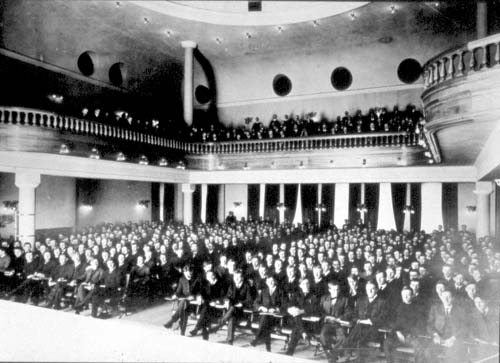
2. After this addition is completed, the space under Sibley Dome can be renovated into a major university auditorium, as it once was, accessible from the arts quad.sibley hall auditorium

3. Finally, the spaces in E. Sibley and Rand Hall can be upgraded with new mechanical systems and improvements in the building envelope.

These three steps would match all the important programmatic requirements currently imbedded within the Milstein Hall project, but at far lower cost, a more appropriate use of available resources, greater sensitivity to the historic structures in the area, and a reclamation of underutilized space in Sibley Hall. Such a plan would also finally improve conditions for the library, and for Rand and Sibley, all at lower cost than what is being proposed currently for only the Milstein Hall project.

However, other options — even options that modify the current OMA design for Milstein by reconsidering the cantilever, glass elevator, and glass auditorium — would remain possible under this scenario.

jaywalking

Jaywalking is a song that I wrote in the early 1980s — the exact date of the copyright is buried somewhere in a box up in the attic, part of a “compilation” of songs sent to the copyright office in one bunch to save money, and therefore not searchable on the official copyright web site 1979 — but never before recorded. I tried shooting a video of me actually jaywalking, but the Ithaca backdrop just didn’t look right. Plus, the act of jaywalking is meant to be taken metaphorically anyway, so I ended up just sitting down at the keyboards in front of my computer, using its built-in iSight camera. Check out the YouTube video, or, alternatively, go directly to my Jaywalking music webpage.

i can give you love

Looking through old cassette tapes one day a few years back, I found some preliminary versions of songs that I had written, and then forgotten about. One of them interested me, so I re-learned it, and recently recorded it (officially) for the first time. I’m guessing it was composed circa 1983. I shot a bare-bones YouTube video with my flip recorder (remixed Dec. 1, 2018).

tunnel of love video

Two new videos are now available for your viewing pleasure. The first is a 22-second unedited file straight from my Flip camera to you, shot while waiting at Nathan’s in Coney Island last summer. The second is a music video for Tunnel of Love, a 1980 composition that I recorded last year (remixed Feb. 24, 2018), and for which I shot all the video and created several animated sequences. For those of you with modern computers and high-speed internet connections, please click the “watch in high quality” link when you get to the YouTube page (the link is located at the bottom right of the video window).

Details for some of the still images and animations in the Tunnel of Love video are as follows: the tunnel image comes from the Eagle’s Nest (Kehlsteinhaus), a chalet in the German Alps built as a 50th birthday present for Adolf Hitler; the superimposed semi-circular “tunnel of love” text is extracted from an image of an actual tunnel of love whose location I was unable to determine; the phallic stone turret containing the dancers is part of The Fuerta San Felipe del Morro, constructed in 1539 in Puerto Rico; the animated dancers are based on an image of four Boca Raton salsa dancers, apparently shot at an event for “4over, Inc.” (a wholesale trade printing company whose corporate office is in Glendale, California); the two painting fragments are based on Salvador Dali’s “The Persistence of Memory” (1931), and Hieronymus Bosch’s “The Garden of Earthly Delights” (1504); and the animated dueling trumpeters are loosely based on images of Miles Davis (from the “Tribute to Jack Johnson” album cover of 1970) and Dizzy Gillespie. By the way, for all you trumpet players, the musical notation accompanying the trumpet solo is an accurate transcription, created on GarageBand based on my midi keyboard improvisation, and transfered to the video by (a) executing a screen capture of the musical notation displayed on GarageBand, (b) cleaning up the image and making the background transparent in PhotoShop, and (c) importing the image into Final Cut Express, where it was motion keyframed in sync with the music.

structural calculators

I’ve been working on some structural calculators lately, using some new software to convert Excel spreadsheets into HTML (web) applications. Examples include wood column design, wind and seismic load calculations, and steel beam design. I’ve always wanted to develop web-based calculators that would allow anyone with a browser to solve various structural problems; with this new software, I can develop the applications in Excel and have the JavaScript code created automatically, saving me the effort of learning to write such code myself. Some of you may be interested in checking out the software that does the conversion.

squints on a triple

The song, Squints on a Triple, is based on a true story: my daughter Jennie beat me in a game of Scrabble by putting the word “squints” on a triple word square on her last turn. Scrabble fans know that putting the letter “Q” on a triple word square generates many points; having the letter “Q” simultaneously on a double letter square makes the points scored even greater, and the pain of defeat that much more severe. Warning: song contains some metaphorical content.