A short letter that I wrote on the “pause” in graduate student admissions at Boston University was just published in the Chronicle of Higher Education. My argument is somewhat speculative, but the idea is that financial considerations drive most such decisions, rather than a primary focus on union-busting. I could be wrong, since I have no inside information about the motivations of the BU administrators, and the potential damage to the grad student union may well have entered into the calculations. Read the letter here.
I’m Now a Certified Passive House Consultant
Having passed my written and design exams, I’m now a Certified Passive House Consultant (CPHC), and can be located on “Find a professional” website. This is a designation awarded by Phius, the Passive House Institute US. Essentially, Phius passive houses are designed and built to be air-tight and super-insulated, so they use very little energy. Heating and cooling is typically accomplished with small heat pumps. Air quality is maintained by using heat- or energy-recovery ventilation systems (HRV or ERV).
I’m not sure at this point what I’ll do with this credential, but the coursework — including both self-paced online content and in-person via Zoom sessions — was extremely valuable: highly recommended! My first project, not necessarily one that will achieve Phius certification, will undoubtedly be my own house, which could use an energy/envelope upgrade.
Basketball at Barton Hall
I’ve been stopping by one of two gyms at Cornell on my daily walks, after discovering that my emeritus status gives me access to basketballs, lockers, uniforms, towels, etc. Most importantly, my retired status gives me lots of discretionary free time — I only saw one other person shooting hoops at Barton Hall today (the other gym is in Helen Newman Hall) during what I thought would be prime time for pick-up games (noon).
My new cover of loml
While I’ve been working on a new (original) song, I’ve also been listening to Taylor Swift’s “Tortured Poets Department” album, and learning one of the songs, loml, on guitar — Swift’s sings her version accompanied by piano. I’ve transposed it up a few semitones — from the key of C to the key of E. Yesterday, I decided to just set up two mics and record the song live, using Logic Pro. I did add just a bit of Login Pro software instrumentation (cello and piano) at the end of the song, played live on my midi keyboard. And I balanced my iPhone on the bookshelf over my computer to create the live video (edited in Final Cut Pro).
Can we talk about urinals?
I criticize the urinals in OMA’s Milstein Hall (at Cornell University) in my book of the same name. The fixtures selected, presumably to match the stainless steel serpentine partitions separating the men’s and women’s rooms, are Willoughby UF-1438 special-order stainless steel single person floor mounted stall urinals, intended mainly “for use in security environments” — i.e., correctional facilities (fig. 1).
They are embedded in the concrete floor slab which is problematic for at least two reasons: first, because it violates the principle of “shearing layers” whereby things that need to change or be replaced periodically should not be embedded in things (like a structural floor slab) that are intended to last for the life of the building; and second, because the concrete floor is in such bad shape that it violates the New York State Building Code requirement that “floor finish materials shall have a smooth, hard, nonabsorbent surface.” (ICC, “1209.2.1 Floors and Wall Bases,” in the 2020 New York State Building Code.)
These prison-grade urinals are not only dysfunctional in this academic context, but are also incredibly expensive — well over $1,000.00 each. And while it’s hard these days to find a functional urinal as beautiful as the so-called readymade that Duchamp tried to exhibit in 1917 (fig. 2a), except perhaps on eBay (fig. 2b), functional high-efficiency urinals can be found for well under $200 (fig. 2c).

Fig. 2. (a) Duchamp’s 1917 “Fountain” (photo by Stieglitz); (b) Kohler urinal from the 1950s; and (c) Contemporary American Standard urinal.
It is possible, at least for individuals whose gender identity aligns with the use of so-called men’s rooms, to see some beautiful urinals at Cornell. But to do this, you need to go to the basement of Barton Hall, which was built in 1917, about the same time as Duchamp’s readymade. I can’t say for sure if these urinals date from the building’s opening, or from some mid-twentieth-century renovation, but their similarity to Duchamp’s “Mutt” makes a trip to Barton Hall well worth the effort (fig. 3).
Art or accident?
Last night, I stumbled upon this rectangle of light on the Cornell Arts Quad and wondered if it was an art installation or just the random result of an open window with a projector running in Goldwin Smith Hall.
Update (Nov. 26, 2024): The Cornell Council for the Arts confirmed today that “what you captured was an unplanned, serendipitous art happening as far as CCA is aware. But we think it’s very cool!”
Lake View Cemetery Rules
I often pass through the Lake View Cemetery on my morning walks — my path through the cemetery starts across from Ithaca High School and ends up on Wyckoff Road, leading ultimately to Triphammer Road and then downhill through Cornell’s campus and back home. On one such walk, I took a picture of some cemetery “rules” listed on a sign, one of which states that there shall be no “artificial flowers between April 1 thru October 1.” This triggered my duplication of the image, embellished with photoshopped artificial flowers for Oct. 2.
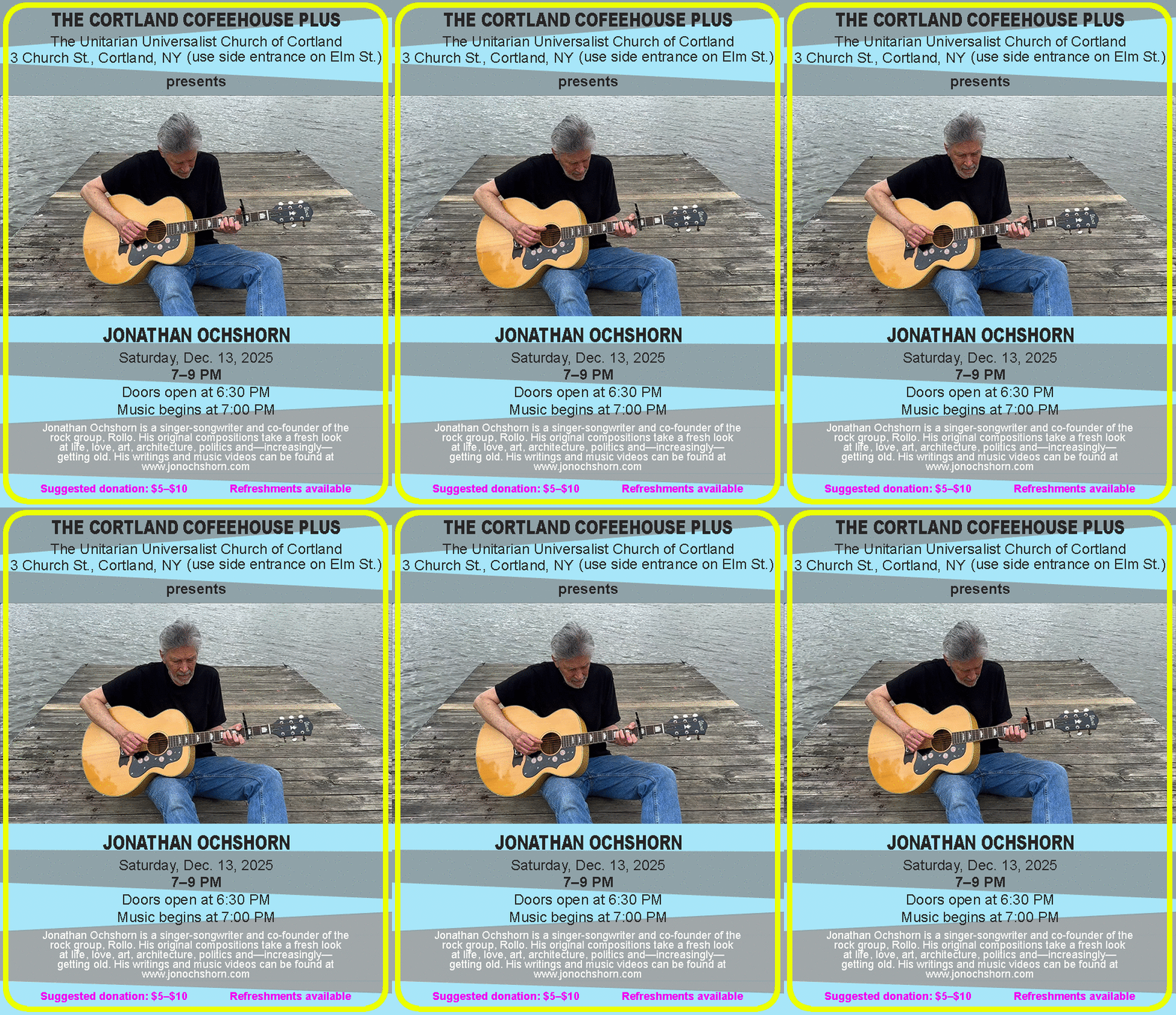
Live performance videos from Cortland Coffeehouse Plus
I was the inaugural performer for the opening of the Cortland Coffeehouse Plus, playing two sets of original songs in the basement of the Unitarian Universalist Church of Cortland, New York, also known as “The Old Cobblestone Church.” According to the Church website: “The building was placed on the State and National Register of Historic Buildings in 1993. The ‘Old Cobblestone Church’ is now the oldest building in Cortland County and is one of only two such cobblestone buildings in the country.” Here are two videos recorded at the performance.
Links to my original songs, covers, and videos can be found here.
Time After Time
A number of years ago, I began recording covers of pop songs that were influential in my musical development (or that I just liked). My self-imposed rules were (1) to pick only one song for each year; and (2) to never repeat any artist or group. Well, I started with Surfer Girl from 1963, and I’ve just made it all the way to 1984 with Cyndi Lauper’s hit single, Time After Time.
Some fun facts about the production: I’m playing the keyboard live in the video; I added the vocal, backup vocal, acoustic guitar, harmonica, bass, and drums later. All in Login Pro X. The video was shot in two parts: first the live piano (in my house); second, the background in the Trader Joe’s parking lot in Ithaca, NY, while I was waiting for Susan to finish shopping there. This was assembled in Final Cut Pro. Everything shot with my iPhone.
Links to all my music can be found here.
Dangerous (lack of) guardrail at Uris Library
Because toddlers, older children, and foolish adults fall off unprotected ledges, model building codes (and codes adopted by the various states, based on the model codes) require that guard rails be placed at such dangerous edges. The actual 2020 NYS Building Code language is as follows (Section 1015): “Guards shall be located along open-sided walking surfaces … that are located more than 30 inches (762 mm) measured vertically to the floor or grade below at any point within 36 inches (914 mm) horizontally to the edge of the open side.” In other words, if there is a vertical discontinuity at the edge of a walking surface of more than 30 inches (762 mm), even if that drop of 30 inches (762 mm) occurs up to three feet (914 mm) away from the edge of the walking surface, then a guard is required. Furthermore, the guard must be at least 42 inches (1067 mm) high and it must be configured such that a 4-inch-diameter (102 mm diameter) sphere cannot pass through. This latter requirement is intended to prevent children from sticking their heads through the guard and getting stuck (yes, this really happens!).
Now, I haven’t been able to track down the NYS Building Code in effect when the addition to Cornell’s Uris Library, designed by Gunnar Birkerts, was designed and built in 1980–1982, but the lack of a compliant guard seems consistent with the standards currently in place and, presumably, with the standards in place in the early 1980s (see Figure 1).

Figure 1. The addition to Uris Library at Cornell is altered using PhotoShop to show a more precipitous vertical drop from the walking surface (left); the addition is shown as it actually appears, still with a dangerous vertical drop from the walking surface (right). Photo and PhotoShop manipulation by Jonathan Ochshorn.
This is because, even though there is a vertical drop of much more than 30 inches (762 mm), this drop does not occur within 36 inches (914 mm) of the walking surface: there is a sloping ledge between the walking surface and the precipitous drop which appears to justify the lack of a code-compliant guard (the horizontal pipe rail at the edge of the walking surface does not comply with the requirement that a 4-inch-diameter (102 mm diameter) sphere, let alone a rambunctious toddler, cannot pass through. Yet, as can be seen in Figure 1, the condition is still quite dangerous, since a toddler or child (or spaced-out adult) could easily run through the open guard, slide down the inclined ledge, and fall to the ground below, possibly sustaining serious injuries.
Now, if the walking surface of the addition were at the top of a very tall building, as modeled in Figure 1, left, the architects may well have felt the need to make a safer guard rail, even though the building code would not have required that they do so! The as-built condition shown in Figure 1, right, is also quite dangerous, and really should have a guard that meets the standards outlined in the building code.
It turns out that the International Code Council (ICC)—which writes the International Building Code (IBC), which, in turn, forms the basis of the New York State Building Code—has fixed this unsafe loophole in the 2024 IBC, not yet adopted in New York State (in fact, the older 2021 IBC has not even been adopted by New York State; as of this writing, New York State’s 2020 Building Code is actually based on the 2018 IBC!). The latest IBC adds “and at the perimeter of occupiable roofs” to the code section (1015.2) which describes where such guards are required. Since the walking surface at the top of the Uris Library addition is an “occupiable roof,” a safe guard rail would be required under that code.
Even though the current unsafe conditions are “grandfathered” under the older code, Cornell should modify the existing pipe rail and turn it into a real guard, as will eventually be required for new construction once the 2024 IBC is adopted.