How Sullivan and Morris make their arguments

I’ve been reading an anthology on architectural theory and came across an essay by the architect Robert Morris writing about “harmony” in 1739. Now I’m not sure if the American architect Louis Sullivan read Morris, but the similarity of their style of argumentation is striking: it consists of stringing together a list of nouns, each modified by an appropriate adjective. So, we get Sullivan’s famous “open apple blossom,” “toiling work-horse,” and “blithe swan” to support his claim about form and function; while Morris gives us “murmuring Rivulets, “silent Grove,” and “verdant Meads” to defend his views about harmony. Here are excerpts from Morris and Sullivan:

Robert Morris,   “An Essay upon Harmony,” 1739, in Harry Francis Mallgrave, ed., Architectural Theory, Volume I: An Anthology from Vitruvius to 1870, Malden, MA (Blackwell Publishing: 2006), p.116: “The Soul by Sympathy to Scenes of perfect Beauty, of Proportion and Elegance, is insensibly drawn and attracted; the murmuring Rivulets, the silent Grove, the verdant Meads, the particolour’d Gaieties of Nature, have their charms which Harmoniously please.”

Louis Sullivan, “The Tall Office Building Artistically Considered,” Lippincott’s Monthly Magazine, March 1896, p.408.: “Whether it be the sweeping eagle in his flight, or the open apple blossom, the, toiling work-horse, the blithe swan, the branching oak, the winding stream at its base, the drifting clouds, over all the coursing sun, form ever follows function, and this is the law.” From Louis Sullivan, “The Tall Office Building Artistically Considered,” Lippincott’s Monthly Magazine, March 1896, p.408.
Revisiting Decorated Sheds and Ducks for Sustainable Building

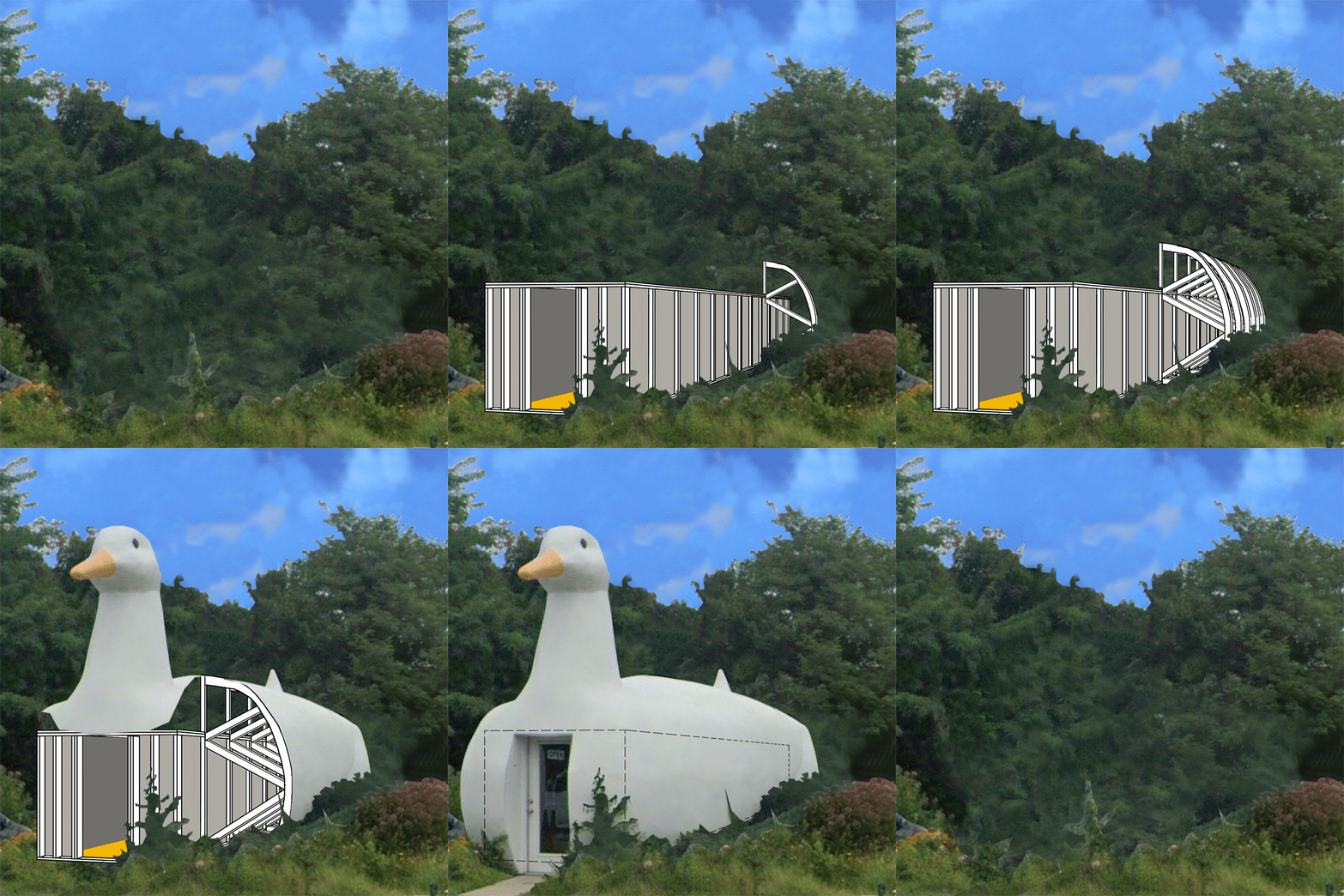
Animation gif showing construction of "duck" cladding over normative rectilinear selling space.Decorated sheds, along with ducks, were first theorized by Robert Venturi, Denise Scott Brown, and Steven Izenour in their 1972 book, Learning from Las Vegas. While their argument focused on semiotics and signs, designing buildings as decorated sheds can also be understood as an important strategy for achieving sustainable design goals. For that reason, it is useful to revisit and reformulate the authors’ original critique, in order to provide a more nuanced discussion of decoration and distortion. This paper’s central claims are advanced in three steps. First, I argue that sustainable buildings increasingly take the form of decorated sheds: energy efficiency and enclosure durability benefit from compact building form; a compact building — one without gratuitous distortion of the enclosure surfaces — is, ipso facto, a shed; such sheds must have continuous control layers, e.g., air barriers and thermal insulation, which create a discontinuity between exterior cladding and building interiors; and cladding, visible to the outside world and disengaged from the building’s underlying structure and interior, can easily be configured as a carrier of decoration. These tendencies are increasingly encouraged in contemporary code mandates and can be seen in programs developed by organizations including Net-Zero Energy Homes, Living Buildings, and the Passive House Institute. Second, while ideas about decorated sheds and ducks theorized in Learning from Las Vegas offer important insights into the design and critique of buildings, I argue that a close reading reveals several logical errors and inconsistencies. Third, I develop a more nuanced argument, one that considers the distinction between decorated sheds and ducks in terms of a fluid matrix organized along the axes of decoration and distortion. Reframing the concepts developed by Venturi, Scott Brown, and Izenour allows these concepts to be better applied to the contemporary use of decorated sheds for sustainable, energy-efficient building.

My paper, entitled “Revisiting Decorated Sheds and Ducks for Sustainable Building,” will be presented at the 114th Annual Meeting of the Association of Collegiate Schools of Architecture in March 2026. You can read the complete web version right now!

Upcoming January 2026 performance

I’m hoping to perform one of my original songs at an upcoming event taking place at the Center for the Arts of Homer, 72 S. Main St., Homer, NY 13077.

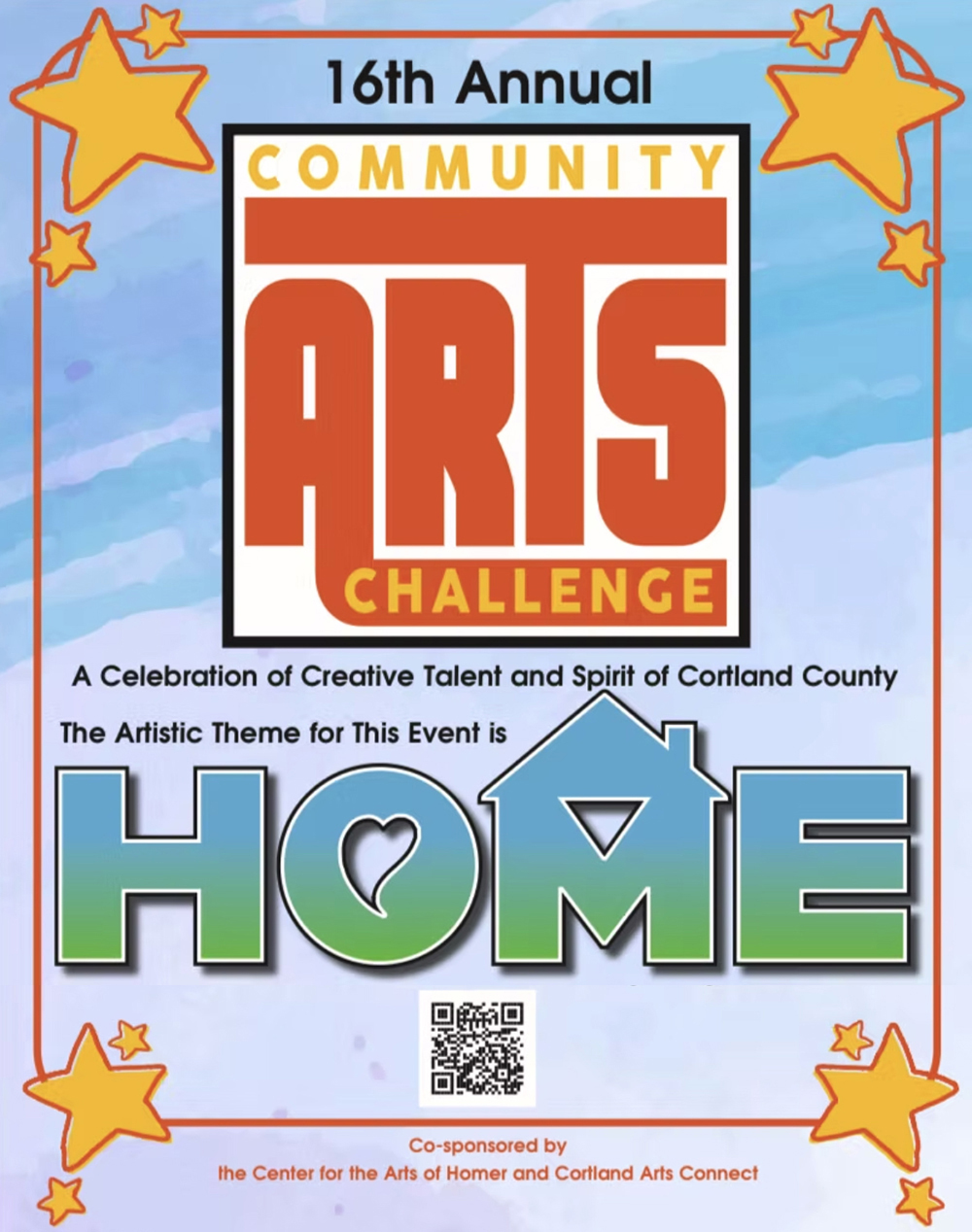
The event is a Community Arts Challenge cosponsored by the Center for the Arts of Homer and Cortland Arts Connect. My song, Walking in Circles, was accepted into the competition and I’m hoping to sing it live at the Grand Opening event on Friday, Jan. 23, 2026, starting at 6:15 PM.

Poster for 16th Annual Community Arts Challenge with the artisitic theme of "Home" cosponsored by the Center for the Arts of Homer and Cortland Arts Connect

Check my performance website for details.

The theme of this year’s competition is “home,” and my song addresses the human (and, I suppose, also the nonhuman) desire to return home. Our path is invariably circular, whether taking the form of a so-called spiritual journey or a return to an inner unconscious realm: “I’m walking in circles/ Not because I’m bound to roam/ I’m walking in circles/ Just to get back home.”

The song documents my daily walk to downtown Ithaca, NY, and then back home.

Two songs played live in Cortland, Dec. 13, 2025

Here are two iPhone videos from my Dec. 13, 2025 performance at the Cortland Coffeehouse Plus at the Unitarian Universalist Church. The videos were edited using my own video clips for audio (taken with my iPhone mounted on a tripod near the Bose PA speakers) and using the more frontal views taken by Susan Schwartz for the video. There is just a little audio enhancement in Logic Pro, mainly to even out some of the dynamics. I selected one video from the first guitar set and one from the second digital piano set. You can find all the studio versions and official YouTube videos on my music website. And also check out the original performance announcement with links to all the songs I performed.


Additional links to live videos from the performance: A Slow-Growing Cancer and Adorno’s Golden Gate

Cortland concert Dec. 13, 2025

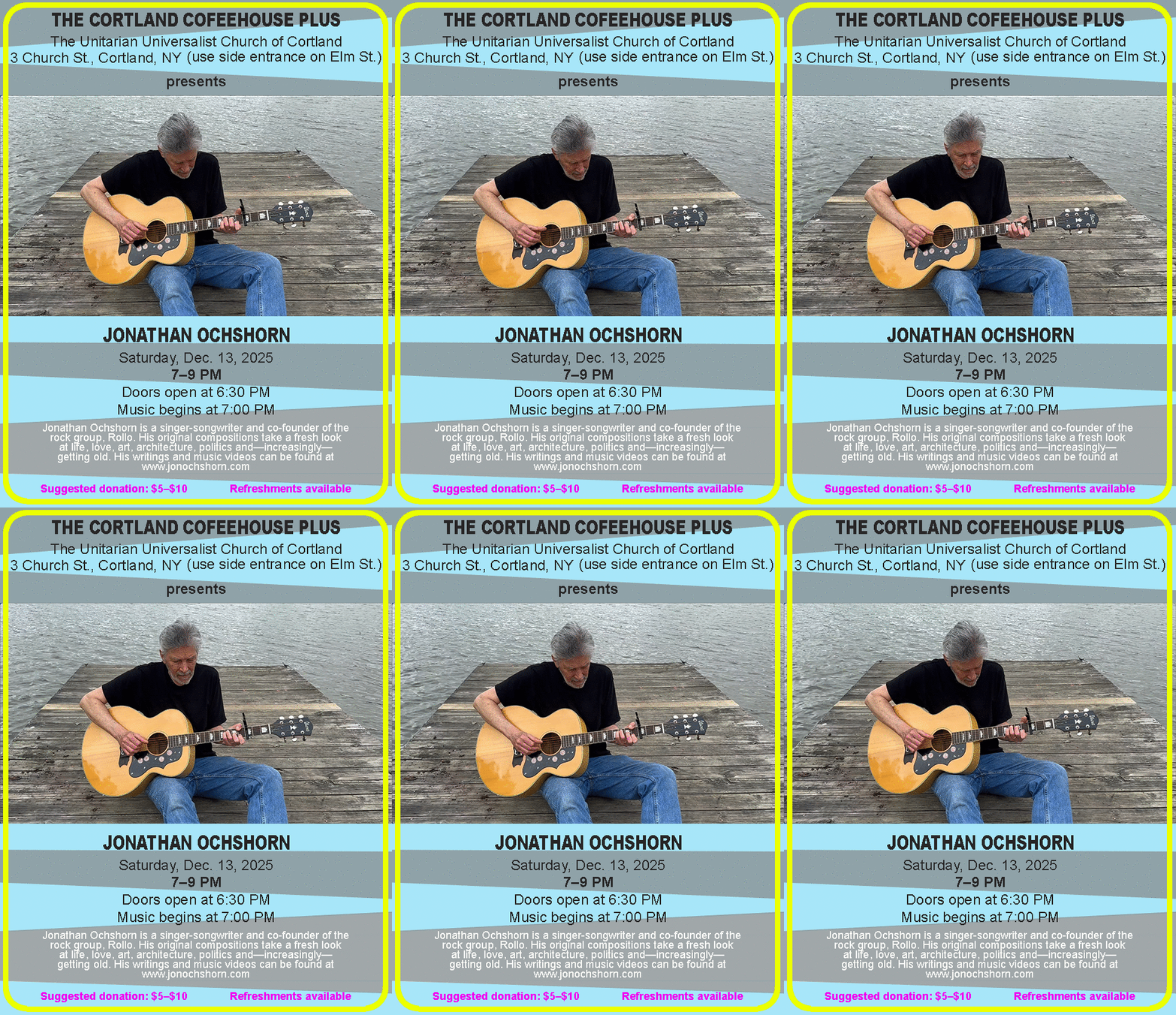
I’ll be performing at the Coffeehouse Plus Cafe in the basement of the historic Cortland Unitarian Universalist Church (3 Church St., Cortland, NY; us side entrance on Elm St.) on Saturday, Dec. 13, 2025, from 7:00–9:00 PM. Doors open at 6:30 PM and there will be lots of delicious refreshments on offer. This is a concert to benefit the various ongoing and potential renovation projects for the church — built in 1837 with cobblestone walls and listed in the National Register of Historic Places.

I’ll be playing two sets — one with guitar and one with keyboards. Some of the featured original songs on my list include “Adorno’s Golden Gate,” “Ode to Fluff,” “OMA’s Milstein Hall,” and “Adaptation.” You can listen to the studio versions on my music website.

Jonathan Ochshorn playing guitar on a pier with water in the background

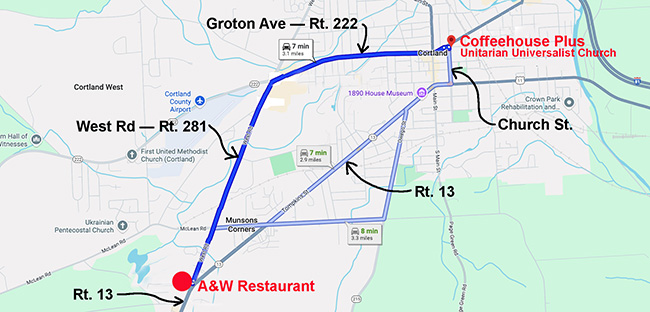
While in the area, you also have the opportunity to visit the legendary (and also historic) A&W Restaurant, built in the early 1960s, and still proudly using 1960s-era telephones to order food inside (or “car hops” to bring food to your car). It’s at the intersection of Rt. 13 and Rt. 281.

Location of the Coffeehouse Plus Cafe and A&W Restaurant in Cortland, NY

Update [Dec. 15, 2025]: I’ve posted two videos from the Dec. 13, 2025 performance.

After the Dance

I’ve been pretty good about making music videos for all the songs I recorded with the band, Rollo, in the 1980s. All except for “After the Dance,” the B-side of Rollo’s 45 RPM vinyl record that we recorded in 1980. The reason for this was that some unknown person had somehow purchased the record and made a YouTube video of the song (with the video showing the record player playing the record, which I guess is or was a thing), so I was able to simply create a link to this person’s video.

I discovered recently, however, that this video is no longer public, so — 45 years after making the record — I finally got around to making an actual Rollo video for “After the Dance.” Nothing fancy, just the record sleeve showing the cover graphics and lyrics. But it’s a great song, written, and with a lead vocal, by Dan Smullyan. Recorded at A-1 Sound Studios in NYC in 1980 with real musicians: Kurt Ochshorn on guitar, monophonic synthesizer, and background vocals; Julius Braunschweig on Fender bass; Ira Grable on drums; me on polyphonic synthesizer, piano, and background vocals; and, as mentioned, Dan Smullyan doing the lead vocal. Enjoy!

Two new prostate cancer songs

To mark the seventh anniversary of my prostatectomy, I wrote and recorded a two-song cycle about my experience with prostate cancer. Both songs cover a lot of the same ground, but from slightly different perspectives.


I played all instruments (some real, some Logic Pro software instruments played live on my midi keyboard) and sang all vocals; I recorded the songs using Logic Pro X and edited the videos using Final Cut Pro.

All of my music and music videos are linked from my music homepage.

Papa Don’t Preach

This is my cover of Madonna’s Papa Don’t Preach, written by Brian Elliot (although Madonna gets some songwriting credit as well). The song appears on her studio album, True Blue, from 1986.

My cover was recorded more or less live in one take, accompanied by electric piano, using Logic Pro X. I added some backup vocals, some additional Logic Pro software instruments (drums, bass, and organ), and some acoustic guitar. The underlying video was shot live and edited in Final Cut Pro. The other video that appears superimposed on my iMac incorporates excerpts from Madonna’s 1986 music video, directed by James Foley, and starring—in addition to Madonna—Danny Aiello as the father and Alex McArthur as the boyfriend mechanic.

For more of my original music and covers.

My adaptation derived from the movie “Adaptation”

I played three songs at the Center for the Arts of Homer open mic on Tuesday, July 8, 2025. Unfortunately, their beautiful theatre was being used for rehearsals, so the open mic took place in a more ordinary community room. Still, the audio was good, and it was nice to play some songs I hadn’t performed very often — especially my 2003 adaptation of Charlie Kaufman’s idea for his movie, “Adaptation.” For the record, I also sang “Walking in Circles” and “If I Could Sing Like That.”

Studio versions of all three songs (as well as all my other songs and music videos) can be found on my music homepage.

I’ve embedded the YouTube live performance video of “Adaptation” below (audio ‘enhanced’ using Logic Pro X). The video was shot by Susan Schwartz.