I’ve written and recorded my first post-retirement song. It’s an extended metaphor about getting old, based on the game of chess — specifically, the “endgame.”
Links to all my music and music videos can be found here.
I’ve written and recorded my first post-retirement song. It’s an extended metaphor about getting old, based on the game of chess — specifically, the “endgame.”
Links to all my music and music videos can be found here.
The following thought experiment is based on 2018 statistics, which are the latest that I could find (so when I say “current,” I am referring to 2018 values).
[Updated below] Analysis and commentary in US public media most often compare the total greenhouse gas emissions (CO2e) of China and the US, abstracting from the fact that China has more than 4 times the population of the US. (Also typically left out of such commentary is the enormous historical contribution by the US to CO2e in the atmosphere.) From this misleading standpoint, one constantly is reminded that China emits more than twice as much CO2e as the US.
But from a per capita standpoint — the only rational way to compare the two countries with respect to their contribution to climate change — China emits less than half as much CO2e as the US.
Even if the US lowers its emissions by 40% compared to 2005 levels — the optimistic estimate based on implementation of the Inflation Reduction Act of 2022 — its per capita emissions would still be 27% higher than China’s current emissions, per capita.
In fact, the US would need to lower its current emissions (which are already 10% lower than its 2005 emissions) by an additional 48% just to match China’s current per capita emissions.
Here are my calculations, and sources:
2018 per capita total greenhouse gas emissions (CO2 equivalent or CO2e)
2018 Total emission
Amount of US emissions if made to equal China’s per capita rate
Percent reduction in US 2018 emissions to equal China’s 2018 per capita emissions
Other calculations:
Updated 16 September 2022: Here is a typical and egregious example of how China is portrayed in US media as “the world’s largest climate polluter” even though its per capita contribution to CO2 is much less than that of the US and, in fact, lower than that of 41 other nations (according to 2016 data).
From David Wallace-Wells, “China Is Writing the Story of the Climate Future,” NY Times, Sept. 14, 2022: “China is not just the world’s largest climate polluter but is responsible now for about half of all global coal use and almost a third of all global carbon emissions — a growing share, and more than twice the American contribution. (Though on a per-capita basis, the United States is still doing much worse.)”
The article does disclose that “on a per-capita basis, the United States is still doing much worse,” but only as a parenthetical remark, as if this admission can be taken as not particularly important.
Title: “Building Bad: How Architectural Utility is Constrained by Politics and Damaged by Expression”
Cornell’s YouTube video of my April 14, 2022, 4:00 PM – 5:00 PM “Chats in the Stacks” book talk (a virtual event) was posted today.
In a free, live, virtual “Chats in the Stacks” book talk, Jonathan Ochshorn discusses his latest book, Building Bad: How Architectural Utility is Constrained by Politics and Damaged by Expression (Lund Humphries, 2021), where he examines how utilitarian function in architecture can be thwarted by political and economic forces, and undermined by artistic expression. In considering several contemporary buildings and projects, Ochshorn avoids advocating for a specific style or practice but provides an objective framework for analyzing architecture through the lens of utility.
Sponsored by the Mui Ho Fine Arts Library, Cornell University, the talk is followed by a live Q&A.
I wrote an op-ed that was just published in The Architect’s Newspaper with the rather unwieldy, but nevertheless accurate, title, “Bad Building: Architecture’s Aesthetics Should Support, rather than Sabotage, a Building’s Function.” The argument in the op-ed derives from my book, Building Bad: How Architectural Utility is Constrained by Politics and Damaged by Expression.
[Updated below, June 8, 2022 and July 17, 2022] This morning, I sent an email to Cornell facilities and accessibility staff, as well as the Ithaca Building Division, alerting them to “protruding objects” on the Arts Quad:
To all concerned with access compliance on the Cornell campus:
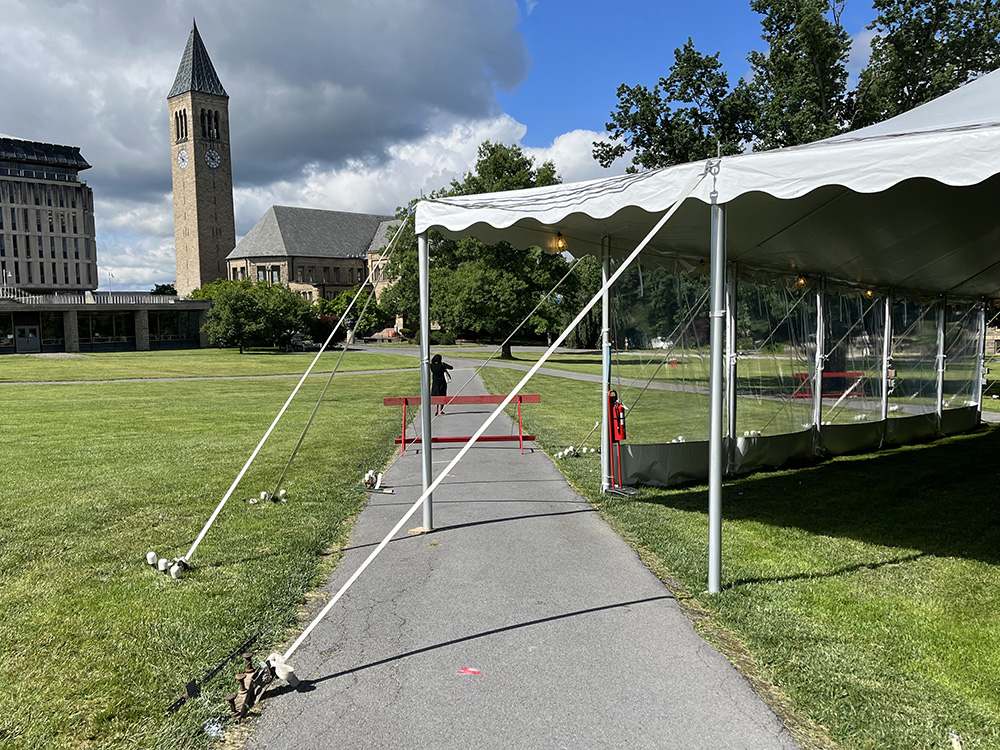
I noticed today (June 4, 2022) that guy-lines stabilizing a Cornell Arts Quad tent are in violation of ADA and NYS Building Code requirements for access along circulation paths. They constitute “protruding objects” and, as such, are illegal and dangerous.
The United States Access Board states: “To prevent hazards to people with vision impairments, the standards limit the projection of objects into circulation paths. These requirements apply to all circulation paths and are not limited to accessible routes. Circulation paths include interior and exterior walks, paths, hallways, courtyards, elevators, platform lifts, ramps, stairways, and landings.”
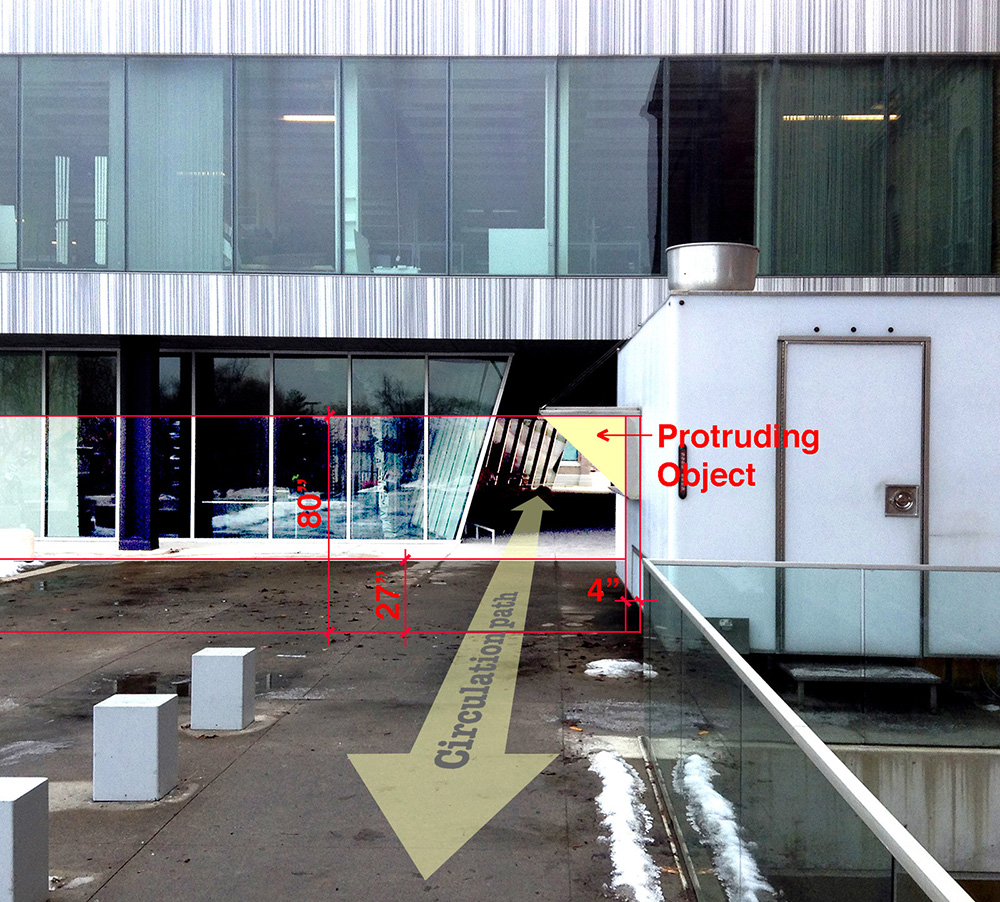
The New York State Building Code requires that “At least one accessible route within the site shall be provided from public transportation stops, accessible parking, accessible passenger loading zones, and public streets or sidewalks to the accessible building entrance served.” Chapter 10 (Means of egress) states that “Protruding objects on circulation paths shall comply with the requirements of Sections 1003.3.1 through 1003.23.4” and Section 1003.3.3 confirms that “Objects with leading edges more than 27 inches (685 mm) and not more than 80 inches (2030 mm) above the floor shall not project horizontally more than 4 inches (102 mm) into the circulation path.” Circulation path is defined in Chapter 2 of the Code as “An exterior or interior way of passage from one place to another for pedestrians.”
[June 8, 2022 Update] Cornell has placed cane-detection barriers in front of most, but not all, of the noncompliant guy-lines on the Arts Quad. In the photo below, the circulation path is protected in one direction only:
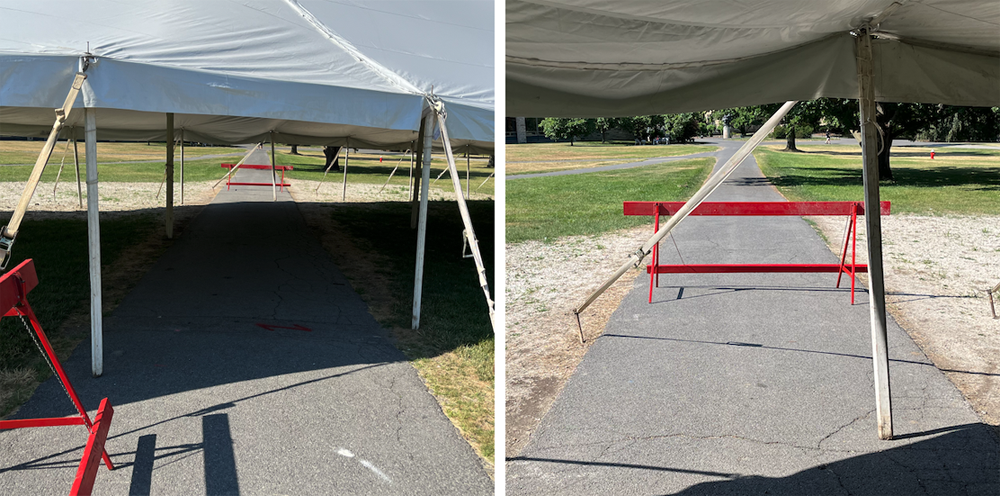
[July 17, 2022 Update] A new tent has been set up on the Arts Quad (see image below), and it has the same issue with ADA noncompliance as was discussed in the June 8, 2022 update above: the cane detection barrier works from the outside-in, but not from the inside-out. Clearly, people move along circulation paths in two directions, and ADA compliance is required for both of them! Guy-lines that stabilize tents become noncompliant protruding objects when they pass through circulation paths between the heights of 27 inches and 80 inches.
I’ll be giving a talk on “Control Layers, Abstraction, and Utilitarian Dysfunction,” based on my book, Building Bad: How Architectural Utility is Constrained by Politics and Damaged by Expression. Details follow:
Date: March 3, 2022, 12:00 PM – 1:00 PM
Format: Zoom meeting / Webinar
This continuing education program is FREE for CSI members, and $20 for non-members (Notice: Any money raised will go towards the Edward Goldberg Memorial Scholarship Fund). This program has AIA Continuing Education Credits PENDING (1 LU/HSW Credit).
Sponsored by the Syracuse Chapter of the Construction Specifications Institute (CSI)
Sign up to attend the talk here.
Information about the book is here.
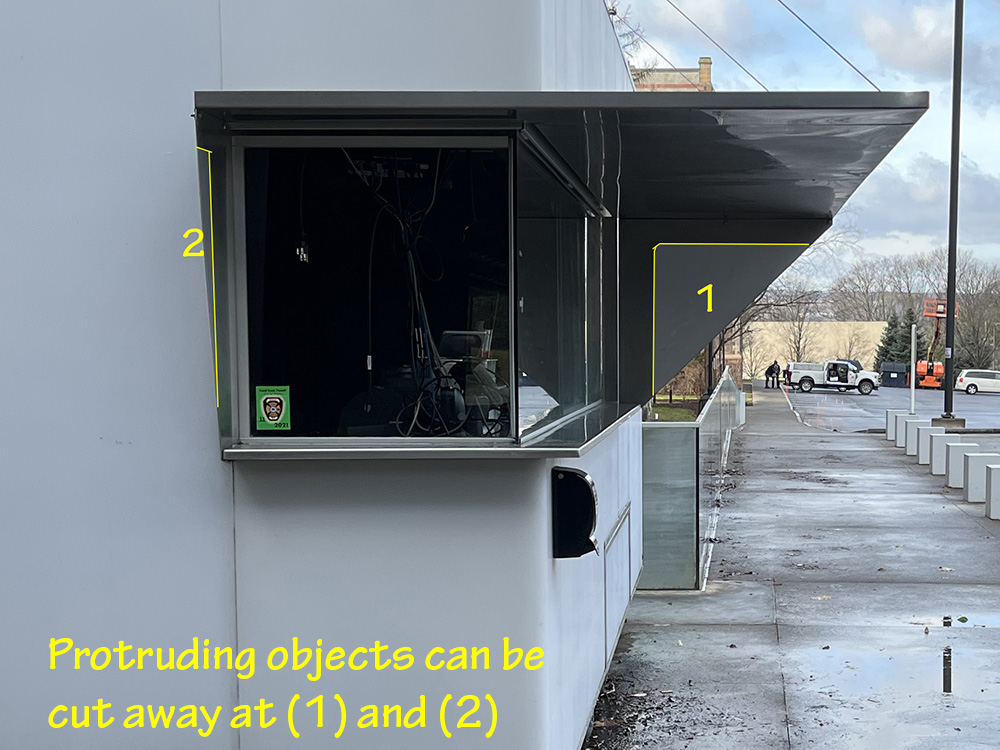
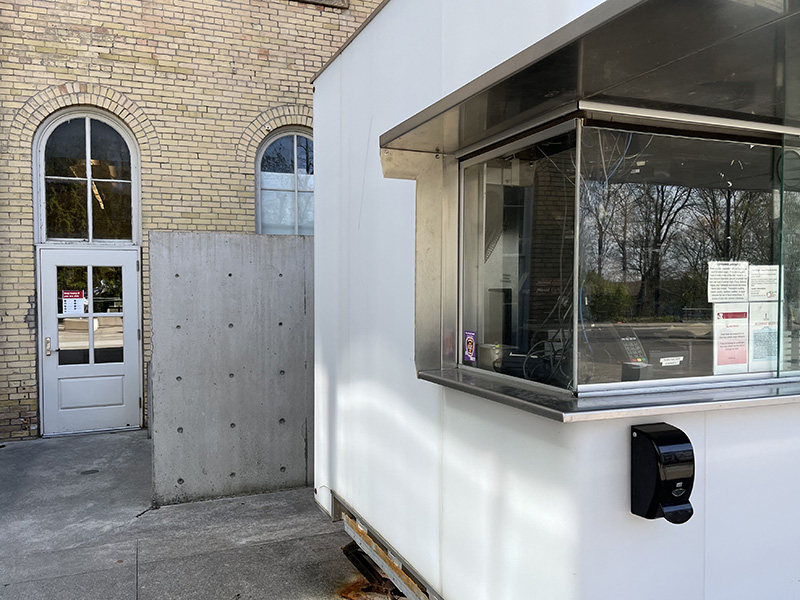
[Updated May 5, 2022 (scroll to bottom)] Two years ago, I wrote to administrators at Cornell University, advising them that “protruding objects” designed into a food truck behind Milstein and Sibley Halls were in violation of the ADA as well as the New York State Building Code.
The United States Access Board states: “To prevent hazards to people with vision impairments, the standards limit the projection of objects into circulation paths. These requirements apply to all circulation paths and are not limited to accessible routes. Circulation paths include interior and exterior walks, paths, hallways, courtyards, elevators, platform lifts, ramps, stairways, and landings.”
The New York State Building Code requires that “At least one accessible route within the site shall be provided from public transportation stops, accessible parking, accessible passenger loading zones, and public streets or sidewalks to the accessible building entrance served.” Chapter 10 (Means of egress) states that “Protruding objects on circulation paths shall comply with the requirements of Sections 1003.3.1 through 1003.23.4” and Section 1003.3.3 confirms that “Objects with leading edges more than 27 inches (685 mm) and not more than 80 inches (2030 mm) above the floor shall not project horizontally more than 4 inches (102 mm) into the circulation path.” Circulation path is defined in Chapter 2 of the Code as “An exterior or interior way of passage from one place to another for pedestrians.”

This image shows the protruding objects in the circulation path by the food truck behind Sibley/Milstein Halls at Cornell (photo and annotations by J. Ochshorn)
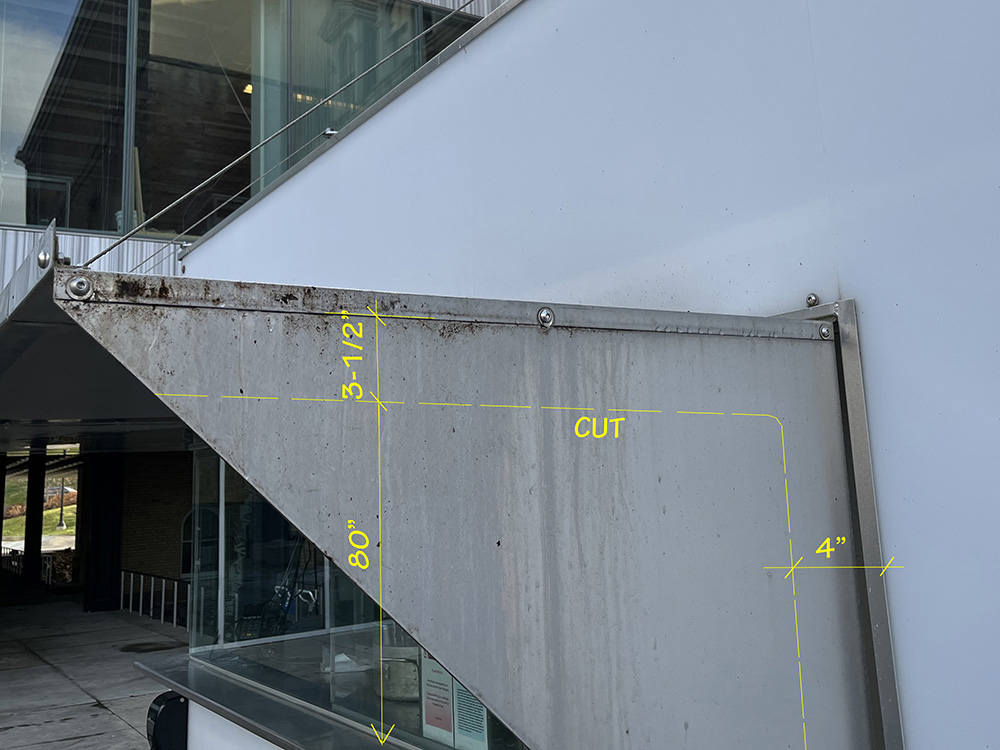
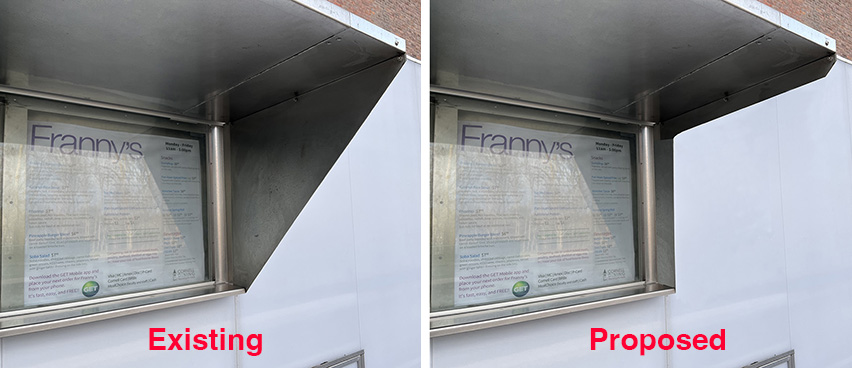
On the two-year anniversary of my first email, I again requested that Cornell remediate this illegal and dangerous situation, embedding several annotated photographs into my Jan. 14, 2022 email that illustrate one possible method of permanently fixing this problem:

Metal “fins” attached to the food truck behind Milstein/Sibley Halls at Cornell University could be altered to comply with ADA requirements.

Metal “fins” on the food truck could be cut in order to comply with ADA guidelines for protruding objects.

“Before” and “after” images showing proposed remediation of protruding objects on food truck behind Milstein/Sibley Halls at Cornell University (photos and Photoshopping by J. Ochshorn).
[May 5, 2022 Update] Soon after my January 14, 2022, email, a moveable sign was placed under one of the noncompliant protruding fins (image below), something clearly inadequate, since the sign could be (and was) moved from its intended position. I complained about the inadequacy of this remedy.
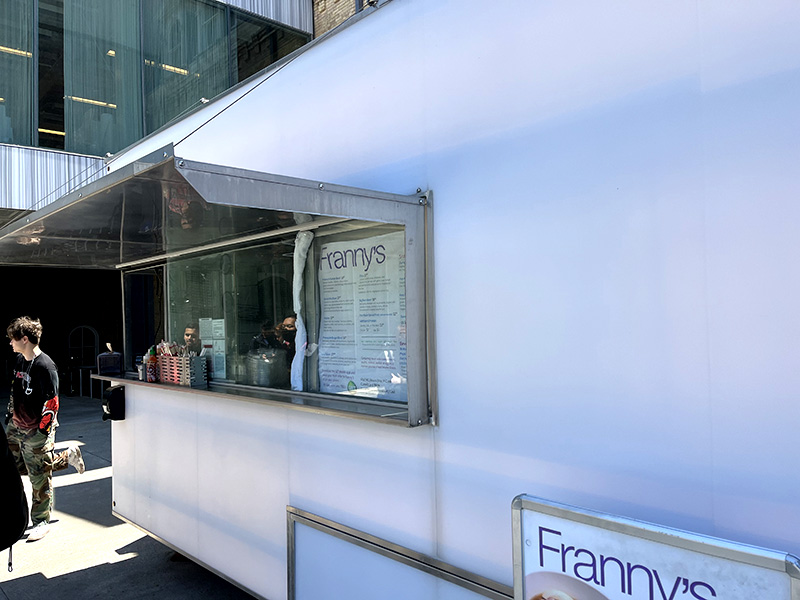
Amazingly, a few months later — about 4 months after my January 2022 design suggestions and more than two years after my initial complaint — I discovered that the noncompliant metal fins had been trimmed, pretty much as I had specified in my photoshopped renderings: the newly-compliant food truck is shown below.
I just recorded a cover of Tainted Love, the 1982 U.S. hit by the English synthpop duo, Soft Cell. It turns out that this song, written by Ed Cobb, was recorded back in 1964 by Gloria Jones, but I never heard that version until recently. My version doesn’t have much in common with either the 1964 or 1982 recordings, probably because it’s the lyrics rather than the music that always intrigued me about this song: such an interesting way of characterizing a damaged (‘tainted”) relationship!
I recorded the song essentially live (vocals and keyboards) over a click track; then created drum, bass, and organ tracks using “software instruments” in Login Pro, played “live” on my Yamaha MIDI-enabled keyboard, and finally added some backup vocals. The glass curtain wall that I added to the video in Final Cut Pro is actually the north wall of Milstein Hall at Cornell University — looking into the basement auditorium — designed by Rem Koolhaas and OMA.
Find links to all my songs and music videos here.
1. OMA-designed architecture studios put required exit and bathrooms in adjacent library.
2. But library is open when studios are closed, or vice versa, creating “security” issues.
3. Problem solved: forbid entry through the fire exit!
See links to all my posts and writings about the Fine Arts Library here.