Category Archives: Architecture

How Sullivan and Morris make their arguments

I’ve been reading an anthology on architectural theory and came across an essay by the architect Robert Morris writing about “harmony” in 1739. Now I’m not sure if the American architect Louis Sullivan read Morris, but the similarity of their style of argumentation is striking: it consists of stringing together a list of nouns, each modified by an appropriate adjective. So, we get Sullivan’s famous “open apple blossom,” “toiling work-horse,” and “blithe swan” to support his claim about form and function; while Morris gives us “murmuring Rivulets, “silent Grove,” and “verdant Meads” to defend his views about harmony. Here are excerpts from Morris and Sullivan:

Robert Morris,   “An Essay upon Harmony,” 1739, in Harry Francis Mallgrave, ed., Architectural Theory, Volume I: An Anthology from Vitruvius to 1870, Malden, MA (Blackwell Publishing: 2006), p.116: “The Soul by Sympathy to Scenes of perfect Beauty, of Proportion and Elegance, is insensibly drawn and attracted; the murmuring Rivulets, the silent Grove, the verdant Meads, the particolour’d Gaieties of Nature, have their charms which Harmoniously please.”

Louis Sullivan, “The Tall Office Building Artistically Considered,” Lippincott’s Monthly Magazine, March 1896, p.408.: “Whether it be the sweeping eagle in his flight, or the open apple blossom, the, toiling work-horse, the blithe swan, the branching oak, the winding stream at its base, the drifting clouds, over all the coursing sun, form ever follows function, and this is the law.” From Louis Sullivan, “The Tall Office Building Artistically Considered,” Lippincott’s Monthly Magazine, March 1896, p.408.

Revisiting Decorated Sheds and Ducks for Sustainable Building

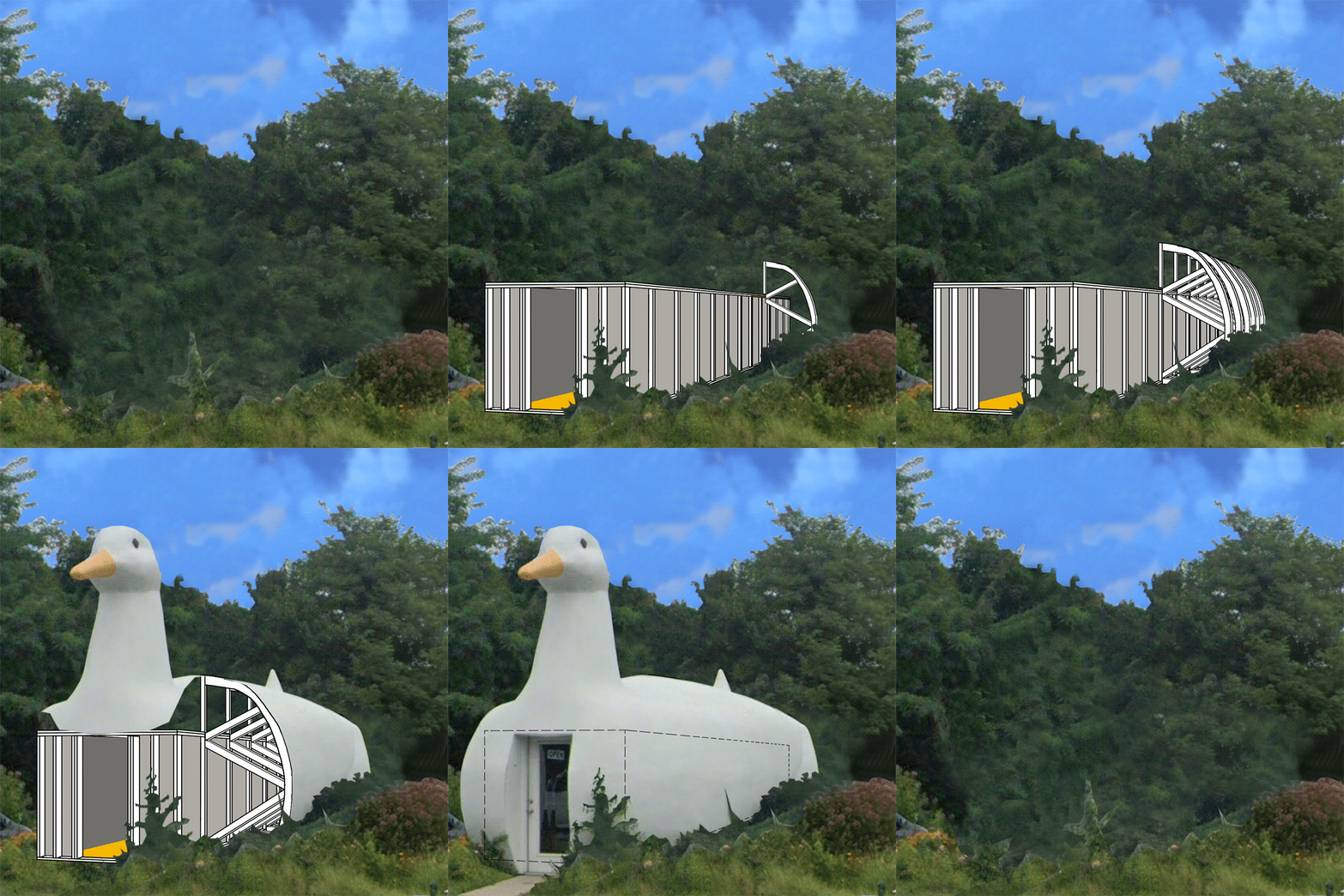
Animation gif showing construction of "duck" cladding over normative rectilinear selling space.Decorated sheds, along with ducks, were first theorized by Robert Venturi, Denise Scott Brown, and Steven Izenour in their 1972 book, Learning from Las Vegas. While their argument focused on semiotics and signs, designing buildings as decorated sheds can also be understood as an important strategy for achieving sustainable design goals. For that reason, it is useful to revisit and reformulate the authors’ original critique, in order to provide a more nuanced discussion of decoration and distortion. This paper’s central claims are advanced in three steps. First, I argue that sustainable buildings increasingly take the form of decorated sheds: energy efficiency and enclosure durability benefit from compact building form; a compact building — one without gratuitous distortion of the enclosure surfaces — is, ipso facto, a shed; such sheds must have continuous control layers, e.g., air barriers and thermal insulation, which create a discontinuity between exterior cladding and building interiors; and cladding, visible to the outside world and disengaged from the building’s underlying structure and interior, can easily be configured as a carrier of decoration. These tendencies are increasingly encouraged in contemporary code mandates and can be seen in programs developed by organizations including Net-Zero Energy Homes, Living Buildings, and the Passive House Institute. Second, while ideas about decorated sheds and ducks theorized in Learning from Las Vegas offer important insights into the design and critique of buildings, I argue that a close reading reveals several logical errors and inconsistencies. Third, I develop a more nuanced argument, one that considers the distinction between decorated sheds and ducks in terms of a fluid matrix organized along the axes of decoration and distortion. Reframing the concepts developed by Venturi, Scott Brown, and Izenour allows these concepts to be better applied to the contemporary use of decorated sheds for sustainable, energy-efficient building.

My paper, entitled “Revisiting Decorated Sheds and Ducks for Sustainable Building,” will be presented at the 114th Annual Meeting of the Association of Collegiate Schools of Architecture in March 2026. You can read the complete web version right now!

OMA’s Milstein Hall: skateboards and broken bubbles

From my book, OMA’s Milstein Hall: “Just as abstract programmatic adjacencies are confused with circulation systems in the design of Milstein Hall, there is also an implicit conflation of a type of performative athletic movement—whether featuring trained dancers, ‘free runners,’ or skateboarders—with the type of movement in and around buildings that constitutes useful circulation.”

You can read my free, open-access versions of OMA’s Milstein Hall and Building Bad on the web, or download free PDFs.

Essay on complexity and contradiction

I’ve written an essay, just published in the open-access journal, AGATHÓN, that challenges the idea that complex building geometries reflect the complexity of contemporary life; it does so by examining Complexity and Contradiction in Architecture, Robert Venturi’s seminal work from 1966, as well as later writings by advocates of a computationally-driven complexity. The essay shows that: a) complexity, rather than being defined absolutely, is relative in everyday speech; b) complexity, as defined in natural systems, cannot be extrapolated to human behavior; c) modern life is becoming simpler, rather than more complex; d) complexity is typically embedded within products and systems and, as such, inaccessible to ordinary consciousness; e) architectural complexity reflects a competitive drive for notoriety associated with avant-garde production, and leads to energy-inefficient buildings with an increased risk of control layer failure.

Jonathan Ochshorn in car with side-view mirror showing the warning: "Objects in Mirror are Closer than They Appear."

What something is and how it appears are perfectly compatible, not in contradiction with each other – being does not negate appearance: ‘Objects in mirror are closer than they appear’ (credit: J. Ochshorn, 2018).

Since the journal is open-access, a pdf of the essay can be downloaded here.

I’m Now a Certified Passive House Consultant

Having passed my written and design exams, I’m now a Certified Passive House Consultant (CPHC), and can be located on “Find a professional” website. This is a designation awarded by Phius, the Passive House Institute US. Essentially, Phius passive houses are designed and built to be air-tight and super-insulated, so they use very little energy. Heating and cooling is typically accomplished with small heat pumps. Air quality is maintained by using heat- or energy-recovery ventilation systems (HRV or ERV).

Logo for Phius Certified Consultant

I’m not sure at this point what I’ll do with this credential, but the coursework — including both self-paced online content and in-person via Zoom sessions — was extremely valuable: highly recommended! My first project, not necessarily one that will achieve Phius certification, will undoubtedly be my own house, which could use an energy/envelope upgrade.

Can we talk about urinals?

I criticize the urinals in OMA’s Milstein Hall (at Cornell University) in my book of the same name. The fixtures selected, presumably to match the stainless steel serpentine partitions separating the men’s and women’s rooms, are Willoughby UF-1438 special-order stainless steel single person floor mounted stall urinals, intended mainly “for use in security environments” — i.e., correctional facilities (fig. 1).

Stainless steel urinal in Milstein Hall

Fig. 1. Stainless steel urinal in Milstein Hall

They are embedded in the concrete floor slab which is problematic for at least two reasons: first, because it violates the principle of “shearing layers” whereby things that need to change or be replaced periodically should not be embedded in things (like a structural floor slab) that are intended to last for the life of the building; and second, because the concrete floor is in such bad shape that it violates the New York State Building Code requirement that “floor finish materials shall have a smooth, hard, nonabsorbent surface.” (ICC, “1209.2.1 Floors and Wall Bases,” in the 2020 New York State Building Code.)

These prison-grade urinals are not only dysfunctional in this academic context, but are also incredibly expensive — well over $1,000.00 each. And while it’s hard these days to find a functional urinal as beautiful as the so-called readymade that Duchamp tried to exhibit in 1917 (fig. 2a), except perhaps on eBay (fig. 2b), functional high-efficiency urinals can be found for well under $200 (fig. 2c).

Three images: (a) Duchamp's 'Fountain' (photo by Steiglitz); (b) Kohler urinal from the 1950s; and (c) Contemporary American Standard urinal.

Fig. 2. (a) Duchamp’s 1917 “Fountain” (photo by Stieglitz); (b) Kohler urinal from the 1950s; and (c) Contemporary American Standard urinal.

It is possible, at least for individuals whose gender identity aligns with the use of so-called men’s rooms, to see some beautiful urinals at Cornell. But to do this, you need to go to the basement of Barton Hall, which was built in 1917, about the same time as Duchamp’s readymade. I can’t say for sure if these urinals date from the building’s opening, or from some mid-twentieth-century renovation, but their similarity to Duchamp’s “Mutt” makes a trip to Barton Hall well worth the effort (fig. 3).

Urinals in the basement of Barton Hall, Cornell University

Fig. 3. Urinals in the basement of Barton Hall, Cornell University

Art or accident?

Last night, I stumbled upon this rectangle of light on the Cornell Arts Quad and wondered if it was an art installation or just the random result of an open window with a projector running in Goldwin Smith Hall.

Update (Nov. 26, 2024): The Cornell Council for the Arts confirmed today that “what you captured was an unplanned, serendipitous art happening as far as CCA is aware. But we think it’s very cool!”

Dangerous (lack of) guardrail at Uris Library

Because toddlers, older children, and foolish adults fall off unprotected ledges, model building codes (and codes adopted by the various states, based on the model codes) require that guard rails be placed at such dangerous edges. The actual 2020 NYS Building Code language is as follows (Section 1015): “Guards shall be located along open-sided walking surfaces … that are located more than 30 inches (762 mm) measured vertically to the floor or grade below at any point within 36 inches (914 mm) horizontally to the edge of the open side.” In other words, if there is a vertical discontinuity at the edge of a walking surface of more than 30 inches (762 mm), even if that drop of 30 inches (762 mm) occurs up to three feet (914 mm) away from the edge of the walking surface, then a guard is required. Furthermore, the guard must be at least 42 inches (1067 mm) high and it must be configured such that a 4-inch-diameter (102 mm diameter) sphere cannot pass through. This latter requirement is intended to prevent children from sticking their heads through the guard and getting stuck (yes, this really happens!).

Now, I haven’t been able to track down the NYS Building Code in effect when the addition to Cornell’s Uris Library, designed by Gunnar Birkerts, was designed and built in 1980–1982, but the lack of a compliant guard seems consistent with the standards currently in place and, presumably, with the standards in place in the early 1980s (see Figure 1).

Figure 1. The addition to Uris Library at Cornell is altered using PhotoShop to show a more precipitous vertical drop from the walking surface (left); the addition is shown as it actually appears, still with a dangerous vertical drop from the walking surface (right). Photo and PhotoShop manipulation by Jonathan Ochshorn.

This is because, even though there is a vertical drop of much more than 30 inches (762 mm), this drop does not occur within 36 inches (914 mm) of the walking surface: there is a sloping ledge between the walking surface and the precipitous drop which appears to justify the lack of a code-compliant guard (the horizontal pipe rail at the edge of the walking surface does not comply with the requirement that a 4-inch-diameter (102 mm diameter) sphere, let alone a rambunctious toddler, cannot pass through. Yet, as can be seen in Figure 1, the condition is still quite dangerous, since a toddler or child (or spaced-out adult) could easily run through the open guard, slide down the inclined ledge, and fall to the ground below, possibly sustaining serious injuries.

Now, if the walking surface of the addition were at the top of a very tall building, as modeled in Figure 1, left, the architects may well have felt the need to make a safer guard rail, even though the building code would not have required that they do so! The as-built condition shown in Figure 1, right,  is also quite dangerous, and really should have a guard that meets the standards outlined in the building code.

It turns out that the International Code Council (ICC)—which writes the International Building Code (IBC), which, in turn, forms the basis of the New York State Building Code—has fixed this unsafe loophole in the 2024 IBC, not yet adopted in New York State (in fact, the older 2021 IBC has not even been adopted by New York State; as of this writing, New York State’s 2020 Building Code is actually based on the 2018 IBC!). The latest IBC adds “and at the perimeter of occupiable roofs” to the code section (1015.2) which describes where such guards are required. Since the walking surface at the top of the Uris Library addition is an “occupiable roof,” a safe guard rail would be required under that code.

Even though the current unsafe conditions are “grandfathered” under the older code, Cornell should modify the existing pipe rail and turn it into a real guard, as will eventually be required for new construction once the 2024 IBC is adopted.

New “vertical opening” calculator!

How does one make a vertical opening—a hole—in a single floor, or through multiple floors, while still being in compliance with the 2024 International Building Code (IBC)? This question is quite important, since architects like making holes in buildings. Even so, a code-compliant answer is surprisingly difficult to track down, especially since the fundamental fire-safety requirement for compartmentalization precludes the use of vertical openings and requires that all horizontal floor assemblies be continuous. In other words, at least at first glance, it appears that holes are not permitted at all.

An admittedly exaggerated image of a vertical opening (hole) in a floor. Image created by Jonathan Ochshorn using PhotoShop.

Fortunately, this basic prohibition of vertical openings is modified in countless ways. Yes, code language in the 2024 IBC, found in Section 711.2.2 of the IBC, starts with the requirement for absolute continuity of fire-resistance-rated horizontal assemblies (so that a fire is more likely to be contained within its floor of origin), but a rather important exception immediately follows: “Assemblies shall be continuous without vertical openings, except as permitted by this section and Section 712.” Practically speaking, Section 712 of the IBC provides the architect with various ways to create vertical openings that, at least in theory, provide protection against the spread of fire in ways that are more-or-less equivalent to the ideal of continuity in fire-resistance-rated horizontal floor assemblies. (Nonfire-resistance-rated floor assemblies, per Section 711.3.2, have similar requirements for continuity and allow the same exceptions.)

Of course, one can always make a hole or “shaft” legal by protecting it with a “shaft enclosure”—such things are covered in Section 713 of the IBC. But to make a real hole in a floor—to visually and spatially connect two or more levels by removing a portion of a floor-ceiling assembly—one of the protection methods listed in Section 712 must, in general, be used. Continue reading my paper on vertical openings in floors. Or go directly to my new and improved vertical opening calculator!


Book presentation at AAP Launchpad event

I presented my latest book, OMA’s Milstein Hall, at Cornell AAP’s joint book launch event, called Launchpad, on April 17, 2024, at 5:30 PM. Details here. Because I was in Madrid for the 2024 ASHRAE International Building Decarbonization Conference, my presentation consisted of a 7-minute music video. I was thinking of adding something like, “Be there. Will be wild!,” but will resist the temptation. Bad taste.

The video was released on YouTube at the same time as the book launch event. Why not subscribe to my YouTube channel to get notices of such things!