[July 13, 2014 Update inserted below]
Readers of AN are no doubt wondering just how Cornell University managed to receive a building permit and a certificate of occupancy for Milstein Hall, what with its alleged monstrous conditions: an auditorium with only one means of egress, no properly rated area separations between connecting buildings, neglect of ADA requirements, and gross indifference to energy consumption. — Kent Kleinman
In a letter to the editor of The Architect’s Newspaper dated Feb. 11, 2014 (and echoing a Building Safety and Code Compliance Q&A posted in November of 2013), Cornell College of Architecture, Art, and Planning Dean Kent Kleinman cites “alleged monstrous conditions” in Milstein Hall, referring to “an online interview with Cornell Professor Jonathan Ochshorn.” Unsuspecting readers must be wondering, he writes rhetorically, how such a building could have received a building permit and a certificate of occupancy if it really were so bad. In fact, the question of how Milstein Hall received a building permit remains a puzzle to this day: after the permit was filed on May 18, 2007, the “issued-for-construction” working drawings showed (1) a large critique room designed for hundreds of occupants with only a single legal means of egress; (2) numerous noncompliant protruding objects (primarily, but not exclusively sloped framing elements) in the egress path; and (3) a noncompliant fire barrier separating Milstein from adjacent Sibley Hall. A few years later, a noncompliant library proposal for adjacent Rand Hall was similarly given a building permit and constructed. All of these instances of noncompliance were not only permitted by the City of Ithaca, but were actually built by Cornell and occupied by Cornell students, staff, and faculty.
Therefore, with the exception of the auditorium (more on that later), Kleinman’s claim that “the auditorium, fire separations, and accessibility were built in compliance with ADA and other codes and to the highest professional standards” is patently false. But first, a few words on the Milstein Hall auditorium that, according to Kleinman, has “not one but four exits.” I personally believe that the auditorium is Code-compliant, and I have never stated otherwise. I certainly did not appeal this alleged issue to any State Code Review Board. Kleinman has probably read something about the auditorium’s alleged deficiencies in The Architect’s Newspaper article he cites, and simply assumed that the false claim originated with me. As a scholar at a major research university, he should check his facts before implying that such “shocking claims” were made by a member of his faculty. However, while we’re on the subject of the Milstein Hall auditorium, it should be pointed out that Kleinman is not only careless in his fact-checking, but he is also wrong about the number of exits in the auditorium, incorrectly assuming that since there are four doors, there must be four exits.
The space in Milstein Hall with deficient exits that I actually complained about was not the auditorium, but the “crit room” under Milstein’s reinforced concrete dome. Photos were proudly published by Cornell AAP showing hundreds of people celebrating Milstein Hall in that very space, even though it only has a single legal means of egress [July 16, 2014 update: the images in question have apparently been moved to this Cornell site].

Photo published by Cornell AAP under the headline: “AAP buzzes as hundreds of alumni, students, and faculty gather during Celebrate Milstein Hall,” March 15, 2012
And it’s not as if Kleinman and others were not aware that the space had serious egress problems. I wrote to Dean Kleinman on March 5, 2012 (and copied my email to the Milstein Hall Project Manager at Cornell and the City of Ithaca Building Department among others) expressing my concern “that events are being planned ‘under the Milstein Hall dome’ and in other spaces in Sibley Hall that may involve more than 49 occupants… Two exits separated by a minimum Code-specified distance are required in such cases, and neither the Milstein dome crit space nor room 261 E. Sibley Hall meet those standards. I have already raised this concern about the Milstein dome with [Milstein Project Manager] Gary Wilhelm and [Assistant Dean] Peter Turner (email dated 9/30/11, copied to [acting Building Commissioner] Mike Niechwiadowicz)… Wilhelm explained to me that a second remote exit from the dome crit space is actually further down the corridor outside the dome itself — an explanation that does not satisfy the egress requirements for fire safety in the NY State Building Code (Wilhelm’s interpretation is explicitly contradicted by a ‘technical opinion’ requested from the International Code Council which I have attached; this opinion strongly confirms my judgment that the dome space cannot legally support occupation by more than 49 people… Cornell, through the ILR school, maintains an excellent web site devoted to the Triangle Factory Fire of March 25, 1911 (https://www.ilr.cornell.edu/trianglefire/), a disaster that was caused, in part, by a cynical and dangerous attitude toward egress. One would think that over 100 years later, the lessons of that tragedy would resonate more clearly in the actions taken within the architecture school.”
The next day, Kleinman responded as follows: “Dear Jonathan, Thank you for your note of concern regarding the occupancy figures for the Milstein Hall dome and parts of Sibley Hall. As before, we take your observations seriously. However, the university and the City of Ithaca building officials, copied on this message, have come to a different conclusion and I have confidence in their competency. I can assure you that, as far as I am aware, there are no cynical attitudes here regarding the importance of providing proper egress for our building occupants. Thank you, Kent K.”
Ultimately, the Capital Region-Syracuse Board of Review agreed with me that the crit room was noncompliant. Six and a half years after a building permit was issued, Cornell is finally being forced to consider options that provide additional exits from that space.
But what about the other issues that I filed with the Review Board on May 28, 2013? In all, there were eight separate “Exhibits,” each describing an alleged Code violation. Exhibit 1 concerned inadequate exits from the crit room, and — as described above — the Review Board supported my contentions and overturned the City of Ithaca’s code ruling that Kleinman had such “confidence” in.
Exhibit 2 described noncompliant protruding objects in the egress paths which present a risk, especially to people with visual handicaps, and are therefore illegal.
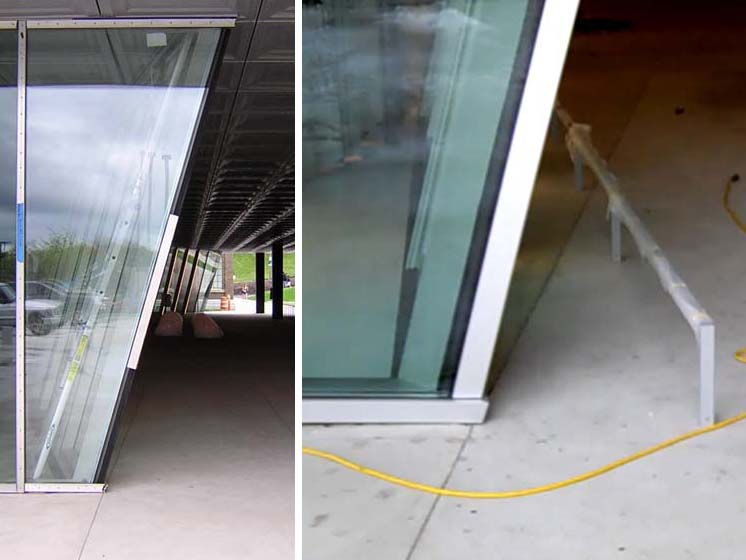
Milstein Hall lacked ADA-mandated guards at the sloping curtain wall even after the building was occupied in September, 2011 (left); some, but not all, of these deficiencies were rectified in 2012 (right)
As in Exhibit 1, the Review Board supported my appeal, and reversed the determination of the City of Ithaca Code Enforcement Official. The Review Board also accepted Cornell’s explanation that they had subsequently corrected a number of deficiencies and that therefore, “although in favor of the Petitioner [i.e., me], the building will be in compliance with the Code.” While it is true that Cornell “fixed” many of the more egregious code violations related to protruding objects long after a building permit had been granted, I still believe that the Review Board incorrectly ruled that the building is now in compliance. For example, sloping framing elements at the edge of egress paths in Milstein Hall — exactly comparable to sloping columns in recently-completed Gates Hall at Cornell that were fitted with appropriate and necessary guards — are still without any “cane detection” devices or guards.

Cornell’s recently completed Gates Hall provides “cane detection” on sloping columns at the edge of egress paths (left); Milstein Hall still has sloping elements at the edge of egress paths with no such protection (right)
Exhibit 3 described inadequate fire barriers between Milstein and Sibley Halls. The story of these fire barriers is almost too bizarre to recount, but here is a short summary: Cornell and its architects submitted “issued for construction” drawings claiming to have created adequate fire barriers separating Milstein Hall from the adjacent buildings it was attached to (Sibley and Rand Halls). In fact, the fire barriers were not adequate when built, and are not adequate now. After I pointed out to the Milstein Hall Project Manager that the aggregate width of openings in the fire barrier exceeded limits specified in the Building Code, Cornell proposed to install special sprinklers on both sides of several fire-rated glazing panels in order to meet the standards for opening width. But these sprinklers did not meet Code requirements for multiple reasons, not the least of which was the fact that the so-called “legacy report” upon which Cornell built its defense of the sprinkler system was no longer active. And even if it had been active, that same report prohibits the sprinkler design that Cornell used in at least three separate ways: it prohibits horizontal mullions in the glazing; it prohibits any combustible material within two inches of the glazing; and it seems to require a 3-foot high “pony wall” below the glazing — none of these conditions are met in the sprinklered fire barrier openings between Milstein and Sibley Halls.
And it gets worse: the sprinklers actually installed (long after the building permit was issued) for the basement and first floor fire barrier openings are only one-sided (i.e., not on both sides of the glazing) in direct violation of the product specifications for use in fire barrier walls. Finally, the alleged fire barrier between Rand and Milstein Hall was never even created — there are still window openings and duct penetrations in the wall separating Milstein from Rand Hall without any protective devices at all.
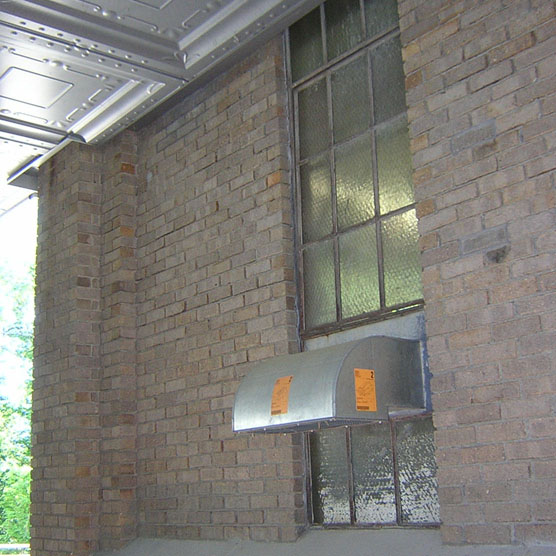
Rand Hall’s alleged fire barrier was never completed: the wall still contains windows and exhaust ducts without any fire-resistive ratings
The Review Board upheld the decision of the City of Ithaca on this matter, but required a submittal from the City on “the testified approvals from the compliance testing lab.” Obviously, since there were no “approvals” from the testing lab to be found, the City of Ithaca was unable to comply with this requirement. Instead, a copy of the legacy report was submitted that was not even applicable, since it was inactive, and that contradicted the City’s own contentions that the opening protectives were compliant. Now, fast forward to a Code Variance Hearing on Nov. 21, 2013, requested by Cornell so that they could build a noncompliant library in adjacent Rand Hall (more on this below): this request for a variance was based, in part, on the the assumption that Rand and Sibley were separated from Milstein Hall by Code-compliant fire barriers. After I provided (once again) evidence that the fire barrier was completely inadequate, the Hearing Board simply granted another Code variance — one that had not even been requested by Cornell — so that opening protectives within the fire barrier would no longer be required!
Exhibit 4 described an improper mezzanine designation. The Review Board upheld the City of Ithaca’s determination that the mezzanine designation was correct. While I disagree with this conclusion, there is, admittedly, a degree of ambiguity in how the Code defines a mezzanine, and so the Review Board’s ruling, in this case, is plausible.
Exhibit 5 described a fundamental problem with Milstein Hall — that it exceeds the floor area allowed by the Code. While the Review Board upheld the City of Ithaca’s determination, I still believe that this ruling covers up some impossibly incoherent Code language contained in Appendix K of the 2002 New York State Building Code, under which Milstein Hall was permitted. This section was unique to New York State, unique to the 2002 iteration of the NYS Code, and it never made sense. In fact, it was subsequently deleted from all later NYS Codes. In other words, under all other known Building Codes (i.e., every Code in recent history, including past and present NYS Codes, including all International Building Codes, and including the 2007 NYS Code that was actually in effect when Milstein Hall was built), Milstein Hall would not be Code-compliant and could not be built, because it exceeds the allowable floor area, not just by a little, but by a factor of more than two.
If you’re wondering why Cornell filed its building permit application for Milstein Hall on May 16, 2007 even though construction didn’t begin until July of 2009 — i.e., more than two years later — correspondence in the Building Department files (see p.71 of Addendum 3 to my “Application for Variance or Appeal“) clearly shows that Cornell was advised that filing before the 2002 Code expired would allow the building to be constructed with only a fire barrier instead of a more difficult, expensive, and design-threatening fire wall required by the 2007 NYS Code. Amazingly, the first set of “issued for construction” working drawings for Milstein Hall in the Building Department files are dated Dec. 5, 2008, more than 1-1/2 years after the permit was filed and long after the 2007 NYS Building Code had already taken effect. But because of the early permit filing, the City of Ithaca allowed Milstein Hall to be designed and built according to the 2002 Code.
The bizarre and incoherent language of Appendix K in the 2002 Code seemed to offer a “loophole” for the construction of Milstein Hall. But even though I continue to believe that the building is noncompliant under that Code, the Review Board ruled otherwise — without providing a consistent and coherent explanation for their position. Email correspondence with Charles Bliss (Department of State, Building Standards and Codes regional representative) shows that the State’s opinion about Appendix K — never actually formalized — was treated as something quite flexible and changeable over time. As a result of the Code Appeal hearing that I initiated, the Review Board ruled that the entire Milstein-Rand-Sibley Hall building must be designed with a single construction type based on Sibley Hall’s wood framing. Clearly, the Review Board believed that Milstein Hall considered alone (i,.e, with its own area and occupancy, but with the governing construction type determined by Sibley Hall) would still be compliant. Only after I pointed out that Milstein Hall, considered alone, exceeded the allowable floor area determined by the Building Code did the NYS Department of State representatives change their opinions about Appendix K, contradicting the prior ruling by the Review Board.
Exhibit 6 described a transparent attempt by Cornell and its architects to circumvent Code sections that would have made it impossible to change the occupancy of studio spaces in Milstein Hall to any “higher-hazard” occupancies, such as large lecture rooms or libraries, in the future. Cornell attempted to do this by giving the studio spaces a “double” occupancy classification that included a higher-hazard designation, even though the Code specifically requires every space to be given an occupancy designation corresponding to the use actually present (and not to some hypothetical future use).
While upholding the City of Ithaca’s ruling, the Review Board actually supported my contention by reminding Cornell “that there is specific requirement from the City of Ithaca Building Department for any changes in occupancy classification or use of this space.” That being the case, I have no idea why their findings supported the City of Ithaca on this matter.
Exhibit 7, like Exhibit 6, actually supports my contention — in this case, that the space in East Sibley Room 261 cannot support an occupancy of 240 people with only a single means of egress — while still upholding the City of Ithaca’s ruling. The Review Board’s requirement that “the posting of the occupant load as stated today needs to be immediately reviewed for the current use and altered as required” validates my position. Yet, even today (Feb. 18, 2014), the posted occupancy has not been changed.
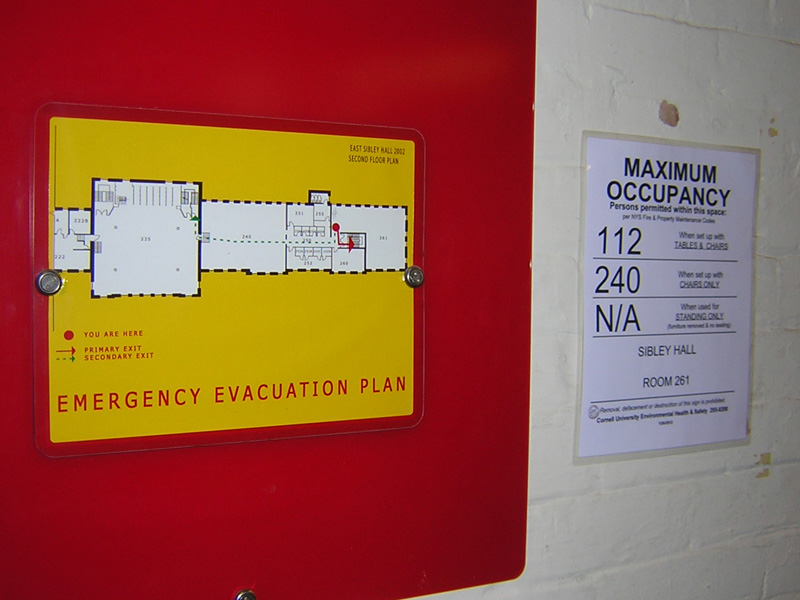
The posted occupancy for Room 261 in East Sibley Hall has still not been changed, as of Feb. 18, 2014, and still permits 240 occupants in a space with only one exit
Cornell (and the City of Ithaca Building Department) have apparently decided that it’s OK to allow 240 occupants in a space with a single exit. Go figure.
[UPDATE July 13, 2014]: I sent an email to Cornell University Fire Marshal Ronald M. Flynn on on April 1, 2014, asking him about this issue. Sometime later, possibly in June 2014, the offending sign was removed, and has not yet been replaced. Interestingly, all of Cornell’s occupancy signs have these words at the bottom: “Removal, defacement or destruction of this sign is prohibited.”
Exhibit 8 describes a noncompliant change in occupancy in Rand Hall, where a library replaced studio spaces in violation of the Code. In this case, the Review Board upheld my appeal, ruling that the library was indeed noncompliant. Cornell subsequently filed a variance request which was granted. I have described this variance in detail in a prior blog post.
This summarizes the eight Exhibits that I provided to the State’s Review Board. What does Dean Kleinman say about all this? “The so-called fire safety issues were appealed by Professor Ochshorn to the state code review board last spring. The review board ruled against Ochshorn and upheld the code official’s interpretation in six of them. Of the two issues for which Ochshorn’s appeal was sustained, one has since been granted a variance. For the other, Cornell is still reviewing its options while using the space in the interim for a less demanding occupancy that is satisfactory to the code official.”
Kleinman’s characterization of my Code appeal as dealing with “so-called fire safety issues” is really quite outlandish, and an insult to all Code Officials and fire fighters who struggle with the enormous economic and human costs of fires. Kleinman claims that of the eight issues I raised, only two of them were supported by the Review Board. Even if that were true, designing a building addition containing a dangerous assembly space with only a single exit along with a library that violates one of the most basic requirements of the Code (that all occupancies comply with allowable floor areas and heights) is hardly an inconsequential blunder. These are serious, not just “so-called,” fire safety issues.
But Kleinman’s statement is false. The Review Board ruled explicitly in my favor on three of the eight issues that I raised, not on two, while implicitly supporting my position on two additional issues (Exhibits 6 and 7, as described above). And because the Variance Review Board felt compelled to issue a variance related to my complaint on Exhibit 3 (inadequate fire barriers), one can conclude that, in the final analysis, the arguments that I raised in Exhibit 3 were also validated — otherwise, a variance would not have been needed.
Adding together the Exhibits where my position was explicitly supported by the Review Board (3 in all) and those implicitly supported either by the Review Board (2) or the Variance Board (1), I think it fair to conclude that at least six of the eight issues I raised were judged to have merit.
Milstein Hall at Cornell University, designed by Rem Koolhaas and OMA, is an interesting building, in some ways an amazing building, and, by virtually any conceivable objective criterion, a disaster. That something amazing can simultaneously be a disaster is hardly a paradox. In fact, disasters are often amazing, and our amazement often increases proportionally with the range and scope of the disaster.
I will not be criticizing the visual appearance of this building, or making judgments about its subjective, aesthetic merit. I personally find the building interesting, and its underlying formal rationale provocative and compelling. But I am not particularly qualified to render such judgments, and other authorities or connoisseurs of architectural taste may well disagree. What follows, instead, is an objective critique of Milstein Hall, looking at the building in some detail from a series of different points of view, none of which are driven by aesthetic considerations. — Critique of Milstein Hall, Introduction
I stand by my qualified assertion that Milstein Hall — as I wrote in my online Critique and as I reiterated in the podcast that triggered the article in The Architect’s Newspaper to which Dean Kleinman responded — was, and remains, a disaster.