Critique of Milstein Hall

I’m working on a critique of Milstein Hall at Cornell University, a new building designed by Rem Koolhaas (OMA) and completed in 2011-2012. Ultimately, the critique will encompass various issues that can be discussed objectively: sustainability, fire safety, nonstructural failure, function, and flexibility. At this point, only the first piece on sustainability is online. Other “chapters” will eventually be linked from the same site.

On the Barnes Foundation move

I had earlier written about my visit to the Barnes Foundation in Merion, PA, and about the music video that resulted. Well, the move of the Barnes from Merion to Philadelphia has been accomplished and the usual critical infrastructure has dutifully provided their predicable and specious arguments to justify this travesty. Do all these critics read and copy from each other, or have they all been given the same talking points by the very political and corporate powers that engineered the move? For those of you who may wish to be art critics someday, pay attention. This is what a critical review consists of: It could have been terrible, but—Wow!—it really turned out to be wonderful! Paul Goldberger (Vanity Fair) writes: “It… could have been stifling… But that is not what Philadelphia has gotten.” Ada Louise Huxtable (Wall Street Journal) writes: “The ‘new’ Barnes that contains the ‘old’ Barnes shouldn’t work, but it does.” Roberta Smith (NY TImes) writes: “Others, myself included… felt that faithfully reproducing the old Barnes in the new space… was a terrible idea… And yet the new Barnes proves all of us wrong.” Peter Schjendahl (The New Yorker) writes: “I couldn’t imagine that the integrity of the collection—effectively a site-specific, installational work of art, avant la lettre—would survive. But it does, magnificently.”

In reaction to this woeful display of critical subservience, I have created a parody of Paul Goldberger’s blog post (it appeared in Vanity Fair earlier this month): only the names and places have been changed (along with some necessary textual revisions to keep the story self-consistent). And of course the images were “photoshopped” just a bit. You can find my parody here.


Surfer Girl

Surfer Girl was written by Brian Wilson in 1961 and released by the Beach Boys in 1963. I decided to record it “live” on GarageBand, playing keyboards and singing the lead vocal simultaneously. This was all documented with the iSight camera on my iMac (I also recorded a live version of a new original song with guitar and vocal recorded simultaneously, but that one is not yet finished). I then recorded three tracks of background vocals, superimposed some lip-synching Flip video clips, and posted it to YouTube. YouTube has an interesting attitude towards such intellectual property violations (although the lyrics of Surfer Girl are only marginally intellectual by any rational standard) — on a case by case basis, they permit someone like me to post such copyrighted material online, as long as I acknowledge that the copyright belongs to others and allow the copyright owners to place an advertisement for an MP3 of the original song adjacent to the video. No problem — you could do far worse than to purchase the Beach Boy’s original version of this song.

Cornell’s net-zero energy building in NYC

Cornell is promoting its NYC Tech Campus “core” as a net-zero energy building: “The main educational building, a home for the Cornell and Technion – Israel Institute of Technology partnership, is being planned to harvest as much energy from the campus site as it consumes: In the parlance of energy experts, it will be ‘net-zero energy.'” [Cornell Chronicle Online, “Cornell’s planned NYC Tech Campus drives for a sustainable ‘net-zero energy’ core,” Oct. 24, 2011]

How the relatively small 150,000 square-foot academic building actually achieves this alleged net-zero energy status is really quite clever, but not because of its advanced technology, or its environmental strategies: rather, it relies on a devious slight of hand. As the first building on what will be a much larger campus, it covers multiple acres of the 10-acre site with arrays of photovoltaic solar panels, and similarly covers multiple acres of the site with geothermal bore holes. The collectors placed over the now-undeveloped site will ultimately be re-attached on the south-facing roofs of future buildings; while the site area staked out for geothermal will be unavailable for geothermal use by other buildings on the site.

In other words, the building only reaches its net-zero status by preventing all the other future buildings on the campus from achieving the same level of self-sufficiency, since these future building sites have been designated for the provision of PV-generated electricity and geothermal energy only for this first, relatively small, academic building.

It’s like arbitrarily drawing a line around all the useful renewable resources in your neighborhood and claiming them all for yourself — one neighbor’s solar collector; another’s wind turbine; someone else’s geothermal system, and so on — and all for the sole purpose of proclaiming that you’ve reached the illusive net-zero mark.

Cornell should rightly take credit for expending a great deal of resources on renewable energy for the Tech Campus. But calling this a net-zero energy building is misleading and disingenuous.

Milstein Hall’s noncompliant fire barrier

Last September, 2011, I requested a meeting with Mike Niechwiadowicz, Deputy Building Commissioner for the City of Ithaca, to discuss, among other things, the inadequate fire barrier between Milstein Hall (designed by Rem Koolhaas and OMA) and Sibley Hall at Cornell University. This fire barrier, already providing less fire protection than what would normally be required, was itself incorrectly specified when a building permit was requested in 2006, under the old NY State Building Code that was about to expire.

Changes were made after the permit was issued, so that the fire barrier was extended from the second floor — where it was originally called for — to the basement and first floor of Sibley Hall. This fire barrier consisted of the existing masonry wall of Sibley, plus fixed panels of 3/4 hour fire-resistance rated glazing or fire-rated glass doors installed in all the window openings that faced Milstein Hall.

Unfortunately, as I pointed out to Cornell’s Project Director for Milstein Hall as well as Deputy Building Commissioner Niechwiadowicz on September 9, 2011, the fire barrier still was noncompliant, as it contained too great a width of openings in the masonry wall, even with their fixed panels of rated glass.

On October 21, 2011, I met with Cornell Project Director Gary Wilhelm, at the suggestion of Mike N., who then sent me his proposed “solution” to the fire barrier problem: to install special sprinklers on enough of the offending glass panels that the maximum width limit would not be exceeded. This special system developed by Tyco Fire Products essentially allows the window openings to count as fire-resistance rated walls. I examined the specifications for this product and found that they were inappropriate for the intended application, because they cannot be used where the rated glazing has any horizontal mullions — and the glazing installed in the Milstein fire barrier has horizontal mullions.
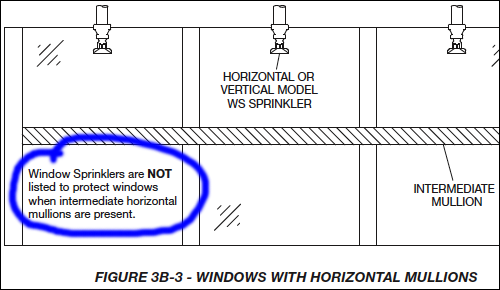
Diagram from Tyco literature TFP 620 prohibiting horizontal mullions

Diagram from Tyco literature TFP 620 prohibiting horizontal mullions

So, I relayed this information to all concerned on October 21, 2011, and didn’t hear anything else about the system until it was actually installed just a few weeks ago.

Well, perhaps I was mistaken about the appropriateness of such sprinklers in this application. Today, I called Tyco and spoke to a technical representative. Not only did he confirm that the system cannot be used where horizontal mullions are present, but he said that the application that I described was completely useless because one half of the sprinklers were sandwiched between the fire-rated glazing and the existing windows of Sibley Hall. Since the sprinklers, to be effective, must be in contact with the heat of the fire, placing a barrier like an ordinary window between a potential fire and the sprinklers renders them nonfunctional and therefore noncompliant.
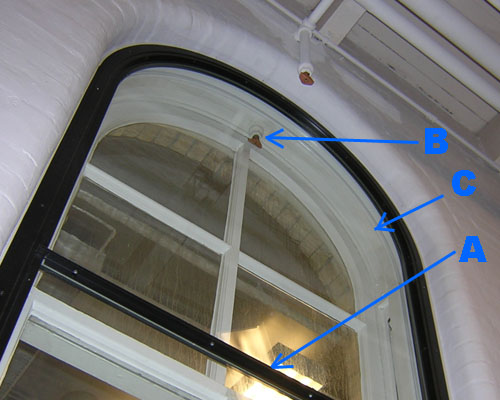
Milstein Hall's sprinkler-protected fire barrier is noncompliant in three ways: A) fire-rated glazing has horizontal mullions; B) sprinkler is sandwiched between fire-rated glazing and existing window; and C) combustible material (wood window trim) is within 2 inches of fire-rated glazing.