Author Archives: jonochshorn

About jonochshorn

Jonathan Ochshorn is a singer-songwriter, registered architect, and Phius Passive House Consultant with an academic background in structural engineering and urban design as well as architecture. He has taught at Cornell University since 1988, and before that at the City College of New York while working with community groups in New York City. He is the author of OMA's Milstein Hall: A Case Study of Architectural Failure; Building Bad: How Architectural Utility is Constrained by Politics and Damaged by Expression (Lund Humphries, 2021); three editions of the textbook, Structural Elements for Architects and Builders; and numerous essays and chapters on building technology in relation to design.

prisoner of art

This new song, like Shrinkwrap, is a commentary on art. By coincidence, I was able to incorporate images of the architecture Pritzker Prize Laureates, on display in Sibley Hall at Cornell, in the YouTube video for the song, but the lyrics are not directed toward them in particular (having been written before the exhibition was mounted). Lyrics, production notes, and an embedded video can be found on the Prisoner music web page (remixed Aug. 24, 2019).

water in rand hall

While Milstein Hall construction has begun, Rand Hall (which will be connected to Milstein Hall, and which will contain mechanical equipment for Milstein Hall) is suffering from neglect. Storm water from two recent rains has backed up in the roof drain pipes and discharged through an eye wash fixture on the second floor, as can be seen in this short video. The water has worked its way down from the second floor into first floor offices (including my own). How is this possible? Somehow, someone has connected the waste pipes from a second-floor water fountain and eye wash fixture directly to the roof drain pipe, instead of connecting them to a sanitary sewer waste line with a proper vent.

milstein hall loses its barcelona chair

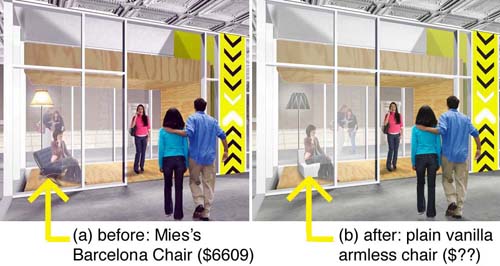
In a stunning, though entirely symbolic, concession to economic pragmatism or, more likely, to mitigate Milstein Hall’s apparent extravagance and elitist sensibility at a time when workers are being laid off and faculty salaries are frozen, Cornell has eliminated the symbolic centerpiece of Rem Koolhaas’s design for its new architecture building: Ludwig Mies van der Rohe’s iconic Barcelona chair has been rendered out of the official rendering of Milstein’s glass elevator, replaced with a plain vanilla chair.
Misltein before and after loss of Barcelona chair
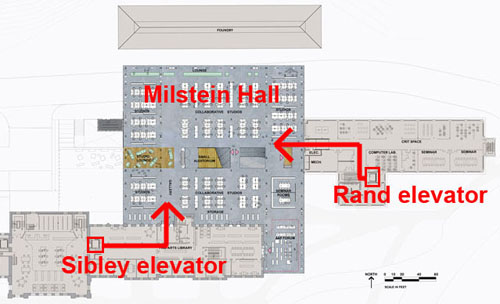
On the other hand, why one even needs this glass elevator in a two-story building remains unclear: Milstein will be physically connected to two adjacent buildings, both with elevators, so that ADA-mandated access is already available. Can it be that architecture students require the constant stimulation provided by such mechanical contrivances in order to be properly initiated into the wacky world of high design?

elevators connected to Milstein Hall

Shock and awe: Cornell attacks the building code!

In 2007, I wrote to Peter Turner, Assistant Dean for Administration of the College of Architecture, Art, and Planning (AAP) at Cornell, urging him to take action on two issues affecting the major lecture room in Sibley Hall, room 157. First, the construction of OMA’s Milstein Hall (Rem Koolhaas, architect) would eliminate natural ventilation, making the room, which is already unbearable, illegal. Since Milstein is an addition to Sibley Hall, it would not be able to be built unless the ventilation issue in Sibley was resolved. I have discussed this in more detail elsewhere.

Second, the lecture hall has only one exit, which is nonconforming with modern building code standards. As it turns out, a recent code interpretation makes it illegal to occupy the lecture hall with only one exit and more than 50 occupants.

Rather than fixing the problem, and improving the safety of these rooms, Cornell has filed a lawsuit challenging the legality of the code interpretation. According to the Ithaca Journal [link no longer works — payment now required to access news archives] (6/17/09), Cornell spokesman Simeon Moss said that “We’re quite confident in the safety of the buildings.” Really? For everyone else building 50+ occupant lecture halls in the United States, two exits are always required, based on considerations of safety and risk. Cornell, however, is “confident” that its lecture halls are safe with only one means of egress. [Update: the Ithaca Journal (8/19/09) reports that Cornell has lost its lawsuit (link disabled by the Journal*); see my short video about the almost immediate creation of a second exit for the room.]

It should also be noted that Milstein Hall is being built with less fire separation between its new construction and the existing Sibley Hall than would be required under the current building code. Thus a fire in the Milstein addition would not only threaten Sibley based on this reduced level of fire separation, but any occupants of the lecture hall in room 157 would only have a single egress path, instead of two. Way to go, Cornell!

Cornell’s attitude is clearly not based on fire science, but on a misguided set of priorities that revolve around money: what is particularly egregious in this attitude is that they have simultaneously decided to spend more than $50 million on Milstein Hall, at a cost of over $1000 per square foot (compared to $400 per square foot or less for normal university facilities) while using up the $20 million Thomas endowment gift — which was intended to support ongoing program development for the architecture department — to pay off additional debt incurred by the high cost of construction.

* Updated 5/23/13: This article in the Cornell Daily Sun describes the lawsuit that Cornell lost. And here is the State of NY Supreme Court opinion.

thoughts on milstein hall

Milstein Hall is a proposed addition to the existing architecture facilities at Cornell University, designed by the Office for Metropolitan Architecture (Rem Koolhaas). At the time of this writing, a building permit has been obtained, but there have been doubts raised about the propriety of going ahead with construction in light of the university’s financial crisis. I personally admire the design of this building, but recognize that this is a subjective judgment which may need to be tempered by more objective analysis. I also acknowledge that placing this project “on hold,” or canceling it entirely, may or may not be catastrophic for the department of architecture, depending on how Cornell responds.

In terms of an objective analysis of the Milstein Hall project, I seek to address several misrepresentations about the building that have been advanced by Cornell:

1. That the project is necessary for the continued accreditation of the department of architecture;

2. That the project “connects” the various programs of the College;

3. That the project is a sustainable building;

4. That the project takes appropriate consideration of the Landmark status of Sibley Hall and the Foundry; and

5. That the project provides flexible space for the college and university.

These concerns are addressed more thoroughly in this memo.

rollo on iTunes!

iTunesRollo, the rock’n’roll group from the early 1980s that consisted of myself, brother Kurt, and songwriter Dan Smullyan, is now on iTunes. Search directly for your favorite songs from the “Don’t Look” album, or search under “Rollo Don’t Look” to preview or purchase any of the 15 tunes. Of course, you can still buy the actual CD at a discounted price from CDBABY.com.

more on milstein code issues

This continues a discussion that started with my blog entry from 17 December 2008, and then continued with entries on January 15, 16, and 21, 2009. Can Milstein Hall be changed in the future to accommodate library or lecture hall occupancies? City of Ithaca Senior Code Inspector John Shipe responded to my previous email as follows:

  • John Shipe wrote (1/22/09):

As you say, Milstein is an addition to Sibley hall separated per NYSBC ’03 Appendix K with a fire barrier per chapter 7 of the same code. And Milstein will be a Unseparated A-3/ B occupancy with the A occupancy being the most restrictive. So the A-3 sets the construction type, height and area for that occupancy and construction type, and all the other requirements for that occupancy such as detection , exiting, etc. throughout the building ( NYSBC 302.3.2 ). All of which are in compliance with the code in which it is permitted under.

As for your argument that you feel the second floor should most likely be a “B” occupancy really falls apart in your own email response:

“a large flexible space for studios that are conducive to improvisational interaction among the AAP programs. A variety of zones within the upper plate supports the college’s physical and programmatic vision for innovative and collaborative learning: AAP Forum, Flexible studio modules, Pin up/Crit, Seminar, Research, Technology bar, Study, Lounge.” [Note that this quote is not mine, but comes from Cornell’s Milstein Hall web site.]

This space is required to be flexible in order to accommodate many programs and situations, and so they permitted it as the most restrictive occupancy so that they would not have to worry about changes in occupancy every time there needs changed for that space . So we have Non Separated use A-3/B (NYSBC 302.4). If you read the entire section you will understand that the A-3 occupancy requirements apply to more than just the structural classification, but also dictates other requirements throughout the building. So even if they changed from a flex space to a library, it would be an equal change of occupancy and based on NYSEBC 812.4.2.2 the existing building would be fine in terms of Height and Area.

Furthermore:

Even if they were to call the second floor area a B occupancy and in the future wanted to change it to an A-3 space it would still be allowed since Milstein is being constructed with a separation of uses and fire areas from Sibley hall by the code required fire barrier so the height and area of Sibley hall does not figure into this equation (NYSEBC 812.4.2.3).

So in my opinion the university is covered by the code in a couple of different ways with the construction of Milstein hall and i know that is not what you want to hear, but those are the facts as i see them.

  • I responded (1/26/09):

Thanks for your response. I’m sorry that it took so long for me to reply, but I’ve had a busy week. I agree with many of your statements, but I do have a few comments:

1. I agree that if the 2nd floor of Milstein is permitted as an A-3 occupancy, that future changes within that occupancy group should not present any problems. I do think, however, that at least some of that floor, if not all of it, would fit better under the group B designation, especially since the proposed uses are quite similar to those in Rand Hall, which you agreed in a previous email would be best classified as group B. This especially applies to some of the small spaces, such as seminar rooms, but also, I believe, to the studio classrooms.

2. I think that the Code does require all uses to be individually designated, even in a nonseparated mixed-use building (Section 302.3.1 says: “Nonseparated uses. Each portion of the building shall be individually classified as to use.”). The Code also suggests that these designations must conform to the actual intended use, and not to a generalized use, even if that generalized use is at a higher hazard level (Section 302.1 says: “…Where a structure is proposed for a purpose which is not specifically provided for in this code, such structure shall be classified in the group which the occupancy most nearly resembles…”).

3. It may be that the reason for designating each space by its actual use, and not giving the whole floor a blanket A-3 designation, is that the specific uses still trigger code compliance issues, even in a nonseparated mixed-use building which is governed in some respects by the higher hazard occupancy (Section 302.3.1 says: “…The required type of construction for the building shall be determined by applying the height and area limitations for each of the applicable occupancies to the entire building. The most restrictive type of construction, so determined, shall apply to the entire building.”) So the A-3 occupancy determines height and area limits for the whole building, but the A-3 occupancy does NOT determine all other requirements. The code section continues: “All other code requirements shall apply to each portion of the building based on the use of that space except that the most restrictive applicable provisions of Section 403 and Chapter 9 [exception for high-rise and sprinklers only] shall apply to these nonseparated uses….”. In other words, as an example, all the chapter 10 means of egress tables must still be checked for each separate occupancy, and not just for the highest hazard (A-3) occupancy.

4. I don’t think that the 2nd-floor could be easily modified to include A-3 uses in the future, if it is designated as group B now. The reason is that the code-required fire barrier you refer to is only legal under Appendix K of the old code. Any future change of occupancy to a higher hazard would not be able to claim compliance based on a fire barrier, since that code provision no longer exists (Section 812.4.2.1 says: “When a change of occupancy group is made to a higher hazard category as shown in Table 812.4.2, heights and areas of buildings and structures shall comply with the requirements of Chapter 5 of the Building Code of New York State for the new occupancy group.”). Also note that Section 812.4.2.3, which you refer to, does not apply to a future change from a group B to a group A-3 occupancy within Milstein. It simply says that separated mixed-use buildings need proper fire barriers between the separated uses. But Milstein is not being designed as a “separated mixed-use building,” and, furthermore, the fire-barrier separation between Sibley and Milstein is intended to act as a “fire wall” under Appendix K of the old code so that height and area limits that would have been triggered by Sibley’s construction type do not apply to Milstein under the old code. But with any future changes in Milstein to a higher hazard occupancy, Section 812.4.2.1 requires that current Chapter 5 height and area limits be met, so that the Appendix K fire barrier from the old code would no longer count as a fire wall under the current code, and the proposed changes would be noncompliant.

Those are my main issues. I agree that the architects seek a flexible floor plan, but I think that all the uses that are listed on their plans (and on their web page), such as “forum,” “studio modules,” seminar,” etc. are best designated as group B uses, which would permit Cornell to modify the plan in the future, as long as the modified uses continue to be group B uses.

milstein code issues (continued)

I received another email today from John Shipe of the City of Ithaca Building Department relating to my concerns about the “flexibility” of Milstein Hall to accommodate future changes. See posts from Jan. 15, 2009 and Jan. 16, 2009 to see how the conversation started.

  • John Shipe wrote:

The building is being built as an A-3/ B occupancy with unseparated uses, so  the entire building is being built to comply with the A-3 requirements. Since it is already constructed to the higher hazard standards the change of occupancy issue will not come into play in the future.

  • I replied:

Milstein Hall is an addition to Sibley Hall, and will be designed and permitted as a mixed-occupancy building with nonseparated uses. However, as I said before, those nonseparated uses must still be “individually classified as to use,” according to the code. Under the code, because the building is designed with “nonseparated uses,” the entire building must be built according to the most restrictive occupancy, which is A-3. I believe that we are in agreement with all of this, since this is taken directly from the NYS code.

The Existing Building Code also says that any future change in occupancy to a higher hazard (e.g., group B to group A-3) must be consistent with area-height restrictions under the current code. The fact that Milstein is designed with a Construction Type consistent with an A-3 occupancy is not the same thing as saying that the occupancy of Milstein is A-3 throughout. The proposed occupancy is mixed,  with a large area consisting of group B. There is nothing in the building code that permits you to decide that these group B occupancies can be later changed to a group A-3 occupancy without meeting the requirements of the Existing Building Code. In fact, the opposite is true: the Existing Building Code specifically requires that Milstein comply with the current New York State Building Code if any occupancy changes are proposed from group B to group A-3.

I believe that you are confusing Construction Type (which in Milstein is consistent with the most restrictive occupancy, as it must be to satisfy code requirements for nonseparated uses) and Occupancy (which in Milstein is mixed, and consists of both group B and group A-3). The Existing Building Code does have a specific exemption for (1) occupancies and construction types that were legal when they were built; and (2) changes in occupancy that go to a lower hazard from a higher hazard. These exemptions do not apply to the situation were are discussing.  What we are discussing is a proposed change in the future to a higher hazard occupancy. The Existing Building Code specifically requires that changes in occupancy to a higher hazard MUST COMPLY with the current code (Chapter 5, New York State Building Code). It doesn’t matter what the construction type is, or whether the proposed occupancy change would have been legal had it been built under an older code. All that matters, according to the Code, is what the occupancy is now, and what the proposed change of occupancy is.

None of this would matter if Milstein Hall were legal under the current building code. The entire problem arises because Milstein is nonconforming under the current code. As such, it’s current occupancy may be “grandfathered” into the future, but changes to that occupancy must be evaluated under the new (current) code.