Category Archives: Architecture

milstein hall and its interconnected spaces

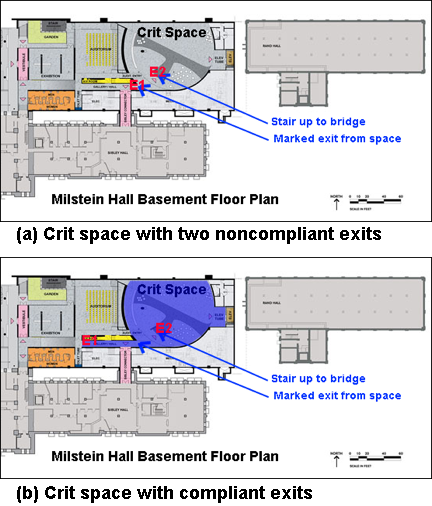
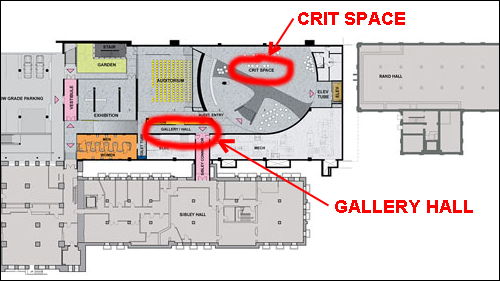
Milstein Hall at Cornell (Rem Koolhaas, OMA architects) contains what appears to be three floors, all interconnected with an opening through which passes an unenclosed egress stair. Such a condition, unless it is designed as an atrium with special smoke control measures, would not be permitted under the New York State Building Code — see my discussion of holes in floors.

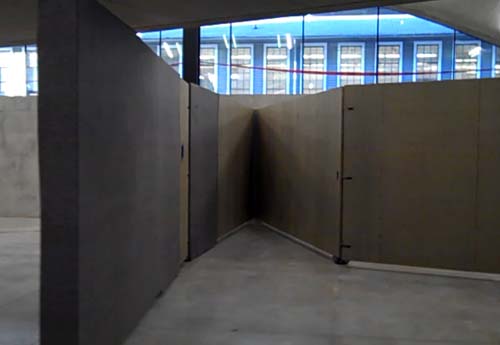
Milstein Hall's interconnected spaces -- crit space below, lobby/bridge in the middle, and studios above -- can be seen in this image

Milstein Hall's interconnected spaces -- crit space below, lobby/bridge in the middle, and studios above -- can be seen in this image

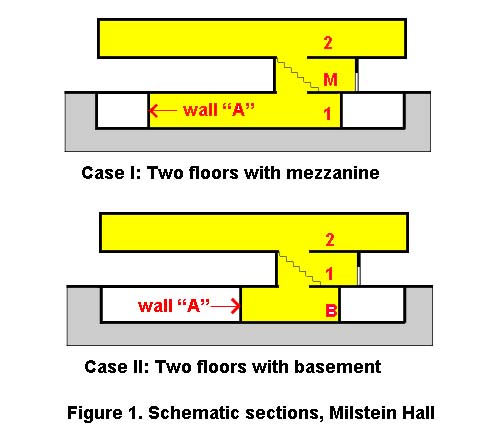
I asked the Project Director for Milstein Hall how such an interconnected opening was possible, since the interconnected spaces were clearly not designed as an atrium. He explained that, contrary to appearances, the building only has two stories with no basement: what appears as the basement is actually the first floor; what appears as the first floor is actually a mezzanine; and only the second floor is really what it appears to be — the second floor. Mezzanines need to be no more than one-third the floor area of the room or space they are in, and the first-floor lobby of Milstein did appear to be no bigger than one-third the floor area of the crit space under the dome to which it is connected.

However, while the interconnected openings in Milstein Hall appear at first glance to meet the “letter” of the Building Code, they may well be noncompliant.
Figure 1
Comparing Case I and Case II in Figure 1, one can see that the entire rationale for allowing an unenclosed egress stair from the second floor to the mezzanine lobby depends on the relative area of the space defined by what I have schematically called wall “A.” If wall “A” is placed in such a way that the area of the space it forms is at least 3 times bigger than that of the lobby (Case I), then the lobby can be counted as a mezzanine, and the egress stair is then technically within an unenclosed opening connecting only two stories, thereby conforming with exception 8 or exception 9 in Section 1005.3.2 of the 2002 New York State Building Code.

However, if wall “A” is moved so that the area of the space it forms is less than 3 times the size of the lobby (case II), then the lobby cannot be called a mezzanine. It now becomes the first floor, and the same openings and egress stair become noncompliant.

This seems entirely irrational, since Case II, with less floor area to house combustible products and a smaller number of occupants than Case I, is nevertheless noncompliant, whereas Case I, with a larger area and therefore more occupants and potentially combustible products, would be deemed compliant.

It seems probable either that the writers of the Code never anticipated that their definition of mezzanine would be exploited in this way, or that other aspects of the mezzanine definition make this geometry noncompliant.

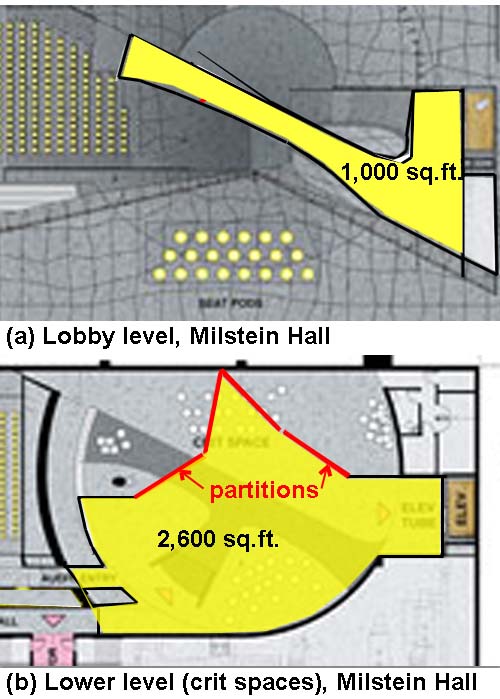
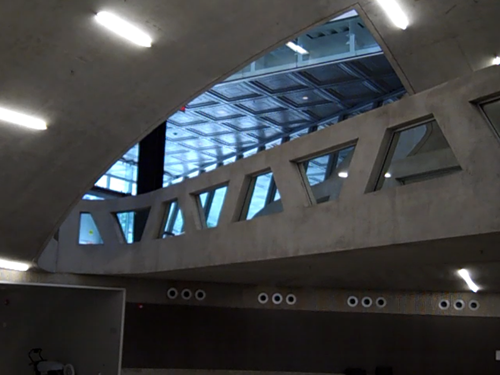
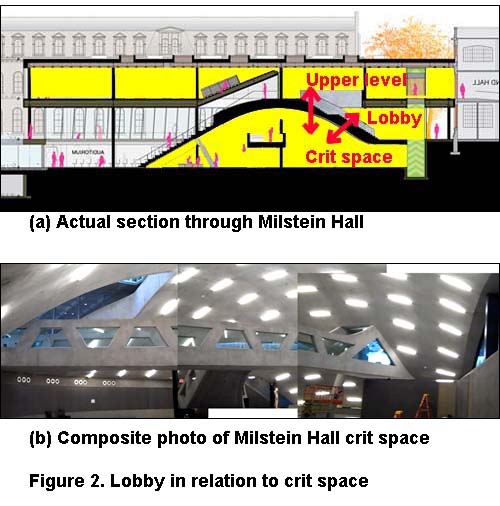
The definition of mezzanine, found in Section 502 of the 2002 Code, states that it must have “a floor area of not more than one-third of the area of the room or space in which the level or levels are located.” The key word here is “in.” The mezzanine must be “in” the room or space, not outside the room or space with an opening that connects them. Now, one might debate what exactly the meaning of the word “in” is (by analogy to Bill Clinton insisting that a proper interpretation of his prior testimony “depends on what the meaning of the word ‘is’ is”). As can be seen in Figure 2, common sense would suggest that the lobby is not “in” the dome. Both the section (Figure 2a) and the composite photo (Figure 2b) show clearly that the concrete structure of the dome creates a distinct “room” or “space” and that the lobby (pictured through the hole in the dome visible at the left of Figure 2b) is completely outside that space.

Figure 2

It is possible (along the lines advocated by Clinton) to define “in” topologically rather than by recourse to “common sense”; in that case the lobby can indeed be tested as a mezzanine “within” the dome “crit space.” In other words, we could draw a continuous contour line through the opening connecting the two spaces and call the resultant figure a single space. But the Code is fairly careful about the prepositions it deploys. If the intent were to allow a mezzanine to have any interconnected relationship to a room or space, other words or phrases could have been chosen instead of “in” or “within.” The Code does not describe a mezzanine as being “next to” or “adjacent to” or “connected to” some other room or space: it specifically says that a mezzanine must be “within” a room.

Still, this is admittedly ambiguous. The commentary to the 2009 IBC doesn’t really help: “So as not to contribute significantly to a building’s inherent fire hazard, a mezzanine is restricted to a maximum of one-third of the area of the room with which it shares a common atmosphere.” Here, the phrase “common atmosphere” has two purposes: first, it signals that the mezzanine must be somehow contiguous with the space it is in; second, it excludes any “enclosed portion of a room” in computing “the floor area of the room in which the mezzanine is located.” Having a “common atmosphere” appears therefore to be a necessary, but not sufficient condition. The mezzanine must also be “in” the room or space, which again brings us back to the question of what “in” is.

But this much is true: if the lobby space cannot be called a mezzanine, then it counts as a story. In that case, the interconnected openings are noncompliant, as they meet none of the exceptions for shaft enclosures outlined in Section 707.2 of the 2002 Code. And even if the lobby is now granted the status of mezzanine, the crit space under the dome becomes locked into its current geometry forever: it can never be reconfigured, for example, into a series of smaller rooms, since the lobby would then exceed its maximum floor area qua mezzanine and would revert back to being a separate story. The opening connecting what would now be three interconnected stories would be noncompliant.

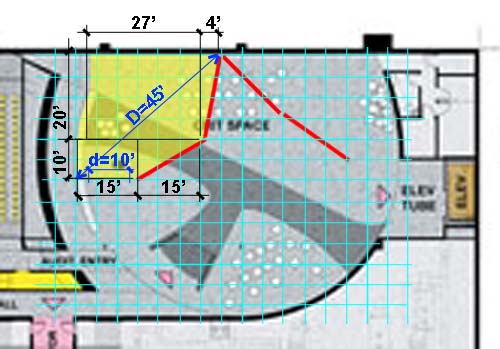
[Update: Oct. 13, 2011] As I describe in a later post, the crit space has now been subdivided into a series of smaller rooms, appearing to make both the lobby noncompliant as a mezzanine, and the interconnected stories with an unenclosed egress stair noncompliant according to the various allowable exceptions for shaft enclosures.

problems with the third-floor exterior wall of East Sibley Hall

[updated below Oct. 13, 2011 and March 9, 2012] Appendix K of the 2002 New York State Building Code made significant changes to the model 2000 International Building Code (IBC) upon which the New York State Code was based. It allowed a building addition to “increase the area of an existing buiding beyond that permitted under the applicable provisions of Chapter 5 of the Building Code for new buildings” as long as a fire barrier was provided.

Normally, a fire wall — not a fire barrier — would be required in such cases, but NYS legislators wanted to make it easier and less expensive (and therefore less safe) to build additions to existing structures. Whereas it is absolutely clear what a fire wall is, and where it must be placed in relation to the parts of a building it is separating, this hastily contrived NYS appendix doesn’t bother to specify exactly where its alternative fire barrier must be provided.

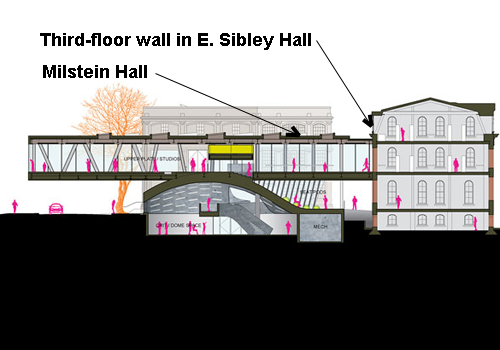
This wouldn’t be much of a problem if the addition were the same height as the existing building. However, Milstein Hall at Cornell University (OMA – Rem Koolhaas architects) is a two-story building addition connected to Sibley Hall, which is a three-story building (see building section below, adapted from Cornell’s Milstein Hall web site). The architects for Milstein initially had called for a fire barrier between the two buildings, but only on the second-floor where they literally connect. It was only later, when this assumption was challenged, that they added fire barrier protection at all levels where the two buildings come into contact (i.e., at the basement and first-floor levels as well) — see update below. Left with no protection at all is the thrid-floor exterior wall of E. Sibley Hall overlooking Milstein’s green roof.

Section showing Sibley and Milstein Halls (adapted from Cornell's Milstein Hall web site)

Sibley and Milstein Halls (adapted from Cornell's Milstein Hall web site)

This is a problem for two reasons. First, the window openings on the third floor of Sibley have no fire protection. Second, the wooden load-bearing exterior wall of Sibley’s third floor has no fire-resistance rating. None of this was a problem when Sibley was a non-conforming, grandfathered, free-standing building. It becomes a problem with the construction of Milstein Hall.

The 2002 New York State Code (specifically, Section 704.10), under which Milstein was permitted, requires that “opening protectives” be provided “in every opening that is less than 15 feet (4572 mm) vertically above the roof of an adjoining building or adjacent structure that is within a horizontal fire separation distance of 15 feet (4572 mm) of the wall in which the opening is located.” All of the window openings in the third floor of E. Sibley Hall that overlook Milstein Hall qualify under this section for opening protectives. The only exception to this requirement is where the roof construction below the openings has a 1-hour fire-resistance rating and its structure (i.e., the steel beams and girders supporting the roof) has a 1-hour fire-resistance rating. Milstein’s roof structure has no fire-resistance rating, so the exception does not apply.

Not only do Sibley’s third-floor windows require opening protectives, but the entire exterior wall on the third floor of Sibley (facing Milstein Hall) needs to be reconstructed with a 1-hour fire-resistance rating. Footnote “f” in Table 601 (exterior bearing walls) requires that the fire-resistance rating of the wall be not less than that based on fire separation distance (Table 602). Table 602 requires a 1-hour fire-resistance rating for Occupancy Groups A or B if the fire separation distance is less than 5 feet.

The fire separation distance between Sibley and Milstein Halls is 0 feet (they are physically connected), based on the most generous assumption that one can make, i.e., that they are effectively two separate buildings. Actually, Appendix K only allows them to be considered as separate buildings from the standpoint of “area” (K902.2). However, if they were considered as a single building — as would be required under the current building code (i.e., without a fire wall) — then all of this discussion would be moot since Milstein Hall would be clearly noncompliant. Either way one looks at it — as a single building or as two separated buildings — the current situation appears to be noncompliant.

[Update: Oct. 13, 2011] As it turns out, the nonconforming fire barrier placed between Sibley and Milstein Hall — to satisfy the ambiguous requirements of Appendix K from the 2002 Building Code of NYS — is not only nonconforming but also noncompliant. The width of fire-rated openings in such a fire barrier cannot exceed 25 percent of the length of the fire barrier wall. In the image below, the aggregate width of openings is shown graphically in relation to the total length of the fire barrier wall. It can be seen that the opening width greatly exceeds the 25 percent limit:

sibley-2nd-floor-small

[Update: March 9, 2012] A noncompliant solution to the fire barrier problem was proposed and recently installed. At great expense. And completely useless. See my analysis here.

cornell’s fine arts library in Rand Hall

There are plans to move Cornell’s Fine Arts Library from Sibley Hall, where it has existed as a nonconforming (”grandfathered”) occupancy for quite a few years, to Rand Hall, which is now connected to Sibley Hall through newly-constructed Milstein Hall. Because the addition of Milstein Hall was, and is, nonconforming with respect to the current New York State Building Code, it may not be possible to put a library occupancy in Rand Hall. I made a similar argument about placing so-called Group A occupancies in Sibley Hall. This same explanation applies to Group A occupancies in Rand.

A future change to an A-3 (library or lecture hall) occupancy in Rand Hall should not be permitted, because such a change would be replacing an existing occupancy with one of a higher hazard. The relevant code language is as follows: Section 812.4.2.1 of the Existing Building Code of New York State says: “When a change of occupancy group is made to a higher hazard category as shown in Table 812.4.2, heights and areas of buildings and structures shall comply with the requirements of Chapter 5 of the Building Code of New York State for the new occupancy group.” Table 812.4.2 classifies group A-3 spaces as having a “relative hazard” of 2 (with 1 being the highest hazard), and group B spaces (the current occupation of Rand’s 2nd and 3rd floor, per email from City of Ithaca Senior Code Inspector John Shipe) as having a relative hazard of 4 (lowest hazard). Therefore, it is clear that a change from group B to group A-3 constitutes an alteration to a higher hazard occupancy.

With such a change, the building — which under the current building code is defined as Rand-Sibley-Milstein — must conform to the requirements of Chapter 5 of the current Building Code of New York State. What are those requirements? Chapter 5 regulates the allowable heights and areas of buildings, based on construction type and occupancy. Since the fire barrier separating Milstein and Sibley Halls is nonconforming with respect to the current code, it [i.e., the fire barrier — clarification added 10/2/11] cannot be invoked to consider Rand-Milstein Hall as a separate building, as would be the case with a fire wall. Therefore, Rand-Sibley-Milstein must be treated as a single building under the current code, and the height/area limits are as follows: the maximum height is 60 feet; the maximum number of stories is two; and the maximum area on a single floor is at most 22,500 sq.ft. The combined second-floor area for Rand-Sibley-Milstein greatly exceeds this limit of 22,500 sq.ft., and the number of stories in Rand-Sibley-Milstein similarly exceeds the Code limit of two. Based on either of these criteria (floor area or number of stories), any alteration to a higher hazard occupancy should not be permitted, as the requirements of Chapter 5 would not be met, and cannot be met.

In other words, putting the library on the 3rd floor of Rand would violate the Code limit of two stories; putting the library on the 2nd floor of Rand would violate the floor area limit.

[Update: Oct. 13, 2011] The move of the Fine Arts Library into Rand Hall has taken place this past week, in spite of the objections I have raised. Here are a few additional points, for the record:

1. On Oct. 7, 2011, I sent an email to the Milstein Hall project director which included this clarification:

“I didn’t mention this to GW at today’s meeting, but my notes that I gave him on Code issues (attached) state that: ‘the exception [to Section 912.5.1 of the Existing Building Code of NYS] only permits a fire barrier, if used in lieu of a fire wall, to meet area limitations for the new occupancy — NOT height limitations. Only a fire wall can meet both height and area limitations for the new occupancy.’ In other words, the library move to the 3rd floor of Rand will not be in compliance even if the fire barrier between Rand and Milstein is upgraded. Only a fire wall would make such a move compliant. On the other hand, an upgraded fire barrier would appear to allow such a move to the second floor of Rand Hall. In either case, the current fire barrier is noncompliant.”

2. The contention that a library (A-3 occupancy) constitutes a higher hazard occupancy compared to the current use in the Rand Hall space is the underlying reason why such a move is noncompliant. The Code is unambiguous about the occupancy of libraries as A-3. Design studios are not specifically mentioned in the Code; rather, they fall under the Group B definition for educational occupancies above the 12th grade. If there was any doubt about the legitimacy of this classification, the Ithaca Building Department files for Rand Hall contain numerous documents, all confirming that the Group B designation was actually used for the studio spaces in Rand Hall. Older documents in the file show a C5.5 designation; this was the old New York State Code subcategory for Educational occupancies within the “Commercial” category — exactly equivalent to the modern Group B designation. See this document copied from the Rand Hall Building Department file.

3. Even if a fire wall were built between Rand and Milstein Halls, it would still be necessary to upgrade the two egress stairs in Rand Hall, which are noncompliant once the occupancy on the third floor changes to a higher hazard. For details, see my email to the Milstein Hall project director.

dragon day 2011

Here’s a quick and short Dragon Day 2011 video. Missing is the confrontation with the Engineers’ Phoenix, but I was engaged in conversation at the time. Nothing much happened in any case. This year was notable in two respects: Rem Koolhaas’s Milstein Hall, under construction, is in the background as the Dragon takes off from Rand Hall; and the Dragon itself is made of metal — so no big fire to end this year’s festivities.

undercover at architecture lecture

Architecture Studio Presentations at Cornell were held Jan. 24, 2011 from 12:30 – 4:30 p.m. in the James Law Auditorium, Schurman Hall (at the Vet School). All students and faculty were required to attend. It’s interesting to watch how our modern students pay attention in classrooms and lecture halls these days: a view from above would reveal hundreds of iPhones, smart phones, tablets, and other electronic devices connecting students (and possibly faculty…) with their email, their games, and with who knows what else.

I shot this video from the back of the lecture hall; some faces are blocked out to protect the digitally addicted.

milstein – uris comparison

Walking across Cornell’s campus the other day, I was struck by the similarity between Uris Hall, designed by Gordon Bunshaft (Skidmore, Owings & Merrill) in the 1970s, and Paul Milstein Hall, designed by Rem Koolhaas (Office for Metropolitan Architecture – OMA) in the 2000s.

Facade of Uris Hall (S.O.M.) applied to the rendering of Milstein Hall (O.M.A.).

Both buildings consist of  large, essentially square, floor plates supported by rigid frames (vierendeel trusses) lifted off the ground and cantilevered in dramatic fashion from their points of support. Both buildings also hover over large, below-grade, auditoriums: in the case of Uris Hall, the auditorium sits politely under the podium; in Milstein Hall, the auditorium rides a reinforced concrete dome that seems to burst through the ground plane. Both buildings mediate their cantilevered steel superstructures and highly-articulated bases with a glass wrapper designed to enclose space and provide an entry at grade without compromising the visual articulation of superstructure and base.

Official rendering of Milstein Hall.

Code compliance issues in E. Sibley Hall, Cornell

Following is a transcription of an email that I wrote to the Dean of the College of Art, Architecture, & Planning at Cornell University on Sept. 6, 2010 (copied to the Assistant Dean for Administration, AA&P; the Project Director for Milstein Hall; and the Building Commissioner and Deputy Building Commissioner of the City of Ithaca) [9/10/10 updates below]:

Portions of East Sibley and Rand Halls are in serious danger of being noncompliant with the NYS Building Code, and their ability to remain occupied for library, studio/classroom, and office use may be in jeopardy.

Once the floor/roof structure of Milstein Hall is in place, two things immediately occur that threaten the continued occupation of the adjacent, connected buildings.

First, all covered space under the structure of Milstein Hall counts as building area for Sibley Hall whether or not those spaces are enclosed, since a fire barrier is not yet in place to separate the two structures. Under these current circumstances, East Sibley Hall contains floors whose areas — that is, the combined, unseparated, floor areas of East Sibley and Milstein Halls — exceed that allowed by the Code, given the limits imposed by the governing V-B construction type for Sibley Hall.

Second, once the floor/roof structure of Milstein Hall is in place, the windows in Sibley Hall under these covered spaces no longer function as openable windows for the purpose of natural ventilation. I understand that Cornell and City of Ithaca Code Enforcement officials have challenged this contention, but I must insist that it remains true. As I pointed out previously, the Code limits natural ventilation to windows opening to “yards” or “courts.” Yards and courts must be “uncovered space, unobstructed to the sky” (see chapter 2 definitions in the Code). The Code does not permit windows used for natural ventilation to open into any other type of spatial geometry, whether or not “outdoor air” can somehow work its way to the window opening. The Commentary to the Code (written for the International Building Code, or IBC, from which the NYS Code derives) is absolutely unambiguous: “In order that adequate air movement will be provided through openings to naturally ventilated rooms, the openings must directly connect to yards or courts with the minimum dimensions specified in Section 1206” (Commentary for Section 1203.4.3 Openings on yards or courts). Since the openings “must directly connect to yards or courts” and since yards and courts must be “uncovered space, unobstructed to the sky,” the East Sibley windows at or below the second-floor of Milstein do not provide natural ventilation. Without mechanical ventilation that meets the criteria specified in the New York State Mechanical Code, the rooms are noncompliant and should not be occupied. In prior emails, I have outlined why the ad hoc provision of room air conditioner units or fans does not satisfy the requirements of the Mechanical Code. Yet aside from such rooms, it is clear that classrooms (e.g., 142-144 ES) or library spaces (e.g., the entire second-floor F.A.L. In E. Sibley) that have absolutely no mechanical ventilation will certainly not meet those Code requirements.

The second floor of Rand Hall, due to changes in the window configuration that have reduced the openable area, also has problems meeting Code criteria for natural ventilation. The current second-floor studio area (field measurements taken 9/3/10, excluding enclosed computer rooms, etc.) encompasses 5,259 square feet. The required vent area from openable windows is 4% of 5,259, or 210.4 square feet. However, the actual available vent area from openable windows, equal to 15 windows times 11.625 square feet of vent area per window, is only 174.4 square feet total. This is clearly noncompliant, and yet no mechanical ventilation is being planned for the studio space [see prior comments].

It is not my intention to speculate as to why East Sibley Hall and the second floor of Rand Hall are being occupied in spite of these apparent Code violations (lack of required ventilation in Rand and East Sibley Halls; and lack of fire barrier protection in East Sibley Hall). But whatever the reasons, the problems need to be addressed. It seems to me that either the noncompliant spaces should be vacated until Sibley/Milstein/Rand Hall is completed, or the twin problems of ventilation and fire protection should be corrected immediately.

Update 1 (9/10/10):

Two passages from NFPA 241: Standard for Safeguarding Construction, Alteration, and Demolition Operations (1996 version quoted here) support my argument about the immediate need for a fire barrier (the NFPA standard mentions “fire wall,” but the same logic applies to a “fire barrier” used as a substitute for a fire wall) between Sibley Hall and Milstein Hall:

1-1.1
Fires during construction, alteration, or demolition operations are an ever-present threat. The fire potential is inherently greater during these operations than in the completed structure due to previous occupancy hazard and the presence of large quantities of combustible materials and debris, together with such ignition sources as temporary heating devices, cutting/welding/plumber’s torch operations, open fires, and smoking. The threat of arson is also greater during construction and demolition operations due to the availability of combustible materials on-site and the open access.

6-6 Fire Cutoffs.
Fire walls and exit stairways, where required for the completed building, shall be given construction priority for installation… [and yes, the fire barrier is required for the completed building].

Update 2 (9/10/10):

I want to clarify that both of the actions I am recommending (mechanical ventilation for E. Sibley Hall rooms adjacent to Milstein Hall; and installation of a fire barrier in all E. Sibley Hall windows adjacent to Milstein Hall) are already part of the Milstein Hall scope of work. The issue is not whether they are required — they are both required and included in the Milstein Hall budget — but whether E. Sibley Hall can remain occupied during construction without these two items being put into place. In my view, the Code is clear on both issues: E. Sibley Hall should not remain occupied without adequate provision for ventilation and fire protection.

Furthermore, since both of these items are already part of the Milstein Hall scope of work, it is absolutely incomprehensible why the project’s phasing plan did not prioritize these two items so that E. Sibley Hall could remain safely occupied during construction. Well, actually, it is not so incomprehensible: the initial plans and specifications submitted to the City of Ithaca Building Department for a building permit included neither a proper fire barrier nor adequate mechanical ventilation for Sibley Hall. It was only after I raised objections through the FEIS comment process that the architects for Milstein Hall extended their fire barrier to the first and basement floors of Sibley Hall, and accepted the need for mechanical ventilation in Sibley Hall (after deciding to put fixed fire-rated glazing in all E. Sibley windows adjacent to Milstein). These architects still have not admitted that natural ventilation from windows under Milstein Hall is no longer a possibility given Code requirements for “yards” and “courts” adjacent to all windows used for natural ventilation; and continue to maintain that it is only because of the fixed glazing required for their fire barrier design that mechanical ventilation becomes necessary.

Construction of Milstein Hall

I’ve just posted the first of a series of informal “construction” videos showing how Paul Milstein Hall (OMA/Rem Koolhaas) at Cornell University is being built. The homepage for the anticipated video series is here. Ultimately, I hope to add additional short videos dealing in turn with substructure, superstructure, and enclosure systems.

The first video, “Getting Ready,” shows some of the preliminary site work and underpinning of adjacent buildings that occurred prior to the actual start of foundation work.

These videos are purely educational and informative in nature: after all, in spite of the numerous problems that this building has, some of which I have discussed elsewhere on this blog (also here), it’s construction is actually quite interesting and in many ways unusual.

Given my prior and continuing criticism of the Milstein Hall design, I would like to acknowledge the support for this video project by the College of Architecture, Art & Planning (Dean Kent Kleinman) and the Construction Manager (Welliver McGuire). Of course, there is a contractual stipulation that some form of educational outreach must be provided along with the actual construction of the building — so my video project proposal, having little if any competition from other faculty initiatives, may have been viewed as a necessity to fulfill this contractual obligation. In any case, I appreciate the support I’ve been given. Disclaimer: Any views or opinions expressed on these videos are entirely my own (except where views or opinions are expressed directly by other people appearing in the videos), and are not necessarily the views of Cornell University, OMA, or any of the consultants, subcontractors, or construction managers involved in the construction of Paul Milstein Hall

Note: links to other Milstein posts updated May 5, 2011.

Rebuild Boardman Hall

The engineering library is to be closed at Cornell, since virtually all library activity in the college is electronic (see Chronicle article here) [UPDATE 8/13/10: two additional libraries at Cornell being consolidated with the ILR library; see Chronicle article here]. The Fine Arts Library is being largely dismantled and moved to Cornell’s library annex, but only in preparation for its rebirth in Rand Hall, a puzzling decision that I criticized in more detail here.

With the need for great quantities of prime library space increasingly in doubt, Cornell’s bad decision to demolish Boardman Hall in 1958 — in order to build the much larger Olin graduate library on the Arts Quad — should now be seriously revisited. This is a unique opportunity to begin planning to heal the wound that was inflicted on the Quad, an opportunity that may never present itself again.

Compare Boardman Hall (left images) with Olin Library (right images)

Compare Boardman Hall (left images) with Olin Library (right images)

Cornell’s planning and architectural decisions after Word War II have largely been disastrous; in fact, the architectural beauty of the campus is almost entirely due to the pre-WW II infrastructure that remains in place. The Arts Quad, in particular, is one of the greatest such assemblages of buildings in America, and would become absolutely spectacular if its southern edge could once again be defined by Boardman Hall, designed by the same architect, William Henry Miller, who designed Uris Library. Miller was an early graduate of Cornell’s architecture program in the 1870s.

Boardman Hall

Boardman Hall arcade facing the Arts Quad

Preserving and enhancing Cornell’s historic buildings and districts has apparently not been a priority. The recent expansion of housing adjacent to the neo-Gothic West Campus dormitories (originally Baker Court, 1916) and beyond Balch Hall in North Campus (1927) has done to these campus quadrants what Olin Library has done to the Arts Quad. It would be a remarkable and unique decision to take advantage of the imminent reduction in library space needs by actually doing something important for the long-term future of the campus.

The former Law Library in Boardman Hall

The former Law Library in Boardman Hall

Boardman Hall and Uris Library viewed from Sheldon Sundial

Boardman Hall and Uris Library viewed from Sheldon Sundial

Boardman Hall (left) vs. Olin Library (right)

Boardman Hall (left) vs. Olin Library (right)