The Cornell Fine Arts Library Site Narrative

[Updated below 8/12/15] It’s well known that architects are trained to write and speak using a specialized vocabulary, one that is intended to help them “express” their design intentions without actually developing a coherent argument. The Urban Dictionary puts it this way (defining what they call archispeak):

Large, made-up words that architects and designers use to make themselves sound smarter than you (you being the client or the confused observer of design). It does nothing to inform or enlighten the consumer of architecture and mostly serves to numb them into obedience or self doubt.

Being well acquainted with this phenomenon, I’m aware that exposing such absurdities will have little or no impact on the development of a particular project: as the Urban Dictionary suggests, the clients have already been numbed into obedience. And when the clients themselves are architects, as in this case, it’s likely that they come to the project already pre-numbed. Still, even if only to amuse myself, I’ve looked through the “Site Narrative” prepared by AAP alumnus Wolfgang Tschapeller for a Fine Arts Library in Rand Hall at Cornell University and made the following page-by-page notes:

Cover. “Rather than acting as a physical symbol, it radiates activity and occupation.”
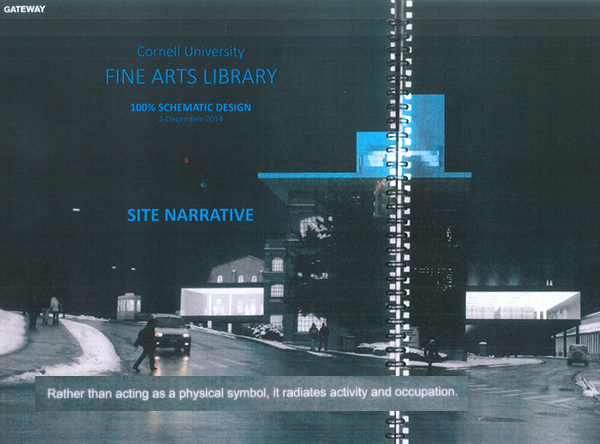
Fig. 1 Site Narrative dated 2 December 2014. Image has been cropped to reduce size and some text has been enlarged for clarity

Fig. 1 Site Narrative dated 2 December 2014. Image has been cropped to reduce size and some text has been enlarged for clarity

This is metaphor masquerading as reason. What does radiating activity actually mean? That when one looks at the physical object, one imagines some sort of activity happening inside? Is this because there are windows in the building and one can look inside and see “activity,” or because—unlike ordinary buildings with windows—some mysterious and undefined architectural sensibility is at work here which causes otherwise distracted students, staff, faculty, and visitors to gasp in awe, their once banal and humdrum existence now transformed by the knowledge that “activity and occupation” are radiating from this object?

Page 1. “The perimeter of the Arts Quad is clearly defined, with Rand Hall being the single exception that protrudes outwards at the Northern termination point of East Avenue.”
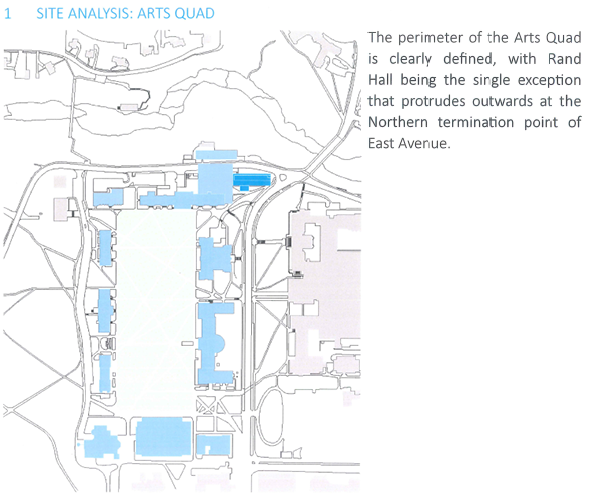
Fig. 2 Site Analysis Arts Quad. Plan has been moved under title and cropped to reduce size and some text has been enlarged for clarity

Fig. 2 Site Analysis Arts Quad. Plan has been moved under title and cropped to reduce size and some text has been enlarged for clarity

Well, if you highlight Rand Hall by giving it a dark blue tone, and fade out all the other protruding objects, maybe no one will notice that the perimeter of the Arts Quad is actually defined by protrusions, whether created by the buildings themselves (e.g., the wings of Goldwin Smith Hall), additions to those buildings (e.g., the back of Lincoln Hall or—dare we mention it—Milstein Hall), or new buildings (e.g., the Johnson Museum). What is also not mentioned is that Rand Hall, rather than being an anomalous creation, was once part of a larger grouping of informal and industrial structures (including the Foundry just north of Milstein Hall) that, as late as 1951, defined a zone of structures to the north and west of the current arts quad perimeter.

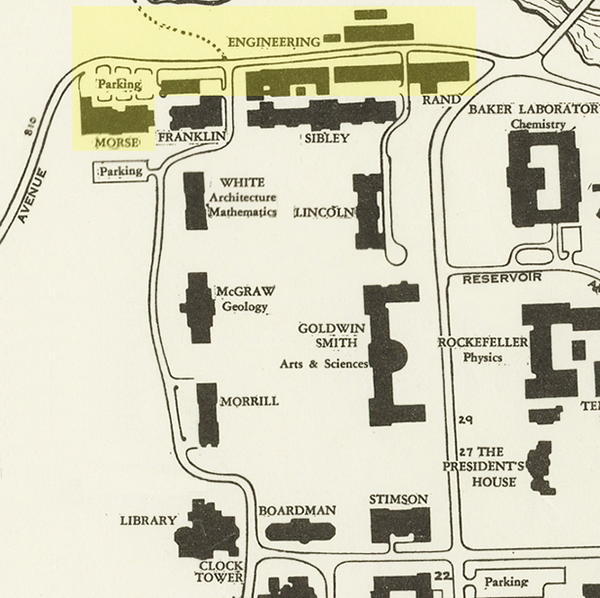
Fig. 3 The Campus of Cornell University, Ithaca, NY, 1951 (yellow highlighted region shows industrial-type structures) https://olinuris.library.cornell.edu/exhibitions/olinat50/library-born)

Fig. 3 The Campus of Cornell University, Ithaca, NY, 1951 (yellow highlighted region shows industrial-type structures)

Page 2. This page makes the case that Rand Hall, occupying a unique spot both at the “gateway” to the main campus from North Campus, and at the end of the East Avenue axis, should have a more explicit marker (“superstructure” or “lantern”) to denote its importance or significance.
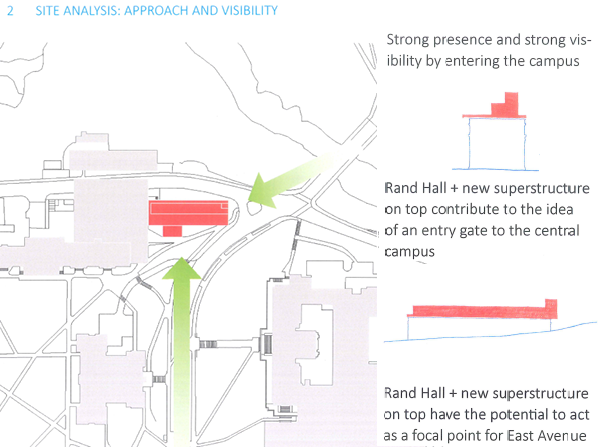
Fig. 4 Site Analysis: Approach and Visibility. Image has been cropped to reduce size and some text has been enlarged for clarity

Fig. 4 Site Analysis: Approach and Visibility. Image has been cropped to reduce size and some text has been enlarged for clarity

There’s nothing particularly wrong with that general proposition, but nothing particularly right about it either. I’m not a fan of symbolic speech in any of its forms (whether spoken or visual), especially when taken seriously. The purpose of the Rand Hall “marker” has this in common with the purpose of many other historic markers: to call attention to the wealth, power, or taste of a particular entity, in this case the College of Architecture, Art, and Planning and the University as a whole.

Page 3. Here we have a further defense of “symbolic speech,” with the architect providing his own critical appraisal (“another piece of contemporary architecture of high quality”).
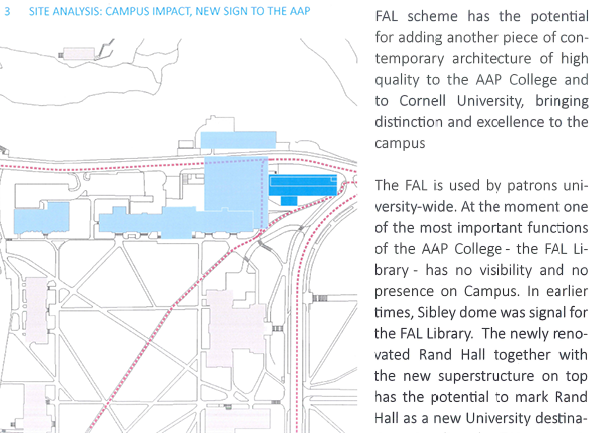
Fig. 5 Site Analysis: Campus Impact, New Sign to the AAP. Image has been cropped to reduce size and some text has been enlarged for clarity

Fig. 5 Site Analysis: Campus Impact, New Sign to the AAP. Image has been cropped to reduce size and some text has been enlarged for clarity

The idea that important spaces need symbolic expression (“…one of the most important functions of the AAP College – the FAL Library – has no visibility and no presence on Campus”) is absurd. A prime counterexample is M.I.T.’s legendary Building 20, a place known for innovation and important theoretical discoveries, that consisted of “a temporary wooden structure hastily erected during World War II on the central campus…” (torn down in 1998 and replaced with Frank Gehry’s Stata center).
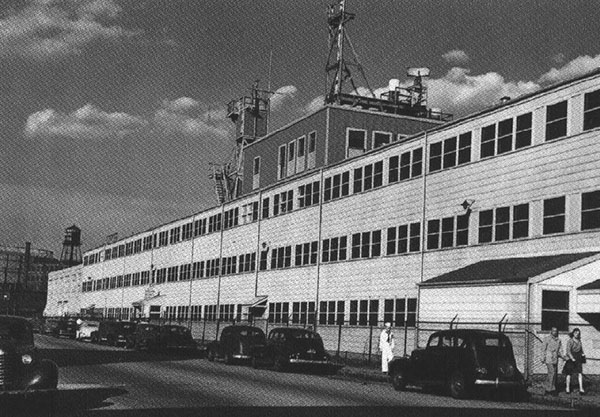
Fig. 6 Building 20 at M.I.T., a classic "low-value" building

Fig. 6 Building 20 at M.I.T., a classic “low-value” building

This building served its purpose quite well without any added symbolic architectural gestures to express its significance. It also embodies the wisdom espoused by Jane Jacobs (see Chapter 10 of The Death and Life of Great American Cities) regarding the value of old, “low-value” buildings: “Old ideas can sometimes use new buildings. New ideas must use old buildings.” Rand Hall, as an old, adaptable, flexible, industrial structure, served that purpose admirably over the years: starting in the early 1970s, it became home to architecture design studios, the Program of Computer Graphics moved in, and then various iterations of innovative computer labs were installed on the second floor. It accommodated a small wood and metal shop, which was later enlarged to include laser cutters, 3D printers, and other advanced tools. None of this could have happened in a high-end, symbolically-loaded, and expensively-renovated building. Like Milstein Hall, the proposed design for Rand Hall will hinder, if not destroy, any capacity to accommodate new and innovative program development.

Along these same lines, Cornell Architecture’s legendary graduate programs in Architectural Design and Urban Design (from which Wolfgang Tschapeller, the architect of this proposal, graduated in 1987) occupied classic low-value and “undesirable” basement rooms in Sibley Hall for many years. In other words, it is faculty and students who create important work and thereby define the reputation of places like Cornell, not symbolic architectural gestures.

Page 4. This image purports to distinguish between the two entrances to the Fine Arts Library, one characterized as a “public entrance” and the other “for AAP only.”

Fig. 7 Site Analysis: Entry. Image has been cropped to reduce size and some text has been enlarged for clarity

Fig. 7 Site Analysis: Entry. Image has been cropped to reduce size and some text has been enlarged for clarity

What’s peculiar about this plan diagram is the fiction that some sort of purposeful path connects the three departments of AAP (art, planning, and architecture) to the second-floor “AAP” library entrance. The yellow dotted line shown on the site plan, starting with Tjaden Hall (Art) on the left, actually crashes through a side wall of the art facility, not bothering with the formality of using an actual door, then enters into the basement of West Sibley Hall through a locked exit-only door, then presumably takes a stair or elevator to the second floor, where it moves through the Sibley Dome into E. Sibley, from which it enters Milstein Hall’s architecture studio and finds its way into the Rand Hall library. The path through Milstein Hall is not well-defined by hallways or corridors; rather, one must figure out a way to move diagonally through the orthogonal studio layout without invading the privacy of the studio classes.

In spite of all the talk about Milstein Hall being designed for the “college” and creating a “sense of connection across disciplines” (“Walkways and doorways connecting Milstein Hall to Rand and Sibley halls provide the practical advantage of moving through the college’s buildings along with promoting a sense of connection across disciplines”), it’s clear that the second floor level of Milstein Hall which connects to the proposed library in Rand Hall is an architecture-only space, making it more than a bit awkward for faculty and students from the two other departments to avail themselves of this special AAP entry.

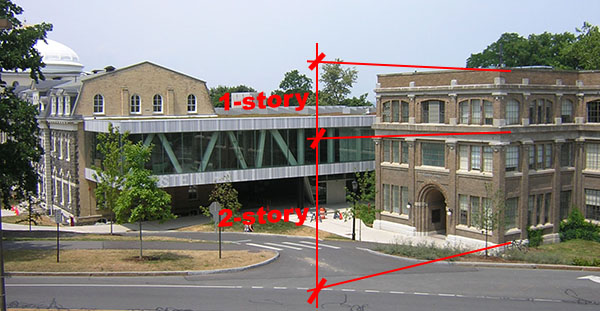
Furthermore, if one really wanted to draw useful conclusions from an analysis of public and AAP-only entrances, it seems to make more sense to put a two-story library on the bottom two floors, corresponding to the location of both the public and AAP-only entrances, and also reinforcing the formal division of the building into a two-story “base” with a one-story “top” (Figure 7a); while putting the shop functions on the top floor allows easier access to roof-top venting (currently, the shop exhausts directly into the ground-floor covered space between Rand and Milstein Halls), although it also makes the delivery of shop material (including Dragons) a bit more difficult.
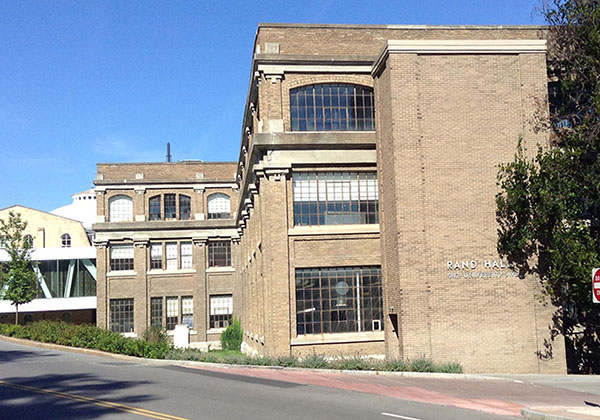
Figure 7a. The formal division of Rand Hall's facades into a two-story "base" and a one-story "top" contradicts the position of a double-volume space on the top two floors. (Photo by J. Ochshorn, August, 2015)

Figure 7a. The formal articulation of Rand Hall’s facades into a two-story “base” and a one-story “top” contradicts the idea of creating a double-volume space on the top two floors. (Photo by J. Ochshorn, August, 2015)

Page 5. The “articulated skyline” of Cornell is an imaginary, or abstracted, view of the campus looking west.
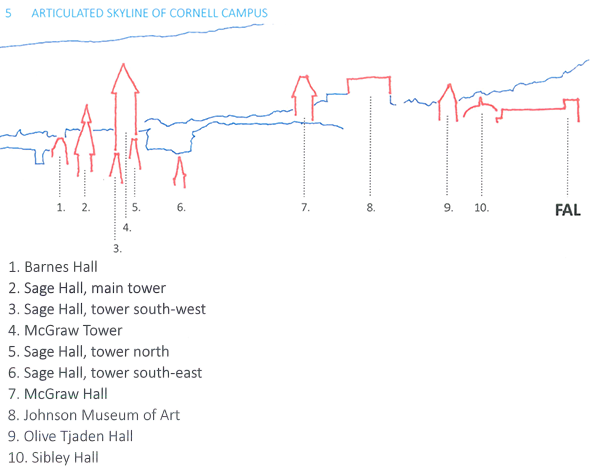
Fig. 8 Articulated Skyline of Cornell Campus. Image has been cropped to reduce size and some text has been enlarged for clarity

Fig. 8 Articulated Skyline of Cornell Campus. Image has been cropped to reduce size and some text has been enlarged for clarity

Mostly towers are shown (Uris clock tower, McGraw tower, etc.), but also some other things like the Johnson Museum, Sibley Dome, and, of course, the proposed Rand Hall “lantern.” There is no argument made on this page; any other intervention silhouetted into this diagrammatic landscape would have the same merit, or lack of merit. But we get it: there are lots of things that poke into the sky at Cornell. On the other hand, it is interesting to see what is left out of this diagram: the biggest and most visible “tower” seen when crossing the Thurston Avenue Bridge is neither the Sibley Dome, the Johnson Museum, nor any of the towers diagrammatically indicated; rather it is the Olin Chemistry Research Lab, presumably left out of the diagram because it just didn’t fit into the architect’s fictional narrative.
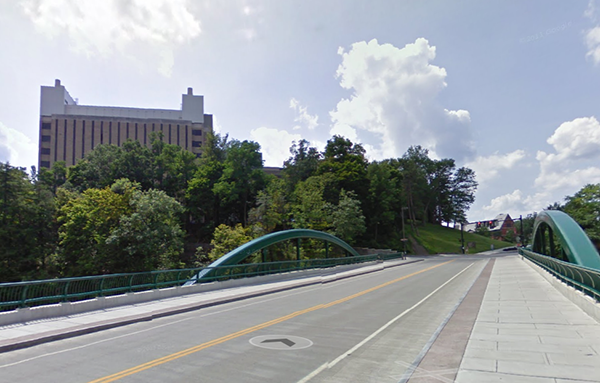
Fig. 9 Google Street View looking south from the Thurston Ave. bridge at the Olin Chemistry Research Lab

Fig. 9 Google Street View looking south from the Thurston Ave. bridge at the Olin Chemistry Research Lab (none of the architect-designed or architect-proposed “gateways” are visible)

Page 6. “Lantern as part of the new superstructure will serve both as an urban marker and a means of adequately presenting the volumes of books. Adaptive reuse of an existing university facility creates a high quality environment for one of the most important functions of the AAP College.”
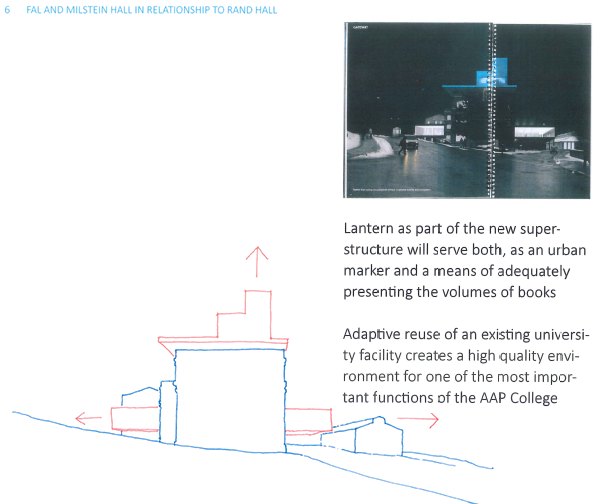
Fig. 10 FAL and Milstein Hall in Relationship to Rand Hall. Image has been cropped to reduce size and some text has been enlarged for clarity

Fig. 10 FAL and Milstein Hall in Relationship to Rand Hall. Image has been cropped to reduce size and some text has been enlarged for clarity

Sorry, but how is this an “urban marker”? And in what way is this “adequately presenting the volumes of books”? I think some other, more explicit, diagram is needed to explain this drawing to us grown-ups. Like the Little Prince says: “J’ai alors dessiné l’intérieur du serpent boa, afin que les grandes personnes puissent comprendre. Elles ont toujours besoin d’explications.”
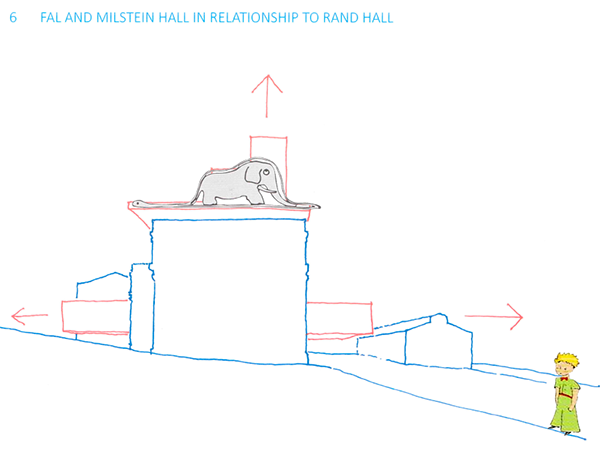
Fig. 11 My collage of the page 6 "lantern" diagram with the famous hat-vs.-"serpent boa" image from Antoine de Saint-Exupéry's Le Petit Prince

Fig. 11 My collage of the page 6 “lantern” diagram with the famous hat-vs.-“serpent boa” image from Antoine de Saint-Exupéry’s Le Petit Prince

Page 7. “4 levels of mezzanine shelving house the entire FAL collection, leaving generous spaces for reading and working. Upon entering immediate and clear overview of FAL-Collection. Dignified double-height reading room, similar to iconic historic and contemporary library buildings i.e. Bibliotheque St. Genevieve, new and old national Library in Paris, Academy of Fine Arts in Vienna…”
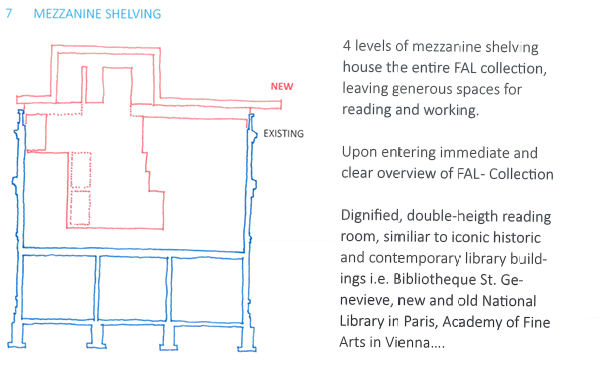
Fig. 12 Mezzanine Shelving. Image has been cropped to reduce size and some text has been enlarged for clarity

Fig. 12 Mezzanine Shelving. Image has been cropped to reduce size and some text has been enlarged for clarity

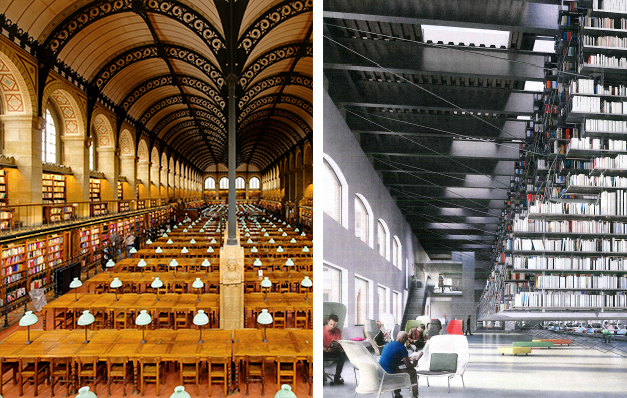
First, there are only two levels of mezzanine shelving, not four, with the other two levels counting as “stories” rather than mezzanines, and the whole thing being noncompliant with the 2010 Building Code of New York State for reasons explained in a prior post. Second, there is nothing clear about the “overview” one gets of the collection; rather, one is confronted with a puzzling mass of book stacks, far more confusing in form than the current organization of the “temporary” stacks. Third, what makes the double volume “dignified”? And by what stretch of the imagination is it similar to “iconic” buildings like the Bibliothèque Sainte-Geneviève?

Fig. 13 Compare Henri Labrouste's Bibliothèque Sainte-Geneviève, completed in 1850 (left) with the proposed Fine Arts Library (right)

Fig. 13 Compare Henri Labrouste’s Bibliothèque Sainte-Geneviève, completed in 1850 (left) with the proposed Fine Arts Library (right)

Page 8. “…The mezzanine shelving, mainly used in book storages is a very economic means of storing books. A fusion of the economy of object defined book storage and generous user defined library spaces is proposed.”
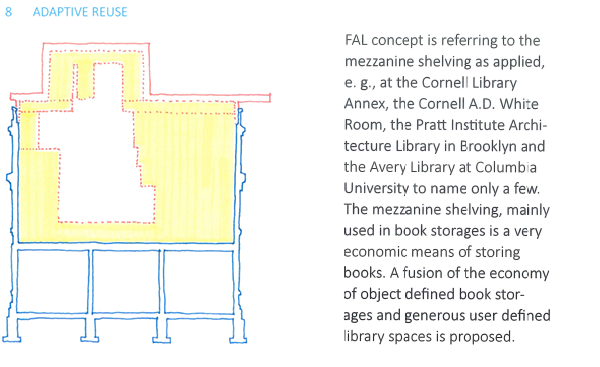
Fig. 14 Adaptive Reuse. Image has been cropped to reduce size and some text has been enlarged for clarity

Fig. 14 Adaptive Reuse. Image has been cropped to reduce size and some text has been enlarged for clarity

Very “economic”? So if we demolish the perfectly adequate third floor and roof of Rand Hall, place incredibly expensive transfer girders spanning 45 feet from wall to wall where the roof used to be, meanwhile reinforcing at great expense what used to be perfectly adequate columns on the exterior walls and underpinning the foundations to deal with the newly-increased loads transferred from the transfer girders, and then hang several floor levels from these girders that, being disengaged from the original floor plates for which a new elevator was finally installed as part of the Milstein Hall project, require a second elevator to be inserted, and then—after so much money has been spent that the $6 million gift from a generous alumna doesn’t even begin to cover the project costs—buy relatively normal book stacks (aka “object defined book storage”), we are justified in characterizing this boondoggle of a project as “a very economic means of storing books”?

The page has the title, “Adaptive Reuse.” Is this some kind of a joke? Please just read the definition in Wikipedia and draw your own conclusions.

Page 9. The architects attempt to create a logical bridge between the utility of interior reading, working, and stack spaces, and the “high spatial quality” of their design.
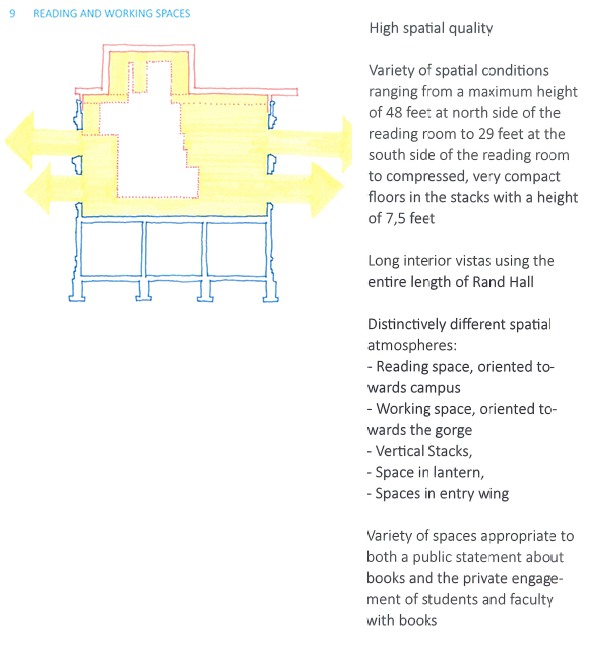
Fig. 15 Reading and Working Spaces. Image has been cropped to reduce size and some text has been enlarged for clarity

Fig. 15 Reading and Working Spaces. Image has been cropped to reduce size and some text has been enlarged for clarity

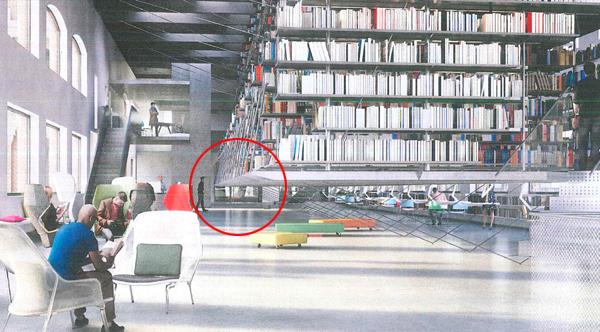
First, nothing in the design points to an understanding of how students and faculty actually use library space in the twenty-first century. As can be seen in the “artist’s rendering” posted by Cornell (Figure 16 below) or in the floor plans available in the Dean’s office at Cornell (but otherwise not made public), seating in the double-volume space is perfunctory and provides (1) no place for groups or individuals seeking moderate privacy, (2) no electric outlets for digital devices (please don’t tell me there will be floor-mounted receptacles), and (3) no white boards for sketching. Yes, I know there are one or two seminar rooms with undefined function, but there is nothing in the proposal that shows any awareness of, or interest in, what a twenty-first century library might consist of, what students, in particular, might find useful in such a space, and why students would want to “read” or “work” on little round tables where they have neither privacy, food, nor the ability to collaborate with other students.
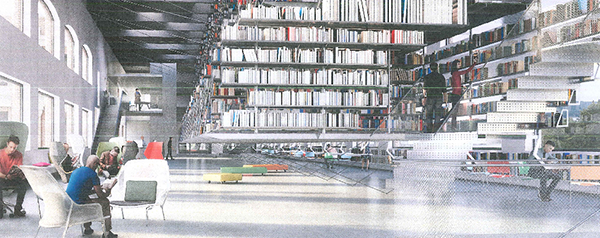
Fig. 16 Perspective rendering provided Cornell shows perfunctory seating for "reading" and "working," with no apparent interest in the two things that a twenty-first century library could actually benefit from: (1) informal collaborative spaces distinct from seminar rooms misleadingly labeled as "collaborative spaces"; and (2) food

Fig. 16 Perspective rendering provided by Cornell shows perfunctory seating for “reading” and “working,” with no apparent interest in the two things that a twenty-first century library could actually benefit from: (1) informal collaborative spaces distinct from seminar rooms misleadingly labeled as “collaborative spaces”; and (2) food

Second, something called “high spatial quality” is supposedly created because one encounters a variety of vertical and horizontal dimensions—48 feet here, 29 feet there, 7.5 feet in the stacks, long vistas—as if quality can be explained on such a basis. Retreating just a bit, the architects then pick a more neutral word instead of quality: atmosphere. But even here, they define “different spatial atmospheres” not by spatial qualities, but by orientation, e.g., with “reading space, oriented toward campus” (by which they must mean East Avenue) or with “working space, oriented towards the gorge” (by which they must mean University Avenue). It’s not clear what distinguishes “working” from “reading” space—perhaps “working” in this library means using the library’s iMacs rather than one’s own laptop or tablet. Why, in a world increasingly defined by wireless connections to portable devices and the digitization of visual resources, are we being asked to believe that a library featuring—get ready for this: books and computers!—represents some sort of insight into the role that such spaces might play in the university’s (and college’s) future? Stuart Brand, in How Buildings Learn, answered this question is 1994:

Schools of architecture… are wonderful and terrible. Wonderful because they foster the last great broad Renaissance-feeling profession, terrible because they do it so narrowly. They focus obsessively on visual skills such as rendering, models, plans, and photography. Sight substitutes for insight. The artistic emphasis discourages real intellectual inquiry, diverting instead into vapid stylistic analysis…[emphasis added]

Having invested so much money into deforming a perfectly flexible and adaptable building into something that can only be one thing—a big double-volume space with hanging stacks of books—it will require another huge expenditure of money for the college and university to fix this mistake.

But back to the text: it is hardly clear why students who are “reading” would prefer to look down University Avenue, directly into the southern sun, while students who are “working” would prefer to look across University Avenue. In fact, none of the students shown in the renderings seem aware of their orientation towards one or the other street, being absorbed in their “work” or “reading.” The “orientation” arrows in the diagram are entirely specious. What would be useful instead are solar arrows demonstrating the futility of doing anything productive on the southern side of this solar greenhouse. Yes I know that, as in Milstein Hall, one can always buy expensive curtains or blinds to compensate for the spatial conditions advertised as being the organizational basis for the scheme.

How are these spaces “appropriate to both a public statement about books and the private engagement of students and faculty with books”? These are all mindless assertions, or archispeak (“high spatial quality,” “different spatial atmospheres,” spaces that are “appropriate” as “public statement” and for “private engagement”) that have no evidentiary underpinning. In fact, what the space seems designed to do best is simply to exhibit itself.

Pages 10-11. The north “working” spaces have “diffused natural daylight conditions and long views towards the gorge.” The “lavish south reading space” also has “natural daylight.”
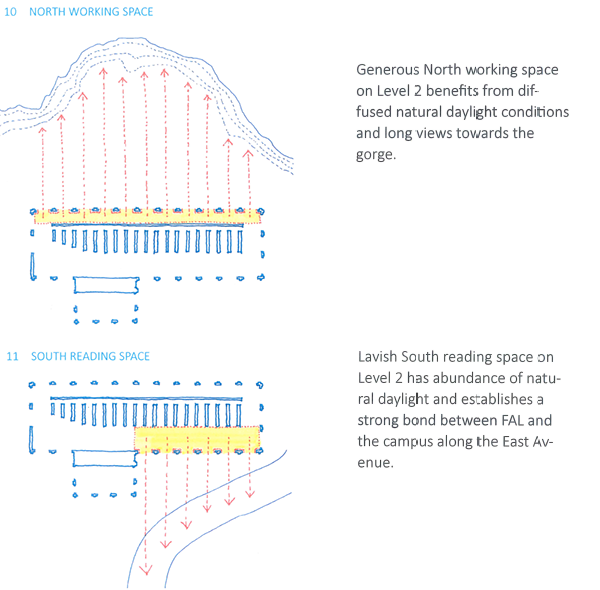
Fig. 17 North Working Space (p.10); South Reading Space (p.11). Image has been cropped to reduce size and some text has been enlarged for clarity

Fig. 17 North Working Space (p.10); South Reading Space (p.11). Image has been cropped to reduce size and some text has been enlarged for clarity

I won’t comment on the alleged “strong bond” established “between FAL and the campus.” What is remarkable is how these two pages are devoted to natural lighting on the north versus the south edges of this building, and yet not a single useful statement is made about potential problems, or mitigation measures, arising from the building’s southern and eastern exposures. Nothing is said about the low eastern light in the morning that affects both the “reading” and “working” spaces or the intense southern light that creates glare and heat gain in the “reading” zones. And nothing is said about the library’s evening and night hours when there is no natural daylight, diffused or otherwise. Electric light fixtures are neither discussed nor shown in any of the renderings. Does the whole basis of the library’s internal organization (orientation) suddenly disappear during evening and night hours?

Page 12. The plan diagram shown is of the second floor, yet the text describes “Mezzanine shelving galleries [that] are always open-ended, providing long perspective views South across the campus and librarians offices, West- into Milstein Hall Studio space and East- towards the Thurston Bridge.”
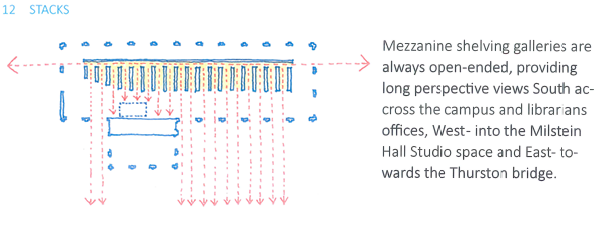
Fig. 18 Stacks. Image has been cropped to reduce size and some text has been enlarged for clarity

Fig. 18 Stacks. Image has been cropped to reduce size and some text has been enlarged for clarity

First, how can there be “open-ended” galleries with views “[s]outh across campus and librarians offices”? The librarians offices actually block these so called open-ended views. Defining “blocked by the wall of an office” to mean “open-ended” is rather Orwellian. Second, of the four stack levels, none of the mezzanine floors have views into the Milstein Hall studios (only the second floor level does). Furthermore, looking west from the second floor mezzanine, all one sees is the mechanical room unceremoniously placed on what was Rand Hall’s third floor (now being redefined as the second-floor mezzanine level) in order to bring conditioned air into Milstein Hall. Third, are the architects really taking credit for “providing long perspective views”? Do they not understand that perspective arises because of well-known geometric principles activated within our own perceptual apparatus (in which light emanating from the three-dimensional world passes through a small lens in our eye and is projected on our retina), and not because of some design that may or may not have parallel lines of walls or book shelves.

Fig. 19 Albrecht Dürer's canonical illustration of the geometric basis of perspective, from The Painter's Manual, 1525

Fig. 19 Albrecht Dürer’s canonical illustration of the geometric basis of perspective, from The Painter’s Manual, 1525

Page 13. A page supposedly about “collaborative spaces” shows two yellow plan areas, only one of which might actually be a collaborative space (but is better characterized as a “seminar room”).
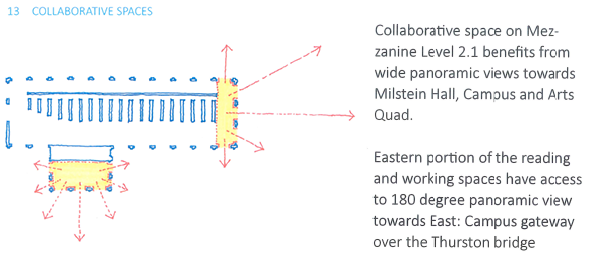
Fig. 20 Collaborative Spaces. Image has been cropped to reduce size and some text has been enlarged for clarity

Fig. 20 Collaborative Spaces. Image has been cropped to reduce size and some text has been enlarged for clarity

Why this room, isolated from the main library space, “benefits from wide panoramic views” is not clear. Does this mean that collaboration is more effective because one can look out of windows in three directions? Or simply that this space in Rand Hall happens to have windows facing in three directions and any programmed use in that room would equally “benefit” from the views? And in what sense is this a collaborative space? It’s actually programmed as a seminar room, and so will not necessarily be available for spontaneous use by groups of students. The other highlighted space is just part of the double volume at the eastern end of the building and has nothing to do with collaboration.

Page 14. Another collaborative space is highlighted, this one in the “lantern” on the top floor.
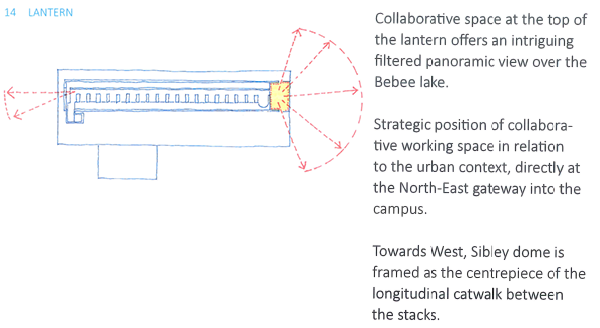
Fig. 21 Lantern. Image has been cropped to reduce size and some text has been enlarged for clarity

Fig. 21 Lantern. Image has been cropped to reduce size and some text has been enlarged for clarity

I’m not sure what a “filtered panoramic view” means: perhaps the windows are treated in some way to minimize solar gain and glare, which “filters” (obstructs?) the view.

Page 15. This diagram shows a “relationship” of “special volumes.”

Fig. 22 AAP Volumetric Relationship. Image has been cropped to reduce size and some text has been enlarged for clarity

Fig. 22 AAP Volumetric Relationship. Image has been cropped to reduce size and some text has been enlarged for clarity

What’s clear from the alternate “massing” image taken from OMA’s Milstein Hall web page (see Fig. 23 below) is that Tschapeller’s characterization, or abstraction, of a useful massing strategy for the AAP buildings is entirely arbitrary and self-serving. In fact, OMA’s Milstein Hall design was intended to provide the required “gateway” from North Campus; do we now need another “gateway” to the original “gateway”?
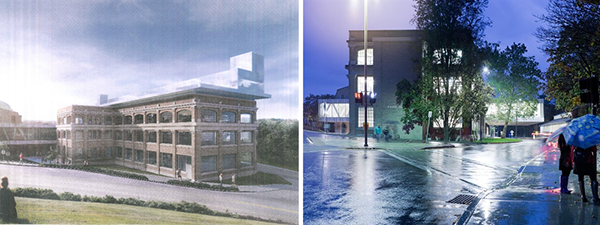
Fig. 23 Comparison of Tschapeller's Rand Hall "gateway" with OMA's Milstein Hall "gateway"

Fig. 23 Comparison of Tschapeller’s Rand Hall “gateway” with OMA’s Milstein Hall “gateway”

[Update Aug. 12, 2015] Before Rand Hall suddenly, somehow, needed to serve as a “gateway,” Milstein Hall was proudly advertised as having already accomplished this programmatic goal :

Milstein Foundation: “Milstein Hall, at the nexus of the central and north campuses, serves as a gateway structure that perfects one of Cornell’s key entrances.  As such, it is having the same catalyzing effect on the Cornell campus that Milstein development has had in New York City.”

AAP News: “Irma Milstein, a Cornell parent, committed $10 million to Cornell in 1999 for a building creating a distinctive gateway to the campus. At the time, Irma and Paul’s son Howard was active on the Cornell Board of Trustees.”

ArchDaily: “The insertion of Milstein Hall amongst the existing AAP buildings forms a new gateway for the northern end of Cornell’s campus and transforms together with the recently completed addition to the Johnson Arts Museum an underutilized area into a new corridor for the arts, planning and design.”

American Institute of Architects: “The insertion of Milstein Hall among the existing AAP buildings forms a new gateway for the northern end of Cornell’s campus and, together with the recently completed addition to the Johnson Arts Museum, transforms an underutilized area into a new corridor for the arts, planning, and design.” (Notice how this 2013 quote is essentially identical to the 2011 ArchDaily description above.)

Architectural Record: “An enormous steel-truss structure that stretches 195 feet by 170 feet on its second floor and cantilevers 50 feet over University Avenue to the north, it creates a new gateway to this part of campus and orients the architecture school to views of Fall Creek Gorge. So Koolhaas may talk big about playing quietly, but his building certainly makes itself heard.”

Cornell Daily Sun: “Thanks to last year’s $10 million gift to the College of Architecture, Art and Planning, plans to provide AAP students with a new state-of-the-art facility as well as a new gateway to Cornell’s campus are well underway.”

Emphasis added in the quotes above. What’s clear from all this is that the idea of a “gateway” is more than a bit overblown and self-serving. [end of 8/12/15 update]

Page 16-17. On page 16, we read that putting something new on top of something old “allows for a clear distinction line between the existing and the new.” On page 17, we read that this “clear distinction” ought to be made ambiguous by “suggesting” the continuity of the brick facade above the parapet using mirror tricks.

Fig. 24 The Existing Versus the New (p. 16); Reading of the Canopy as Part of the Cornice (p.17). Image has been cropped to reduce size and some text has been enlarged for clarity

Fig. 24 The Existing Versus the New (p. 16); Reading of the Canopy as Part of the Cornice (p.17). Image has been cropped to reduce size and some text has been enlarged for clarity

Making a distinction between “old” and “new” is apparently a reaction to the Secretary of the Interior’s Standards for Rehabilitation, which state that:

9. New additions, exterior alterations, or related new construction… shall be differentiated from the old and shall be compatible with the massing, size, scale, and architectural features to protect the historic integrity of the property and its environment.

This is the same standard cited in the defense of Milstein Hall’s aggressive massing in relationship to the Foundry building, and is clearly so subjective and ambiguous that it can be cited to defend pretty much any intervention. What is not mentioned, of course, are the following propositions from the same document:

1. A property shall be used for its historic purpose or be placed in a new use that requires minimal change to the defining characteristics of the building and its site and environment.

2. The historic character of a property shall be retained and preserved. The removal of historic materials or alteration of features and spaces that characterize a property shall be avoided.

5. Distinctive features, finishes, and construction techniques or examples of craftsmanship that characterize a property shall be preserved. [Think industrial sash windows, for example.]

After all that, to broach the idea of visually extending the brick facade into the space of the new lantern (thereby compromising the lantern’s ability to be perceived as something “new”) by reflecting its image in the canopy soffit—at least from the point of view of someone pretty much directly under the canopy, looking up—is nothing short of bizarre.

Page 18. The so-called “canopy,” a new overhanging roof extending primarily on the south and east sides of the building, is described as a “technical necessity.” Why? Because it “helps protect the existing facade by reducing the exposure to moisture runoff on the brick masonry” and because it “helps to shade the large scale windows.”
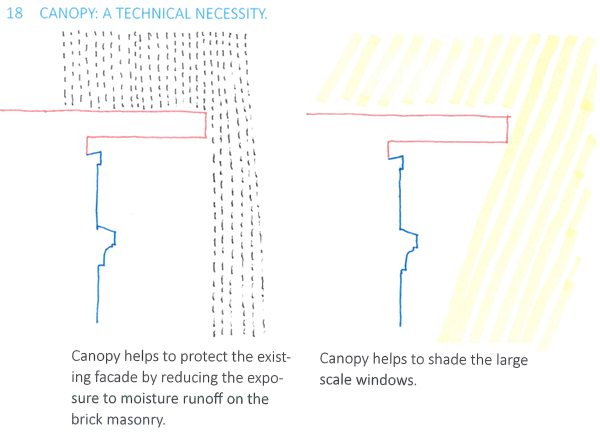
Fig. 25 Canopy: A Technical Necessity. Image has been cropped to reduce size and some text has been enlarged for clarity

Fig. 25 Canopy: A Technical Necessity. Image has been cropped to reduce size and some text has been enlarged for clarity

But does the canopy actually do anything significant to reduce wind and sun exposure? A substantial percentage of wind during the rainy seasons in Ithaca comes from the north and west—precisely the locations where the canopy does not extend beyond the brick facade and would therefore have no effect on the exposure of the brick to wind-driven rain. But what about sun exposure on the south and east, the two facades where the canopy extends beyond the brick line. As can be seen from my solar diagram (Figure 26 below), the southern sun at noon at the height of summer in Ithaca has an altitude angle of approximately 70 degrees which is reduced to approximately 48 degrees on September 20 at noon. What this means is that even when the canopy is most effective (noon at the summer solstice), only the third-floor southern windows are shaded; by September 20 at noon, none of the southern windows are shaded. Of course, at all other hours—say 10 am or 2 pm—the sun is lower in the sky and so even this minimal amount of shading is reduced. And the eastern canopy is completely useless since the morning sun is low in the sky all year long. In other words, the “technical necessity” of the canopy is a complete fabrication and bears no relationship to reality.
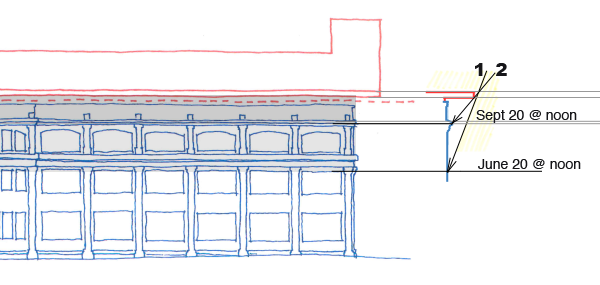
Fig. 26 My solar diagram shows that maximum shading, during the summer solstice at mid-day (line 1) only shades the third floor windows, while no shading is provided at all by mid-September (line 2)

Fig. 26 My solar diagram shows that maximum shading, during the summer solstice at mid-day (line 1) only shades the third floor windows, while no shading is provided at all by mid-September (line 2)

Page 19-20. Comparing the existing building, on the one hand, and the proposal with the east stair tower removed on the other hand, claims are made about “re-establishing the urban relationship of Rand Hall in its setting, as well as the architectural integrity of the building.” However, three things were deliberately left out of the photoshopped proposal photo (or is it an archival pre-stair-tower image?): 1) the gridded industrial sash windows, which give the building much of its “character,” are shown as if they have been salvaged rather than removed; 2) the historically sensitive “lantern” (pardon my sarcasm here) is not shown; and 3) two new egress doors which destroy the integrity of existing ground floor windows on both the south and east facade, and which became necessary when the architects decided to remove the perfectly adequate east stair tower, are not shown. But more importantly, what on earth is meant by the “urban relationship of Rand Hall in its setting”? And even if there were such an “urban relationship” on this rural campus, why—at this awkward intersection of East and University Avenues—would either the existence or removal of a stair tower make any difference? In other words, the East Stair Tower is hardly a major issue one way or the other, as these recent site photos indicate.
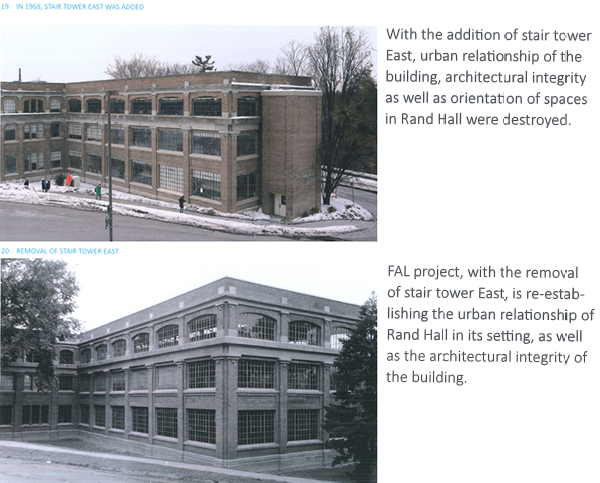
Fig. 27 In 1968, Stair Tower East was Added (p.19); Removal of Stair Tower East (p.20). Image has been cropped to reduce size and some text has been enlarged for clarity

Fig. 27 In 1968, Stair Tower East was Added (p.19); Removal of Stair Tower East (p.20). Image has been cropped to reduce size and some text has been enlarged for clarity

One last point: To demolish a perfectly useful and innocuous egress stair that has been attached to Rand Hall for virtually half of its life, while simultaneously destroying the integrity of the original building structure (removing the roof and third floor slabs), replacing its characteristic industrial sash windows with modern insulated glass, busting through the south and east facades at the ground level to provide emergency egress doors that violate the rhythm and pattern of the masonry openings (and that would otherwise not have been needed), and adding a visually anomalous hat (“lantern”) over the existing cornice line, all the while claiming that these moves re-establish the “architectural integrity of the building,” is rather incredible.

More writings on the Fine Arts Library proposal.

The continuing saga of Milstein Hall’s nonstructural failure

Cornell seems determined to create a series of building disasters on the entire north side of its historic arts quad. I’ve been discussing the problematic 100% schematic design proposal for a Fine Arts Library in Rand Hall recently. Also in the news lately is a lawsuit filed by Cornell against I.M. Pei’s new addition to the Johnson Museum. And Milstein Hall continues to self-destruct in both predictable and unexpected ways. The following videos describe a recent failure of the retaining wall and glass guard rail adjacent to Milstein Hall’s loading dock, as well as another leak in the green roof directly over the design studios.

The glass guard rail and retaining wall failure may have resulted from an inattention to the redesign of Milstein Hall when an underground parking structure was removed from the project as a result of the 2008 financial crisis. What was to be an ordinary reinforced concrete wall supporting the parking structure seems to have transformed into a retaining wall when the underground structure was canceled and replaced by soil, which exerts a lateral pressure, especially when saturated with water. Perhaps, thinking that someday the parking structure would be built, the wall was left in place, but without adequate attention paid to its new structural role. Water easily migrated through the construction joint between the building and the retaining wall, corroding reinforcement that for some reason connected the two structures. The detailing of the glass guard rail, as shown in this unedited construction video from August, 2011, also seems to help water get into the concrete wall by acting like a lever when subjected to horizontal loading, allowing small cracks to open up between the concrete wall and the metal channel which holds the glass in place.

The leak in Milstein Hall’s green roof is at least the third roof leaking incident since the building opened a few years ago. Students noticed water dripping on their desks in the vicinity of one of Milstein Hall’s many skylights; a large section of the green roof was subsequently removed so that the leak could be identified and repaired.

Buildings use 30%, not 40%, of total energy in the U.S.

[Updated and revised Oct. 1, 2016 to correct a minor math error in the calculations]

Much of the impetus for “green” buildings comes from an oft-repeated statistic about all the energy consumed in or by buildings: “In 2014, 41% of total U.S. energy consumption was consumed in residential and commercial buildings” [U.S. Energy Information Administration]. This statistic, which hovers around 40% plus or minus one or two percentage points, shows up in USGBC publications, U.S. government publications, and in hundreds of other sources.

Remarkably, it’s not easy to track down exactly what this alleged energy use consists of; that is, how exactly buildings are consuming so much of the total energy harvested or produced in the U.S. The problem is that the typical breakdown of energy usage doesn’t clearly identify the sources of energy and their applications — for example, energy use may be identified as “residential” or “commercial” but these values may not include electric power, which often has its own separate category. But we can’t easily find out where and how the electric power is used.

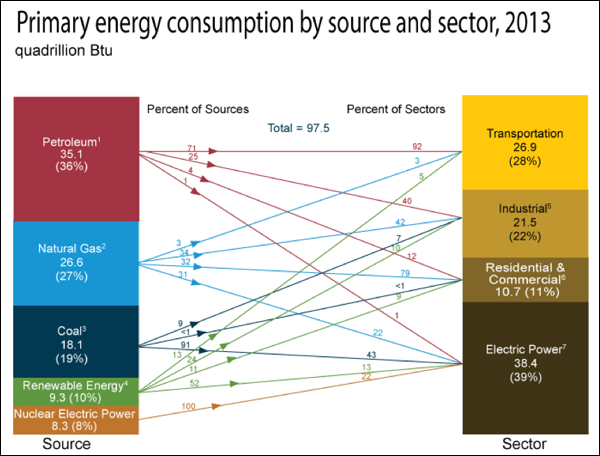
Figure 1. Primary energy consumption by source and sector, 2013 (US). Source: https://www.eia.gov/energy_in_brief/article/major_energy_sources_and_users.cfm

Figure 1. Primary energy consumption by source and sector, 2013 (US). Source: https://www.eia.gov/energy_in_brief/article/major_energy_sources_and_users.cfm

From Figure 1, we see that residential and commercial buildings in the U.S. use 11% of all energy, excluding electric power. Electric power generation uses 39% of all energy, but only some of that is used in residential and commercial buildings.

From Figure 2, we see that EU residential and commercial buildings use approximately 60% of total electricity produced, with residential accounting for about 30% and commercial buildings for the other 30% (it is presumed that the breakdown in similar for U.S. buildings). So that adds another 0.30 x 39% = 11.7% of all energy to residential and 0.30 x 39% = 11.7% to commercial, for a total residential and commercial energy use of 11 + 11.7 + 11.7 = 34.4%.

Figure 2. EU27 Electricity Consumption by Sector. Source: https://shrinkthatfootprint.com/how-do-we-use-electricity

Figure 2. EU27 Electricity Consumption by Sector. Source: https://shrinkthatfootprint.com/how-do-we-use-electricity

To make these statistics consistent with the oft-cited figure of 40%, we’ll assume that the combined residential and commercial electric usage in the U.S. is 74% of the total, rather than 60%, with 0.37 x 39% = 14.43% of all energy from residential, the same amount from commercial, and a total residential plus commercial energy use of 11 + 14.43 + 14.43 = 40%.

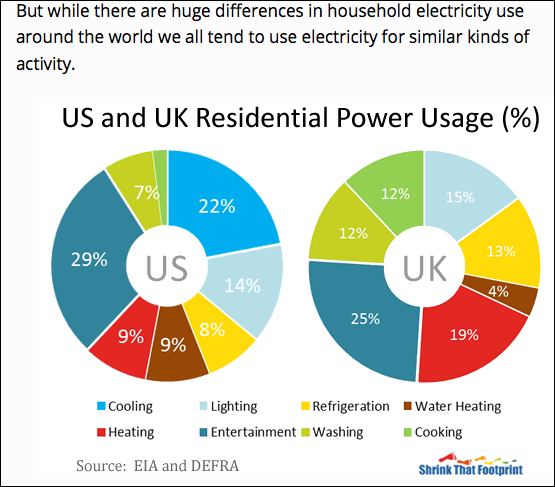
However, not all of this electric energy is used by “the buildings.” From Figure 3, we see that, in the U.S., 44% of this electric use is not really from the “building” itself: 29% of electric use is for entertainment (presumably television, computers, etc.), and another 15% is for things like refrigerators, washing, and cooking. That leaves 56% for the building; so instead of a residential electric usage of 14.43%, the actual “building” usage (cooling, lighting, etc) is more like 0.56 x 14.43 = 8.08% of all energy.

Figure 3. US and UK residential power usage. Source: https://shrinkthatfootprint.com/how-do-we-use-electricity

Figure 3. US and UK residential power usage. Source: https://shrinkthatfootprint.com/how-do-we-use-electricity

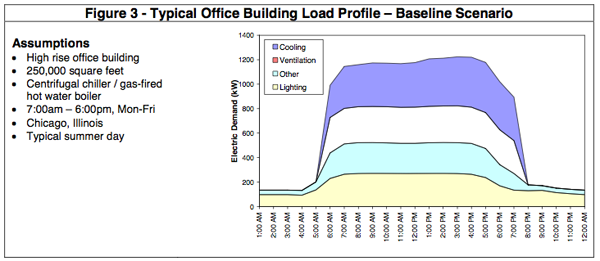
From Figure 4, we can see that commercial (office) buildings use about 20% of their electric usage for “other” things — presumably non-building plug loads — which leaves about 0.80 x 14.43 = 11.54% of all energy consumed in the U.S. for commercial building electric use.

Figure 4. Office building electric load profile. Source: https://www.iluvtrees.org/wp-content/uploads/2009/05/iltofficebuildingprofile.pdf

Figure 4. Office building electric load profile. Source: https://www.iluvtrees.org/wp-content/uploads/2009/05/iltofficebuildingprofile.pdf

Adding this all together, we can see that “buildings” (residential and commercial) consume 8.08 + 11.54 = 19.6% of all energy in the form of electricity and another 11% of energy other than electricity (mainly natural gas; see Figure 1). The total energy consumed by residential and commercial buildings is therefore about 30% of all energy consumed in the US, rather than the 40% figure so often cited.

Where does the other 70% go? Well, from Figure 1, we see that 28% goes to transportation (cars, trains, buses, planes, etc.) and 22% goes to industrial applications. The balance (about 20%) goes to various “non-building” uses of electricity (see Figure 2) of which about half, or 10%, is assumed to be for industrial/commercial non-plug-load uses and the remaining 10% is for other “non-building” uses (plug loads) within residential or commercial buildings.

In other words, only by adding the 10% plug load electric energy use to the 30% of total energy actually used by residential and commercial buildings do we get a figure close to 40%. But plug loads are not affected by building design measures such as increased thermal insulation, or more efficient mechanical systems, or more attention to passive or sustainable energy strategies. It seems therefore a bit misleading to include them within “building” energy use, since it is not the “building” that is using such energy.

More problems with Cornell’s Fine Arts Library proposal

Although the mezzanines proposed for the Fine Arts Library in Rand Hall at Cornell are noncompliant because too many floors are interconnected, it turns out that they would be noncompliant even if only two floors were interconnected. This is because they are too big.

Instead of measuring the actual areas of rooms and spaces, the architects of the Fine Arts Library 100% schematic design proposal have invented a new area category which they call “useful area.” This “useful area” omits what the architects call “circulation area” from the actual net areas of rooms and spaces, so these areas do indeed become quite useful: useful, that is, for fudging the actual numbers so that the mezzanines appear to be compliant.

For example, the net areas of Mezzanine 3.1 and Level 3 are 1,989 and 3,883 square feet respectively, according to data in the architect’s proposal. However, for a floor area of 3,883 square feet, the maximum allowable gross area of the mezzanine would be 3,883/2 = 1,942 square feet. Why use gross area instead of net or “useful” area? Because that’s what the Commentary to the IBC (which is the model Code from which the NYS Building Code is derived) says should be used. But even the net area of this mezzanine would be too big.

The second-floor mezzanine is just as bad. The architects claim that the “useful” area serving as the basis for the second-floor mezzanine area calculation is 7,610 square feet which, when the circulation area is added to it, creates a net area of 8,539 square feet. This number appears to include every room on the second floor, including the bathrooms. Clearly, the second-floor mezzanine is not “in” the bathroom space, and so this area must be excluded. Instead, let’s assume a more reasonable area of 8,000 square feet for the second floor. The maximum allowable mezzanine area would therefore be 4,000 square feet. However the net area listed for this mezzanine level is 4,589 square feet — far too big for the room or space it is in.

By hanging the stack levels above the second floor, two additional problems are created, or only one problem if you believe that creating a four-foot-high dust-collecting space under the entire second-floor stack level — just so the stacks will appear to be hanging from above — is not a problem. What remains a problem is that this geometry creates what the NYS Building Code or the ADA calls a “protruding object” — that is, a surface with a leading edge that is high enough above the floor (more than 27 inches) so that it presents a danger to anyone with a vision disability, even those using canes. The entire second-floor stack level, hovering about four feet above the rest of the second floor, creates one huge protruding object.

Not only does the entire edge of the second floor stack area appear to be a "protruding object," but the architects appear to have configured the edges with a knife-edge geometry

Not only does the entire leading edge of the second floor stack area appear to be a “protruding object,” but the architects appear to have configured these surfaces with a knife-edge geometry (photo screen-captured from a rendering linked from Ithacating in Cornell Heights)

More writings on the Fine Arts Library proposal.
Bound for Glory

I went to see three sets at Bound for Glory yesterday, WVBR’s long-running live (and free) Sunday evening radio concert program at Anabel Taylor Hall at Cornell. Guy Davis performed, and also took this selfie.

Me (left) and Guy (right) between sets at Anabel Taylor Hall

Me (left) and Guy (right) between sets at Anabel Taylor Hall at Cornell

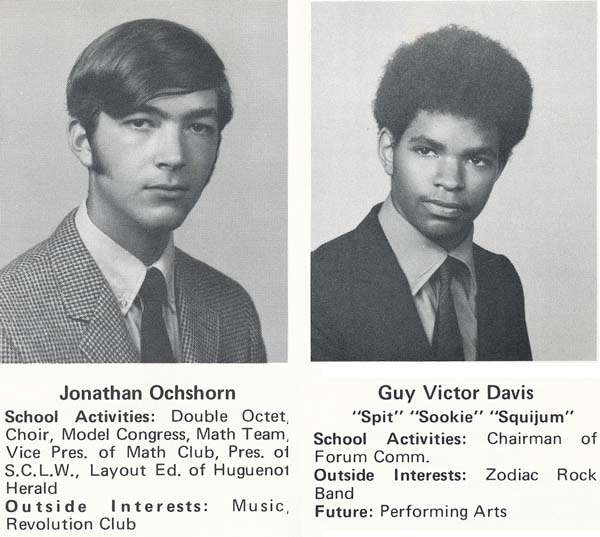
The two of us were in the same class at New Rochelle High School, but our paths never really intersected there. Guy is an amazing singer, songwriter, musician, and performer — something I was not entirely aware of until I saw him play yesterday. You should definitely check out his web site and buy one or more of his CDs.

From the New Rochelle High School yearbook (1970)

From the New Rochelle High School yearbook (1970)

While we’re on this subject, it turns out that there were a number of other students from that same class from New Rochelle who went on to have professional careers as musicians. Amy Madden is a singer, songwriter, bassist, writer, and poet (recently inducted into the NYC Blues Hall of Fame). Andy Tuck “worked throughout the 70’s and 80’s as a professional jazz pianist and composer” (some of his amazing music can be heard here).

From the New Rochelle High School yearbook (1970)

From the New Rochelle High School yearbook (1970)

And then there were two other former friends who started out with me in the New Rochelle school system, but presumably finished their secondary education elsewhere:

Kapilow (left) and Mintzer (right) also turned into amazing musicians

Kapilow (left) and Mintzer (right) also turned into amazing musicians

I met Rob Kapilow in Junior High School where he impressed me, not necessarily with his piano playing, but with his impassioned interest and advocacy for entering into relationships with 15-year-old girls. But that was then. From his current web site, we read: “Kapilow’s range of activities is astonishingly broad, including his What Makes It Great?® presentations (now for over fifteen seasons in New York and Boston), his family compositions and Family Musik® events, his “Citypieces”, and residencies with institutions as diverse as the National Gallery of Canada and Stanford University.”

Bob Mintzer actually went to elementary school with me. I remember a “den” in his house — at that time, having grown up living only in apartments, I had been to very few actual single-family houses, and I’m pretty sure this was my first experience with a real den. Such things can make a big impression on a ten- or eleven-year-old boy. Bob is now “a twenty year member of the Grammy award winning Yellowjackets who also leads a Grammy winning Big Band, travels with his own Quartet, and plays with numerous bands globally.”

Am I leaving anyone out?

Why Cornell’s current Fine Arts Library may (or may not) be noncompliant.

When an existing building is renovated under the 2010 Existing Building Code of New York State, and the renovation involves a change to a “higher hazard” occupancy, then the Code requires that “heights and areas of buildings and structures shall comply with the requirements of Chapter 5 of the Building Code of New York State for the new occupancy classification.” Since the replacement of Group B studio/classrooms with a Group A3 Fine Arts Library at Cornell University constitutes such a change to a higher hazard occupancy, placing this library on the third floor of the Rand Hall portion of the combined Sibley-Milstein-Rand Hall complex can only happen if the entire complex satisfies Chapter 5 height and area limits under the current (2010) Code. This is true even if the various original elements of the combined building (i.e., Sibley, Rand, and Milstein Halls considered separately) were all built under older (or were built prior to the implementation of) Codes and even if they satisfied all height and area limits under those older Codes.

As I wrote in 2012, the Fine Arts Library was constructed on the third floor of Rand Hall even though this renovation clearly did not comply with the 2010 Building Code of New York State. I challenged this Code violation before the Capital Region-Syracuse Board of Review on July 18, 2013 and the Board ruled in my favor. Subsequently, Cornell — unwilling to fix the Code violations — applied for a Code variance, which was inexplicably granted. This variance allows Cornell to ignore two fire safety provisions in the Code which otherwise would have made this occupancy unlawful. These Code provisions concern floor area and height limits in the Code (specifically Sections 503.1 and 504.2). Cornell asked permission to increase the allowable floor area of Rand-Milstein-Sibley Hall from about 22,500 square feet to 70,000 square feet in order to permit the library to exceed the second-story limit stipulated in the Code (even though the current library is not on the second floor); Cornell  also asked permission to occupy the third story of the “Rand Hall” portion of the combined building because the Code also does not permit library occupancies in sprinklered, Type V-B buildings on any floor level higher than the second story.

In arguing for this Code variance, Cornell’s paid consultant made reference to two sets of fire barriers that were inserted between Milstein Hall and Rand Hall, and between Milstein Hall and Sibley Hall. These fire barriers were created in order to justify the otherwise noncompliant floor area of the Sibley-Milstein-Hall complex when Milstein Hall was constructed under the 2002 Building Code of New York State, and the consultant claimed that these fire barriers helped make a noncompliant Rand Hall library safe. When I pointed out at the variance hearing that neither of these fire barriers satisfied Code requirements for openings, a member of the Review Board took it upon himself to suggest that a second Code variance be added to the agenda — one not even requested by Cornell — to waive Section 715.1 in Chapter 7 of the Code so that opening protectives (for the windows that penetrate the fire barriers) would no longer be required. This, of course, was completely gratuitous, since once height and area limitations were waived, the Fine Arts Library could be placed anywhere in the building complex irrespective of any fire barrier deficiencies. Moreover, it was never the fire barriers, or lack thereof, that created the Code problem that the variance sought to remedy. Even with perfectly operating fire barriers, the Rand Hall library renovation would have been grossly noncompliant because it would still have violated the height limit (for a third-story library) and the floor area limit (for a second-story library).

That being the case, the Fine Arts Library in its current location on the third floor of Rand Hall — even after the approval of this Code variance — may still be noncompliant. Specifically, the “questionable mezzanine” in the Milstein Hall portion of the combined building violates floor separation requirements in the 2010 Code. While Chapter 5 of the 2002 Building Code of New York State allowed the Milstein Hall mezzanine to be considered as part of the floor below, Chapter 5 of the 2010 Building Code of New York State no longer recognizes that allowance. Instead, the mezzanine floor is considered to be separate from the floor below, even though it remains a portion of the “story” below (floors and stories have different meanings in the Building Code). Milstein Hall therefore has three floors, according to the 2010 Code, instead of only two floors according to the 2002 Code,  while the number of stories (two) hasn’t changed. Because no more than two floors (or two stories) can be interconnected by an opening without a shaft enclosure, the three floors of Milstein Hall are not compliant under the 2010 Code. This fact seems to to preclude any change to a higher hazard occupancy within the combined Sibley-Milstein-Rand complex unless a shaft enclosure is constructed at the Milstein Hall mezzanine such that no more than two floors are interconnected. In other words, because Cornell did not seek a variance for this nonconforming mezzanine, the Fine Arts Library may still be noncompliant.

Milstein Hall's entry-bridge mezzanine, pictured above, is open not only to the floor below, but also to the floor above (photo by J. Ochshorn)

Milstein Hall’s entry-bridge mezzanine, pictured above, is open not only to the floor below, but also to the floor above (photo by J. Ochshorn)

On the other hand, one could argue that the mezzanine — defined and regulated in Chapter 5 of the Code — need only satisfy specific Chapter 5 height and area limits. Since these height and area limits appear to be met, the fact that the mezzanine has become nonconforming as a result of Chapter 7 stipulations may not be relevant, even though these stipulations have become applicable because of changes in the rules governing mezzanines that appear in Chapter 5.

The bottom line is this: the fire safety of Rand and Sibley Halls has become hopelessly compromised by the construction of Milstein Hall — an addition that created an enormous combined building that not only greatly exceeds allowable areas specified in either the 2007 or 2010 Building Code of New York State, but also precludes the placement of new assembly spaces (such as libraries or lecture halls) anywhere in the combined building that is currently occupied by Group B functions (e.g., studio-classrooms or offices). Any new Fine Arts Library placed in the Rand Hall portion of the building complex would be well-advised to include a 3-hour fire wall separating Rand from what would then become a smaller building consisting only of Sibley and Milstein Halls. In this way, Rand Hall would regain its independence and its Type II-B construction status, which would in turn allow assembly spaces on all its floor levels unconstrained by any height or area limitations.

Cornell’s proposed Fine Arts Library in Rand Hall

[Updates below] A schematic design proposal for a new Fine Arts Library at Cornell has been submitted by AAP alumnus Wolfgang Tschapeller. For some reason, the 100% schematic design submission is being treated as a top-secret document, and can only be seen by venturing into the Dean’s office in Cornell’s College of Architecture, Art, and Planning.

The schematic plans for Rand Hall's proposed Fine Arts Library have not been posted online

The schematic submission for Rand Hall’s proposed Fine Arts Library has not been posted online

I have already criticized the decision to invest in a major library project “given the rapidly fading importance of physical books in academic life…” The newly unveiled scheme reinforces this judgment: it is extravagant beyond belief, removing virtually the entire third floor of Rand Hall, and inserting what amounts to a hanging four-level stack structure within the double volume thus created — the fourth level actually penetrates what used to be a skylight over the third floor space and thereby becomes a “lantern” hovering above the original building, echoing an earlier programmatic intention, expressed in the original competition for the design of Milstein Hall, that it was to serve as a “gateway to the campus.”

By destroying the structural integrity of the original building (i.e., by removing the third floor), a number of major steps must be taken to make the scheme viable: large transfer beams spanning from exterior wall to exterior wall must be added at the old roof line — these support the hanging stack levels — while the exterior columns must be reinforced so that they are able to resist buckling even with their effective length doubled. Diagonal bracing needs to be added to the new structural frames since floor slabs that previously provided necessary stability have been removed. In addition, the perimeter foundations of the building need to be reinforced to resist the added loads coming down from the transfer beams. Remember that most foundations are cast in place before a superstructure is built; clearly, it’s much harder to underpin an existing building. In fact, what was a perfectly viable 3-story industrial building, admirably capable of supporting pretty much anything that one wanted to place inside, has become a bespoke artifact that will become — when the library proves obsolete in the near future — unusable for anything else unless the whole thing is re-configured again at great expense. (Well, I suppose that with the interior stacks removed, the double-height space could be converted into a basketball court.)

There are several additional problems with this scheme.

Another elevator and shop disruption. Even after finally installing an ADA-compliant elevator in Rand Hall as part of the Milstein Hall addition, this new renovation of Rand Hall — by creating “floating” stack areas disconnected from the original Rand Hall floor plates — actually requires a new, second, elevator to access the stacks. Such an elevator, aside from the extravagance of having two expensive elevators in a 3-story building, will require that the 2nd-floor slab be removed under the elevator — even so-called pitless elevators require some space under the elevator cab so that the cab floor surface lines up with the floor slab adjacent to it. This, along with all the other required work in the first floor of Rand (including a new mechanical room, structural modifications along the building perimeter, and the creation of new fire-rated doors and openings), will disrupt the operation of the Rand Hall shop, a College facility that has become extremely important to our teaching mission.

Wall insulation. By placing insulation on the inside of the existing masonry walls, the brick and concrete exterior materials will now be colder in the winter, and will not be able to dry out to the interior spaces. This makes them more susceptible to deterioration, mold growth, and other potential problems. Joseph Lstiburek has written about these issues in an article called Interior Insulation Retrofits of Load-Bearing Masonry Walls In Cold Climates. Putting insulation on the inside of a multistory building also guarantees that there will be thermal bridges at the intersecting floor levels, since the concrete- and steel-framed floor slabs interrupt the wall insulation and provide conduits for heat loss or heat gain (depending on the season). If a masonry building is to be insulated retroactively, it is far better to place the insulation on the outside. Not only are thermal bridges avoided, but — equally important — the thermal mass of the 12-inch-thick brick walls is taken advantage of to stabilize interior temperatures while increasing comfort in the space. All that thermal mass is wasted when it is separated from the interior spaces by a layer of insulation placed on the inside surface of the brick.

The architects explain that they wish to preserve the historic character of the building by intervening on the interior rather than the exterior surfaces. Two points should be mentioned regarding this decision. First, Rand Hall is not a particularly distinguished example of early twentieth-century brick-clad industrial/academic building, and was never placed on any official list of historically significant buildings. It was deliberately excluded from the “local historic district” designation that applies to the rest of the nineteenth-century Arts Quad buildings at Cornell; in fact, the University planned to demolish it entirely when they first created a program for Milstein Hall. That it was “saved” has more to do with a vision of sustainability that values the preservation of existing floor area, rather than a notion that the building itself was of historical significance.

Of course, this viewpoint can be challenged, and others may assess the historical significance of Rand Hall differently. But even if its value as a historical artifact is assumed, the architectural design contradicts this very assumption, and brings up the second point: not only are Rand Hall’s historically-specific industrial sash windows being removed and replaced with generic large glass panes, but a rather aggressive “hat” is being placed on the top of the building that radically transforms its character. To put this another way, such a hat would never be permitted on a historically-designated building such as, for example, Sibley Hall. That it is meant to be deployed on Rand Hall obviates any claim to the historical importance of that building, and betrays a cynical opportunism with regard to historical preservation in general.

Rand Hall's proposed "hat" would never be permitted on any other historically-important building (e.g., Sibley Hall)

Rand Hall’s proposed “hat” would never be permitted on any other historically-important building (e.g., Sibley Hall)

Cost. This project is so expensive that approximately $4 million still needs to be raised, in spite of the generous gift of $6 million from Mui Ho and several million dollars more promised by Cornell (under the guise of deferred maintenance, or some such thing). It is incredible that all this money and effort is being set aside for a project that is likely to become obsolete in a short period of time, if it isn’t already. I am not raising the issue of cost out of some misguided belief that architecture can be created without spending money — i.e., without spending more money than would otherwise be required for a bare-bones building. That being said, any client must weigh the money being spent on gratuitous architectural embellishment against the ephemeral benefits (if any) gained by such an expenditure as well as the opportunity costs foregone. The proposed scheme would undoubtedly be thrilling to behold, and creating and experiencing such thrills is certainly a part of the human project. Yet that hardly means that every building needs to embody such heroic posturing.

Even if one wanted to keep a library with physical books, the current “temporary” library on the third floor of Rand serves this purpose admirably. It is true that many of the collection’s books are housed off-site in an annex, but this is hardly an inconvenience. As a library user, I can attest to the ease of finding books in Cornell’s online catalog and placing “orders” for them (actually from any library on campus in addition to the library annex) that are then delivered directly to the Rand Hall circulation desk within a day or two if they aren’t already available in digital form. Because the books and periodicals that are used most often have been placed in Rand Hall and are not in the annex, any inconvenience is minimized. The idea of making a fetish of these physical objects by recreating some sort of nineteenth-century library stack condition when it is clear that books will increasingly be digitized — a tendency that has the potential of making the knowledge embedded in books accessible to all rather than restricted to an elite — this idea can only be characterized as reactionary and counterproductive.

Having said all this, the schematic plans prepared by Tschapeller are remarkable in one other important respect: unlike the plans for Milstein Hall, this schematic design proposal contains an extremely careful Code analysis which attempts to address my objections to the original (temporary) placement of the Fine Arts Library into Rand Hall. These objections had resulted in a determination by a NYS hearing board that the placement of the library in Rand was, in fact, noncompliant; Cornell then requested a Code variance which was granted in spite of my objections. Amazingly, the new schematic proposal actually adopts one of the suggestions that I made at the variance hearing — to construct a fire wall at the west end of Rand Hall and thereby to free Rand Hall from the constraints imposed on it by virtue of its ill-advised connection to Milstein and Sibley Halls. Now that a fire wall is being proposed, it is worth noting that, in their request for a Code variance, Cornell and its “experts” justified their request for the variance by claiming that precisely such a fire wall could not be built. Here is what I wrote about that contention in my official response (pdf) to Cornell’s variance request:

The petitioner describes the construction of Milstein Hall as having been “downgraded” by virtue of its connection to Sibley Hall and states that providing “a fire barrier” [the petitioner must mean “fire wall” here, since a “fire barrier” was provided] separating Sibley from Milstein Hall was rejected “because of concerns for the historic character of East Sibley.” First, to argue that fire walls were not provided out of concern for issues of historic preservation is disingenuous, irrelevant, and untrue. Fire walls were not provided because the architects for Cornell University, supported by City of Ithaca Code Officials, made the determination that fire walls were not required under Appendix K of the 2002 BCNYS.

Second, the implication that only a fire wall would have allowed Milstein and Rand Halls to be freed from the constraints imposed by Sibley Hall’s Type VB construction is simply untrue. Sibley Hall’s construction type can be changed at any time to Type IIIB by simply upgrading the sloping third-story exterior wood bearing walls so that they have a 2-hour rating (even using fire-retardant-treated wood framing per Section 602.3 of the 2010 BCNYS). While this would be inconvenient, it is hardly impossible – especially since the entire third floor of East Sibley Hall is currently vacant and slated for a substantial renovation.

Third, it was always possible to create a fire wall between Milstein and Rand Halls, neither of which have any historic designations (only Sibley Hall is so designated). Creating such a fire wall would have allowed Rand Hall to be considered a separate building of Type IIB construction, so that a proposed library occupancy on its third floor (or second floor) would have been compliant. That Cornell chose not to build such a fire wall between Rand and Milstein Halls, when it had the opportunity to do so, cannot be blamed on any alleged sensitivity to “historic character.”

Building Code problems. I mentioned above that the Tschapeller proposal attempts to address my objections to the placement of a library in Rand Hall, at least from a fire-safety perspective. There are, however, two serious Code problems that remain. The first problem is that a 2-hour fire wall is not sufficient in this context. Only if the entire building consisted of library (Group A-3) occupancy would the 2-hour fire wall work; however, this is not the case since the first floor of Rand Hall “is predominantly an industrial shop” (Tschapeller). Because such a wood/metal shop is clearly a Group F-1 occupancy, the Code exception pertaining to Group A and Group B occupancies — an exception that permits 2-hour fire walls — does not apply, and a 3-hour fire wall is needed. As I wrote in my official variance complaint (pdf also linked above), “Table 705.4 [in the 2010 NYS Building Code] applies to fire walls, and a fire wall constructed according to Table 705.4 would need a fire resistance rating of 3 hours, since its construction would be governed by the F-1 occupancy on the first floor of Rand Hall, for which note ‘a,’ allowing a 2-hour barrier for groups A and B (with Types II or V construction), does not apply.”

This is true even if the entire building is defined as nonseparated construction governed by the Group A-3 library occupancy, as proposed in the architect’s schematic design report. Section 508.3.2.1 of the 2010 Code (Occupancy classification) states that: “Nonseparated occupancies shall be individually classified in accordance with Section 302.1. Code requirements shall apply to each portion of the building based on the occupancy classification of that space except that the most restrictive applicable provisions of Section 403 [not applicable here] and Chapter 9 [fire sprinklers] shall apply to the entire building or portion thereof.” All that the nonseparated status accomplishes is to make it unnecessary to have a fire separation between the first floor and the library above and all that it constrains are allowable areas and heights “based on the most restrictive allowances for the occupancy groups under consideration for the type of construction of the building…” The nonseparated status therefore does not eliminate the need to consider each occupancy type separately when considering the required fire-resistance rating of a fire wall. Rand Hall therefore cannot be considered as a separate building with its own construction type, unless a 3-hour fire wall is constructed.

This interpretation has been confirmed by James D. Connell, P.E., Team Leader, A & E Services, International Code Council, Inc. in an email sent to me dated April 20, 2015. The International Code Council (ICC) develops model codes and standards, including the International Building Code which serves as the basis for the 2010 Building Code of New York State. While their Code interpretation has no official standing in this context, it provides additional evidence that the logic underlying the architect’s Code analysis for the fire wall separating Rand from Milstein-Sibley Halls is flawed. The ICC opinion states: “A three hour fire-resistance-rated fire wall is required and,” in answer to my follow up question (“does Table 706.4 note ‘a’ permit a 2-hour wall, even with the F-1 occupancy…”) states unequivocally, “No.  Note ‘a’ in Table 706.4 does not apply to fire walls separating Group F-1 occupancies from other occupancies.  The vertical continuity of fire walls in Section 706.6 will require the 3 hour fire wall to extend full height.” It makes no difference whether or not the A-3 and F-1 occupancies are considered nonseparated uses.

The second Code problem concerns the mezzanine floors that are proposed for the 2nd and 3rd stories of the library occupancy. While the architects have been careful to design these mezzanines so that they conform to Code requirement limiting their aggregate area to no more than one half the area of the room or space in which they are situated, and while they have cleverly limited the number of interconnected stories to two (since mezzanines do not count as stories), they neglected to consider the requirement in Section 707.2 of the 2010 New York State Building Code that all floor openings must not only connect no more than two stories, but also must be “separated from floor openings and air transfer openings serving other floors by construction conforming to required shaft enclosures.” Mezzanines, while not counted as “stories,” are still counted as “floors”; therefore openings connecting any more than two such floors are not permitted unless protected by a shaft enclosure. [See this blog post from Feb. 28, 2017, for clarification of the mezzanine issue.]

This interpretation has been confirmed by Jason C. Toves, Technical Staff, Architectural & Engineering Services, Technical Services, International Code Council, Inc. in an email sent to me dated April 20, 2015 and in a phone conversation on the same day.

It should also be noted that this Code interpretation also applies to the mezzanine (entry bridge) level in Milstein Hall [see 4/22/15 update below], and renders the entire design concept for Milstein Hall — with its three interconnected floors — noncompliant. I had written about Milstein’s “Questionable mezzanine designation” in 2012.

[4/22/15 update] Actually, Milstein Hall’s mezzanine, although still “questionable,” isn’t overtly noncompliant because the 2002 Building Code of NYS, under which it was permitted, has a subtly different take on the story-floor distinction. The language in Section 505.1 of the 2002 Code is different from the language in later versions and states: “A mezzanine or mezzanines in compliance with this section shall be considered a portion of the floor below.” That appears to suggest that the Milstein mezzanine does not count as a separate floor which means in turn that only two floors are interconnected. Later versions of the Code have corrected this error by replacing the word “floor” with the word “story,” making it clear that the Rand Hall mezzanines (based on the 2010 Code) would be noncompliant, since they do count as separate floors. It should be noted that Milstein Hall is now nonconforming, and future changes may not be possible unless its mezzanine condition is somehow fixed.

[4/29/15 update] Here’s the image that Cornell uploaded to their twitter account, showing the four stack (floor) levels, all interconnected in violation of the 2010 Building Code of NYS.

Cornell posted this seductive image of the proposed library in Rand Hall (https://twitter.com/cornellaap/media) clearly showing the four stack levels (floors), all interconnected without shaft enclosures in violation of the Building Code

Cornell posted this seductive image of the proposed library in Rand Hall (https://twitter.com/cornellaap/media) clearly showing the four stack levels (floors), all interconnected without shaft enclosures in violation of the Building Code

[4/30/15 Update] The 2010 Building Code of NYS provides various ways to safely create openings between floors, enumerated in various exceptions to Section 707.2, which otherwise requires a shaft enclosure for all floor openings. The current schematic library design attempts to use exception 7, which permits openings between two stories, but also requires that those openings be separated from floor openings “serving other floors.” It is this latter requirement, listed as exception 7.6, that is not met in the current scheme.

There is, however, a way to preserve most of this scheme’s formal characteristics — not that doing so is a good idea, since this scheme, even aside from its fire safety issues, has many other problems described above — by utilizing one of the other exceptions in Section 707.2: specifically, exception 5 for atriums.

Once the opening in this space is evaluated and defined as an atrium on the basis of exception 5, it is no longer necessary to meet the requirements of exception 7 (which restricts interconnections among “floors”), and only the requirements for atriums, listed in Section 404 of the Code, need be satisfied. It turns out that such requirements are rather minimal because the proposed atrium opening only connects two stories. This is true because the mezzanine requirements in Chapter 5 are actually met and the mezzanine floors therefore do not count as stories. Two-story atriums need not satisfy the smoke control requirements of Section 909 that otherwise would require much additional modifications to the scheme.

Adjacent spaces (i.e., book stack floors) that would normally need to be isolated from the atrium opening by one-hour fire barriers are not required for any three floors (Section 404.5 exception), so that only one of the four stack levels would need some kind of separation from the open space. That’s it: exit access travel distance is limited to 200 feet in atriums (rather than 250 feet for normal sprinklered assembly occupancies), but other than that, no other fire-rated separation is required, and no smoke control systems are needed.

The proposed 2-hour fire-resistance-rated fire wall is still noncompliant, and would still need to be upgraded to a 3-hour wall, as described above.